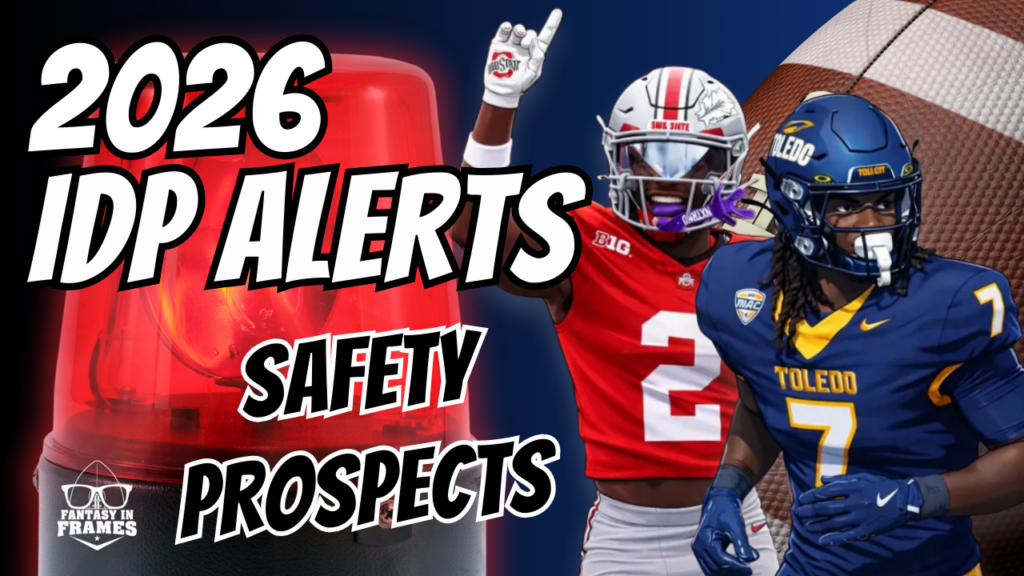
Welcome to 2026 IDP Alert: Safety Prospects!
The 2026 NFL Draft safety class is one for the record books, folks. NFL. com is saying that DB (as well as EDGE, DT, LB, and TE) have the fastest run times we have seen since 2003. These sixteen players below offer intriguing upside, especially at the high end, where elite options may find landing spots that could be crucial in dynasty drafts. In a year where the overall defensive rookie class is already viewed as deep and impactful (strong LBs, EDGE rushers, and DBs), the safeties provide a rare mix of blue-chip talent and mid-round sleepers who could produce early and sustain relevance for years.
What elevates it toward “all-timer” status? This isn’t just hype: it’s a class loaded. In this article, we take a look at over twenty IDP DBs getting drafted this offseason. If landing spots cooperate and these prospects hit their ceilings, managers might look back in a few years and call the 2026 safety haul one for the ages.
2026 NFL Draft Safety Prospects – Key Projections & Combine Numbers
So I write a yearly artilce called over on F6P called, Combine Cheat Codes: NFL Combine Drills 2026: Cheat Codes for Fantasy Football and IDP There is a few metrics that I have found to be interesting such as the connection to a player to adjuest to deep balls thriwn, and to be agile enough for pass deflections. The data includes that these are the metrics where players could thrive and what to look for:
40 times between 4.35-4.66
Height: 5-11 or greater
Weight: 200 to 211
First 10-yard split of 40: 1.50 to 1.67
Three-cone: Under 7 seconds
Vertical: 35.5 to 38
Short shuttle: 4.15 to 4.25
| Name | College | Age | Hand | Arm | Wing | 40 | 10-YD | BP | Vert | BJ | SS | 3-Cone |
|---|---|---|---|---|---|---|---|---|---|---|---|---|
| Caleb Downs | Ohio St. | 9 1/2 | 30 1/4 | 73 1/4 | ||||||||
| Emmanuel McNeil-Warren | Toledo | 9 1/4 | 32 1/8 | 78 1/4 | 4.52 | 1.58 | 35.5 | 122 | ||||
| Dillon Thieneman* | Oregon | 229 | 31 3/8 | 78 1/8 | 4.35 | 1.52 | 41 | 125 | ||||
| Genesis Smith* | Arizona | 8 7/8 | 32 1/2 | 79 1/4 | 42.5 | 128 | 4.18? | |||||
| Zakee Wheatley | Penn St. | Senior | 9 1/2 | 31 | 3 | 2.5 | 122 | |||||
| AJ Haulcy | LSU | 229 1/4 | 30 7/8 | 4.52 | 1.62 | |||||||
| Keionte Scott* | Miami (FL) | 259 5/8 | 31 3/8 | 76 5/8 | ||||||||
| Kamari Ramsey | USC | 22 | 9 1/4 | 31 | 4.47 | 1.57 | 16 | 36 | 120 | |||
| Jalon Kilgore | South Carolina | 21 | 9 3/8 | 33 1/4 | 4.4 | 1.56 | 16 | 37 | 130 | 4.32 | ||
| Bud Clark* | TCU | Senior | 9 1/8 | 31 5/8 | 4.41 | 1.56 | 38 | 127 | ||||
| Cole Wisniewski | Texas Tech | 9 3/4 | 31 1/8 | |||||||||
| Jalen Huskey | Maryland | 10 1/4 | 30 7/8 | |||||||||
| Bishop Fitzgerald | USC | 9 1/2 | 31 1/4 | 4.55 | 1.58 | 12 | 33 | |||||
| Jakobe Thomas | Miami (FL) | 23 | 10 5/8 | 31 7/8 | 76 | |||||||
| VJ Payne* | Kansas St. | 22 | 9 1/2 | 33 7/8 | 4.4 | 1.52 | 35 | 127 | ||||
| Isaiah Nwokobia | SMU | 23 | ||||||||||
| Michael Taaffe | Texas | 23 | 9 3/8 | 31 5/8 | 4.5 | 1.58 | ||||||
| Ahmaad Moses | SMU | 22 | 9 1/8 | 30 1/4 | 38 | |||||||
| Xavier Nwankpa | Iowa | 22 | 8 1/4 | 30 3/4 | 4.48 | 1.62 | 37.5 | |||||
| Robert Spears-Jennings | Oklahoma | 22 | 10 2/8 | 32 1/2 | 4.32 | 1.51 | 35 | 125 | 4.43 | |||
| Louis Moore | Indiana | 25 | 9 7/8 | 29 5/8 | ||||||||
| Jalen Catalon* | Missouri | 25 | ||||||||||
| JJ Johnson | N.C. State | |||||||||||
| Sage Ryan | Ole Miss | |||||||||||
| Shyheim Brown | Florida St. | |||||||||||
| Asa Turner | Florida | |||||||||||
| DeShon Singleton | Nebraska | 23 | 10 | 33 3/8 | 39.5 | 130 | ||||||
| Skyler Thomas | Oregon St. | Senior | 9 3/8 | 33 3/8 | ||||||||
| Dalton Johnson | Arizona | 9 3/8 | 30 7/8 | 4.41 | 1.59 | 36 | 119 | |||||
| Jakari Foster | Louisiana Tech | |||||||||||
| Lorenzo Styles Jr. | Ohio St. | 24 | 9 1/2 | 31 5/8 | 4.27 | 1.49 | 39 |
Top Risers (Biggest Stock Boosts)
These players popped with elite numbers and/or dominated drills, often jumping into higher draft tiers (Day 1/early Day 2 potential for some).
- Dillon Thieneman, Oregon Elite, with 78 1/8, 4.35 40 (3rd best amongst DBs), elite 41″ vertical (2nd), 125 broad (3rd). Already a top-50 projection solidified into a likely first-round (top-30ish) range; we’ll be interested to see if he gets drafted as DB2 or DB3 on Draft night.
- VJ Payne, Kansas St., 4.40 40 (T-4th) + 35″ vert (solid) /10’7″ (T-4th),
- Genesis Smith, Arizona Led safeties with 42.5″ vertical (elite explosiveness), strong 128 broad jump (3rd). Testing confirmed upside.
- Lorenzo Styles Jr., Ohio State, Sony Styles’ brother, was a late invite entry and actually outran the aforementioned. Blazing 4.27-second 40 (fastest safety since at least 2003; fastest overall defensive back at combine in many reports), a total dart throw next level, but some team will take a flyer im sure of it.
- Robert Spears-Jennings, Oklahoma 4.32 40 (2nd fastest DB time), 1.51 Ten Yard Splits (3rd), strong jumps (35″ vertical, 125 broad). Testing has been popping as well in group drills—late Day 3 projection locked in for sure now.
- Bud Clark, TCU, 4.41 40 + 38″ vert)
- Jalon Kilgore, South Carolina, 4.40 40 + strong jumps)
- DeShon Singleton, Nebraska, 39.5″ vert.
Relative Fallers / Mixed Bags
No massive stock crashes in this deep, athletic class, but some didn’t “pop” amid flashier performances or underperformed relative to pre-combine hype.
- Zakee Wheatley, Penn St. Top-75 pre-combine, but limited testing pop (no standout jumps/times highlighted). Didn’t separate much in a stacked group. Worst vertical of the day at the position.
- Kamari Ramsey, USC: Not a bad day but middling; didn’t stand out in any category. In a draft class that is deep, that’s not a good thing. Considered to be a top-six prospect that could bump him down.
After an amazing Day. Let’s rank ’em!
Tier One Defensive Back Prospects
DB1 Caleb Downs, Ohio State
Caleb Downs only measured in, he elected to save his drills for Ohio State’s Pro day. is the kind of generational safety prospect that comes along once in a blue moon—a defensive chess master whose rare blend of explosive athleticism, elite instincts, and positional versatility has NFL scouts drooling and fantasy IDP managers salivating.
Widely hailed as the top defensive player in college football over the past two seasons, the Ohio State star (after transferring from Alabama) racked up a trophy case that includes back-to-back unanimous All-American nods, consecutive Big Ten Tatum-Woodson Defensive Back of the Year awards, and the prestigious 2025 Jim Thorpe Award as the nation’s premier DB.
Projected now as a top-6 (or even higher) pick in the 2026 NFL Draft, he delivered 68 tackles (45 solo), five TFLs, a sack, two interceptions, two forced fumbles, and elite PFF marks (87.0 coverage, 83.0 run defense, 83.9 overall) despite versatile, heavy snap usage.
He shares NFL bloodlines (brother Josh with the Colts, father Gary, a former Giant, uncle Dre Bly, an All-Pro CB) that only amplify the hype: this is pedigree meeting production in a way that screams instant-impact stud.
DB2 Dillon Thieneman, Oregon
Our rankings remain largely unchanged here, with no significant shifts, though Dillon Thieneman presents a real opportunity to claim the DB2 spot. Currently slotted as DB3, this prospect brings plenty of appealing traits in a strong safety draft class.
Dillon Thieneman, who transferred from Purdue to Oregon, retains one additional year of eligibility. He’s rumored to possess 4.4-level speed and stands out as a versatile, multi-alignment safety capable of serving as a true “chess piece” on defense.
At Purdue, Thieneman primarily played deep zone safety and demonstrated exceptional ball skills, racking up six interceptions in 2023. While his interception count fell to two after transferring to Oregon in 2025, that drop doesn’t capture the full picture—as savvy IDP managers understand, raw box-score numbers can be misleading and fail to reflect scheme adjustments or role changes.
The decline stemmed from a shift in usage: Oregon deployed him more frequently in the box and closer to the line of scrimmage, where he excelled as a physical, in-the-box defender while still holding up well in coverage.
Thieneman led Purdue in tackles for two consecutive seasons (106 in 2023 and 104 in 2024), totaling 210 during his time there, before adding 83 (or around 92-96 in various reports) more in 2025 at Oregon, posting a solid missed tackle rate of 10.3% and contributing across multiple positions for the Ducks.
The bottom line is his adaptability—he profiles as a genuine three-down safety who can handle any assignment. He earned FWAA Defensive Freshman of the Year and All-America honors early in his career by helping elevate Purdue’s defensive identity. In today’s NFL, where safeties must excel in diverse roles, deliver reliable run support, and avoid coverage liabilities, Thieneman’s skill set positions him as a likely top-50 pick (with some projections even pushing him into first-round or top-20 territory post-combine).
DB3 Emanuel McNeil-Warren, Toledo
Emmanuel McNeil-Warren stands out as a physical, turnover-generating force at safety. What sets him apart as the premier defensive back prospect is his remarkable knack for forcing turnovers. During the 2025 season, he lined up in the box for 61% of his snaps yet still delivered an outstanding 92.0 PFF coverage grade. Add in his nine career forced fumbles, and this prospect becomes especially compelling and high-upside.
Looking at his profile, you will notice a complete hard-hitting safety, forcing nine career forced fumbles across his Toledo tenure, using violent hands and impeccable timing to punch the ball loose consistently. This production includes three forced fumbles in his standout 2025 senior season alone, where he was among national leaders in the category. Add in five career interceptions (including a 37-yard pick-six in 2025), and he’s a clear splash-play threat—ideal for big-play scoring formats in IDP leagues that reward turnovers, fumble recoveries, and defensive TDs.
His 2025 campaign was equally impressive: appearing in 13 games, he posted 77 tackles (36 solo, 41 assisted), 5.5 tackles for loss, 0.5 sacks, two interceptions, five pass breakups, three forced fumbles, and two fumble recoveries. PFF rewarded his work with elite grades, including a 91.8 coverage grade (second among all safeties nationally) and strong run-defense marks (86.5), despite heavy usage near the line. He earned Second-Team All-America honors (Sporting News, FWAA), Third-Team AP All-America, PFF All-America, and was a Jim Thorpe Award semifinalist as one of the nation’s top defensive backs.
DB4 AJ Haulcy, LSU
AJ Haulcy, no question, established himself as one of the premier safeties in the SEC. He possesses ball-hawk skills and great instincts, which trigger production. His outstanding play earned him First-Team All-SEC recognition and First-Team All-American honors from outlets such as Sporting News.
In 2025, he recorded 89 tackles (approximately 49 solo) and three interceptions. Haulcy posted one of the highest PFF grades among SEC safeties (around 87.8 in coverage), proving he could lock down defenders in both man and zone. At the same time, all of this has put him on the map, being heralded as a Breakout defender. The irony is that he already broke out before.
The year prior, in 2024 at Houston, Haulcy garnered first-Team All-Big 12 honors, with five interceptions, ranking second in the league with 13 total passes defended. A smaller sample size, but this season was another victory with 74 tackles, with 43 being solos.
If you want to look at tape of his game, look no further than the standout interceptions (two) he snagged versus TCU.
He is ranked lower because he is one of the smaller guys (6’0) and plays a lot of his snaps deep. But he is a big hitter and spends more than enough time in the box. With a ten percent career missed tackle rate, he’ll be a starter soon in the NFL.


Tier Two Defensive Back Prospects
DB5 Genesis Smith, Arizona
Genesis Smith stands out as the biggest boom-or-bust prospect in this safety group, but his advanced metrics and standout Combine performance mark him as a truly rare NFL prospect—one we haven’t seen in quite some time. Of anyone in these rankings with legitimate upside to climb significantly, Smith has the clearest path to becoming one of the league’s top players at his position.
On tape, Genesis Smith excels at two key areas: elite pass coverage and relentless ball-stripping ability. Widely regarded as one of the best man-coverage safeties in the 2026 draft class, he uses his lengthy 6’2″ frame and prior experience as a track and field high jumper to dominate contested catches and win in tight situations. Scouts have dubbed him a “zone eraser” for his exceptional press-man technique, and he surrendered zero touchdowns in coverage during the 2025 season—a major factor in Arizona ranking 7th nationally in opponent passing yards allowed (around 165-173 per game, depending on final stats).
Smith stepped into a full-time starting role in 2024 and built on it with a breakout 2025 campaign, posting a career-high 77 tackles (35 solo, 42 assisted), along with strong showings like 10 tackles (6 solo) against Arizona State. He consistently attacks the football with an effective “peanut punch,” forcing two fumbles in both 2024 and 2025. His ball skills shine through with three interceptions in 2024 and one in 2025, plus eight pass breakups in 2025 that led the team despite opponents frequently scheming to avoid him.
The primary concern is his tackling consistency, with a missed-tackle rate exceeding 20%—largely due to poor pursuit angles and occasional one-armed attempts, rather than effort issues. That said, teams prioritizing advanced, pass-heavy defensive concepts will covet this blue-chip talent for his coverage prowess and playmaking upside. While this ranking feels a bit aggressive at the moment, with questions lingering (especially around his tackle numbers), it’s still early in the process—only January —with more to come from the Combine and pro day. I could easily see a creative defensive coordinator unlocking his full potential at the next level. For now, his draft status remains fluid, and I’m watching closely to see if he returns for another college season or enters this loaded 2026 class.
DB6 Kamari Ramsey, USC
Overall, Ramsey (no relation to Jalen) turned in a solid but statistically down year, finishing with just 27 tackles—a notable drop from his breakout 2024 campaign, where he posted 60 tackles. The main reason for the dip stems from the team shifting him into a slot corner role, where his production suffered despite the adjustment. That said, he still excelled in limiting passing plays and kept his missed tackle rate low, earning an impressive 88.1 PFF coverage grade that ranked among the top performers.
In real-life football, Ramsey profiles as a true coverage specialist, though his career totals show only two interceptions so far. His value will rise significantly depending on the landing spot and positional fit. Think of him as a versatile, low-end “chess piece” on defense—capable of contributing meaningfully across alignments, even if the raw numbers don’t always reflect his on-field impact.
DB7 Zakee Wheatley, Penn State
What really pops on tape and in scouting reports is his elite closing speed and ball-hawking ability. He flies downhill to the football, tracks it exceptionally well in deep coverage, and consistently creates takeaways with instincts and physicality. He’s nicknamed the “Takeaway King” for good reason, with a career haul of nine takeaways (including 5-6 interceptions, forced fumbles, and recoveries), highlighted by his standout 2024 Fiesta Bowl performance, where he earned Defensive MVP honors.
DB8 Keon Sabb, Alabama
Sapp profiles as a strong value pick in the 2026 safety class once the elite names come off the board—think of him as a reliable, scheme-versatile contributor who won’t wow with flashy stats but delivers consistently against both the run and the pass.
He’s a dependable, average-to-above-average tackler with solid coverage instincts, rarely getting burned deep and holding his own in zone or man/match principles, with few major liabilities. His biggest asset is positional flexibility—he can line up anywhere in the secondary (deep, box, nickel/slot alignments), making him a true chess piece for modern defenses that prioritize multi-role safeties.
Production-wise, he’s not a volume tackler or ball hawk like some of the flashier prospects, but he shows good football IQ, sound angles in pursuit, and the physicality to support the run without overpursuing or missing assignments often. In a draft loaded with high-upside safeties, Sapp stands out as a low-risk, high-floor option who could start early as a rotational piece and grow into a three-down starter. Landing spot will matter a ton—if he joins a team that values smart, adaptable DBs over pure athletic freaks, he could climb boards quickly and prove to be a steal in the mid-to-late rounds.
DB9 Jalen Huskey, Maryland
A Safety/ Cornerback player and former three-star recruit. A bit lower in rank, he could rise during the evaluation process. He offers top athleticism and could fit well, providing a team with many options in passing coverage. We’ll take a look at the Senior Bowl.
DB10 Jalon Kilgore, South Carolina
Jalon Kilgore (South Carolina safety/DB) is a versatile player for folks needing a defensive back. He is firmly on my watch list as an intriguing 2026 draft prospect with high-end traits that could make him a steal depending on how teams view his fit.
He stands out as a strong run defender—a heavy hitter with physicality, toughness, and the willingness to come downhill and support against the run, often compared to an enforcer type (some scouts even draw Troy Polamalu comps for his aggressive style and demeanor). At 6’1″ and around 211 lbs, with long arms and elite athletic testing (including a 4.40 40-yard dash at the Combine and near-perfect RAS scores), he brings NFL-ready size and explosiveness to the secondary.
Tier-Three Defensive Back Prospects
DB11 Bud Clark, TCU
Bud Clark profiles as a ballhawk, but always seems to be around the ball. He needs a bit more work than the top plays at this position, but he has some impressive stats. Needs a bit more polish.
Fun Fact:
Per Todd McShay report, @McShay13 reports, Safeties in the last decade to have this combination:
> 1.75 pass breakup rate
>1.5 interception rate
< 15% missed tackle rate
The only four players are: Kyle Hamilton, Xavier Watts, Talanoa Hufanga, Bishop Fitzgerald (another rookie to appear on this list), and Bud Clark. Well,l that’s a great company.
DB 12 Bray Hubbard – Alabama
Former QB with 79 tackles as a DB (third on the team), 4.5 TFL, two sacks, four interceptions (tied for the SEC lead), six pass breakups, three forced fumbles
DB13 Bishop Fitzgerald, USC
Could make a case as a top-10 Safety in the next few months. Already has already proven to be a disruptive playmaker who creates turnovers with ease. The tape shows good coverage and many plays near the line of scrimmage. I could see it and make a case for it.
DB14 VJ Payne, Kansas State
Don’t block me for saying this. But it’s my opinion, this is the biggest riser and moved up the most post-Combine (look at those measurables). Offers a rare length/speed combo for this position. Developmental traits scream upside down. Production is good but not elite, which leads me to believe that some teams may not have him on their draft boards. A Day 3 steal with starter potential if he refines his technique. Sure, he’ll make some waves and possibly crack the back-end top-10 consideration.
DB15 Robert Spears-Jennings
Emerging himself as a player, we want to keep an eye on him now. Strong testing at Combine.. Raw but intriguing traits for development.
Potent Potable (SNL Jepardy joke) Late Round Grabs and other Honorable Mentions:
DB16 Michael Taaffe, Texas
Safety relies on football IQ to overcome average athletic ability. People like him for his coverage, but no guarantee that translates to IDP. Also, size concerns: 6-foot-3, 193. He profiles as a rotational player.
DB17 Terry Moore, Duke
An injury fades if nothing else. It remains a deeper late selection to consider is Terry Moore, who in ’24 earned Second-Team All-ACC and Second-Team with 71 tackles. At one point, while leading PFF in grading him as the nation’s second-highest safety (90.1 overall, 89.2 coverage), he was often buried on these lists as he suffered an ACL injury in the 2025 season.
DB18 Jakobe Thomas, Miami
Combine mover. Safety showcases run-stopping in-the-box duties, likely as a special teams player in real life.
DB19 DeShon Singleton, Nebraska
Physical box safety with tackling reliability and run support. Limited upside in coverage, hence lower ranking, but a high-floor rotational guy.
DB20 Isaiah Nwokobia, SMU
Safety, good against the run, and producing turnovers. Can’t play single high, but can be a role player at the next level. Why am I putting him lower?
Deep Dive: Lorenzo Syle, Ohio State
A great way to end this list. The younger brother of Sony beat him in the Combine run. He doesn’t fare much for IDP or NFL prospect just yet, but it’s another name proving just how deep this draft class is this year. He’ll get buzz for a while because his run time would make him the ultimate deep flyer as DB21.