Welcome to our 2026 NFC South Pathways to IDP Fantasy Relevance breakdown, where we’ll be looking at first- through fourth-year defenders who have an opportunity to carve out fantasy relevance heading into the 2026 season.
Welcome to our 6th installment of 2026 NFL Pathways to Snaps, and this article will feature the NFC South and their player Pathways to IDP Fantasy Relevance breakdown, where we’ll be looking at first- through fourth-year defenders who have an opportunity to carve out fantasy relevance heading into the 2026 season.
The SEGA game that we will be discussing in this intro is near and dear to my heart: Mighty Morphin Power Rangers: The Movie on Sega Genesis. This game found its way into my collection the same way Comix Zone did. I found it sitting in a discount bin at a local video game store without the original case, but after watching the movie on VHS more times than I could count, I knew I had to have it. So I made sure I did well on my weekly spelling test, took out the trash, and did my weekend chores so I could earn it.
Like most kids growing up in the ’90s, Power Rangers wasn’t just another TV show; it was a way of life. I watched it every chance I got, collected the action figures from garage sales, birthdays, and Christmases, and was lucky enough to have family members who always seemed to know exactly what I wanted. I thought the Red Ranger, Green Ranger, and White Ranger were the coolest, and I’ll admit I had the same childhood crush on Kimberly, the Pink Ranger, that plenty of other kids probably had, as she was my “first love”.
The game also became one of the first video games my younger sister could actually play with me. The arcade-style beat-’em-up gameplay made it easy for her to jump in, even if I usually had to let her collect most of the coins so she wouldn’t lose all of her lives. Years later, when my younger brother was old enough, I introduced him to the game and found myself doing the exact same thing. Looking back, those co-op sessions are what I remember more than any boss fight or high score. I beat that game more times than I could count on my fingers and toes.
What made the Genesis version so memorable for me was that it wasn’t just a movie adaptation. The first couple of levels followed Ivan Ooze’s invasion before shifting into some of the biggest storylines from Season 2 of the television series. You play through Tommy’s journey as the White Ranger in White Light, the Ninja Encounter, and The Power Transfer, where Jason, Zack, and Trini hand the torch to Rocky, Adam, and Aisha before the game returns to the movie for the final battle against Ivan Ooze.
Looking back, it’s a pretty cool way to tell the story because the game isn’t just about stopping the bad guy. It’s about change, growth, and new heroes stepping into bigger roles as the old guard moves on from the show.
That feels like a fitting comparison for the NFC South entering 2026. While the offenses across the division have dominated most of the headlines this offseason, each defense is going through its own transitional phase. Tampa Bay is replacing pieces of its linebacker and EDGE core while opening the door for younger defensive backs to earn larger roles.
Atlanta continues to build around a young defensive nucleus, Carolina is trying to establish the foundation of its next great defense with key additions to its front seven, and New Orleans is searching for the next generation of contributors after leaning on veteran stars for years. Just as the Rangers had to adapt, trust new teammates, and embrace new responsibilities, these defenses are counting on young players to become the next cornerstones.
For IDP managers, these transitions create a tremendous opportunity for fantasy points if you know where to look. This article focuses on first- through fourth-year defenders across the NFC South and where their current pathways to fantasy relevance stand entering the 2026 season. Some are already one training camp away from securing every-down roles, while others are developing behind established veterans before eventually getting their chance to take the field. Before diving into each NFC South roster, here is a quick breakdown of the labels used throughout the article:
Before diving into each NFC South roster, here is a quick breakdown of the labels used throughout the article:

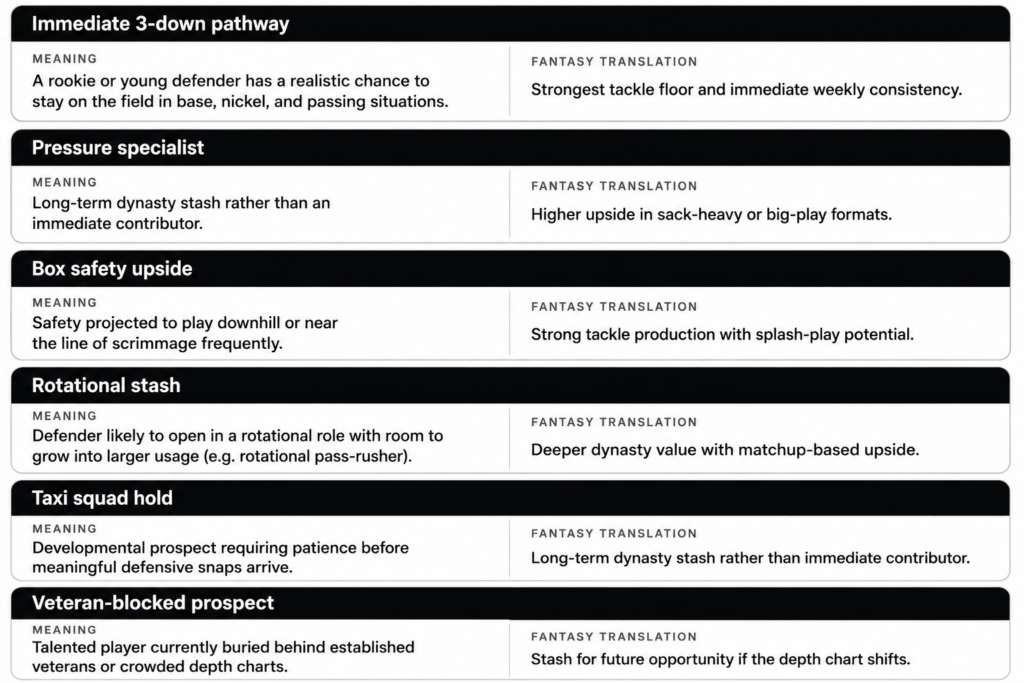
Now that we have the terminology down, let’s go down the 2026 NFC South Pathways to IDP Fantasy Relevance.
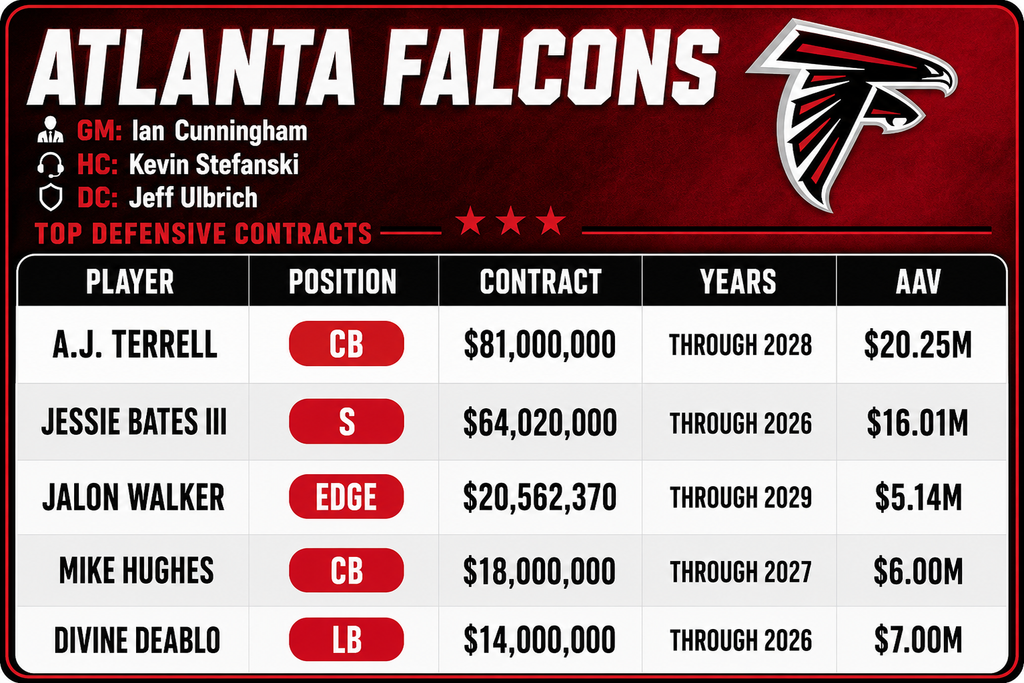
The Atlanta Falcons enter 2026 with one of the more intriguing young defenses in the NFC South. While the offense continues to receive much of the attention, Atlanta has quietly invested significant resources into building a faster, younger defensive core capable of growing alongside the rest of the roster. Jeff Ulbrich now has a unit with a blend of proven veterans and ascending young talent for the second season, creating several pathways for first- through fourth-year defenders to emerge as fantasy contributors. Unlike Houston, where many young defenders have already cemented themselves as cornerstones, Atlanta still has plenty of opportunities for players willing to earn them.
The Falcons’ offseason additions also signal a commitment to becoming more athletic at every level of the defense. Christian Harris arrives looking to revitalize his career after spending his first four seasons in Houston, while first-round pick Jalon Walker headlines the next generation of pass rushers. Combined with an experienced secondary led by Jessie Bates III and A.J. Terrell, Atlanta has positioned itself to gradually transition from a veteran-led defense into one built around younger playmakers.
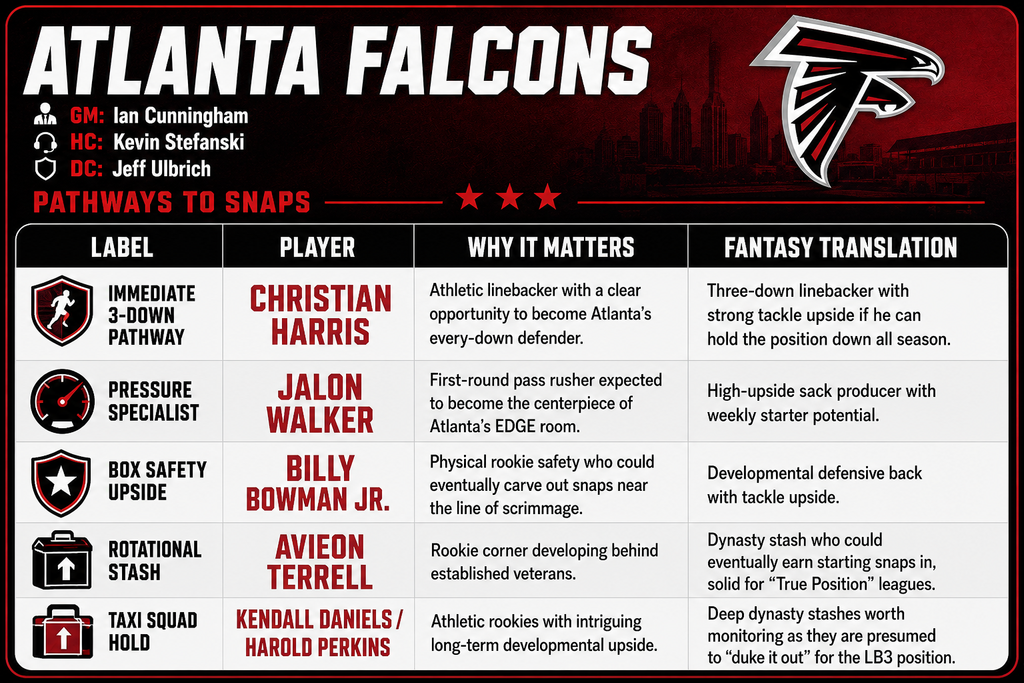
Atlanta’s biggest fantasy storyline may revolve around Christian Harris. The former Texans linebacker remains well within the Year 1-4 window and now finds himself with a fresh opportunity under second-year DC Jeff Ulbrich. Harris has always possessed the athletic traits to become a productive every-down linebacker, and Atlanta appears ready to give him that opportunity. If he secures the green-dot responsibilities and remains healthy, he could quickly establish himself as one of the better tackle producers in the division.
Jalon Walker represents the future of Atlanta’s pass rush. The former first-round pick enters his second season with expectations of becoming the long-term centerpiece off the edge. Walker’s versatility allows him to rush from multiple alignments, something Ulbrich has consistently valued throughout his coaching career. While veterans will still factor into the rotation, Walker possesses the highest long-term ceiling of any young defender on the roster and projects as Atlanta’s premier pressure producer for years to come.
Billy Bowman Jr. offers one of the more interesting developmental stories in the secondary. Jessie Bates III remains the unquestioned leader of the defensive backfield, but Bowman has the instincts, physicality, and versatility to eventually earn snaps closer to the line of scrimmage. If Atlanta begins using him in more box-oriented packages, his tackle opportunities could make him an appealing sleeper in defensive-back-required formats.
The Falcons also continue adding depth throughout the secondary and front seven. Rookie corner Avieon Terrell will have the opportunity to develop behind his older brother’s counterpart, A.J. Terrell, while Kendall Daniels and Harold Perkins provide intriguing athletic upside as long-term developmental pieces. Daniels’ size and versatility make him an interesting defensive back project, while Perkins remains one of the more fascinating lottery tickets on the roster if Atlanta can unlock the skill set that once made him one of college football’s most dynamic defenders.
Additional names worth monitoring include James Pearce Jr., whose rookie season enters with more uncertainty than anyone anticipated. Pearce’s offseason legal situation remains under monitoring, although he is participating in a diversion program that could ultimately resolve the matter without charges if completed successfully. Regardless of the outcome, Atlanta added veteran Samson Ebukam to strengthen the edge rotation and provide insurance should Pearce miss time or require additional development. His talent is undeniable, but both his availability and role will be worth watching throughout the season.
Atlanta’s defense is still very much a work in progress, but the foundation is beginning to take shape. Harris has an opportunity to stabilize the linebacker room, Walker appears destined to become the face of the pass rush, and Bowman gives the secondary another intriguing young chess piece. Add in developmental prospects such as Terrell, Daniels, Perkins, and Pearce, and the Falcons have assembled one of the more interesting collections of young defensive talent in the NFC South.
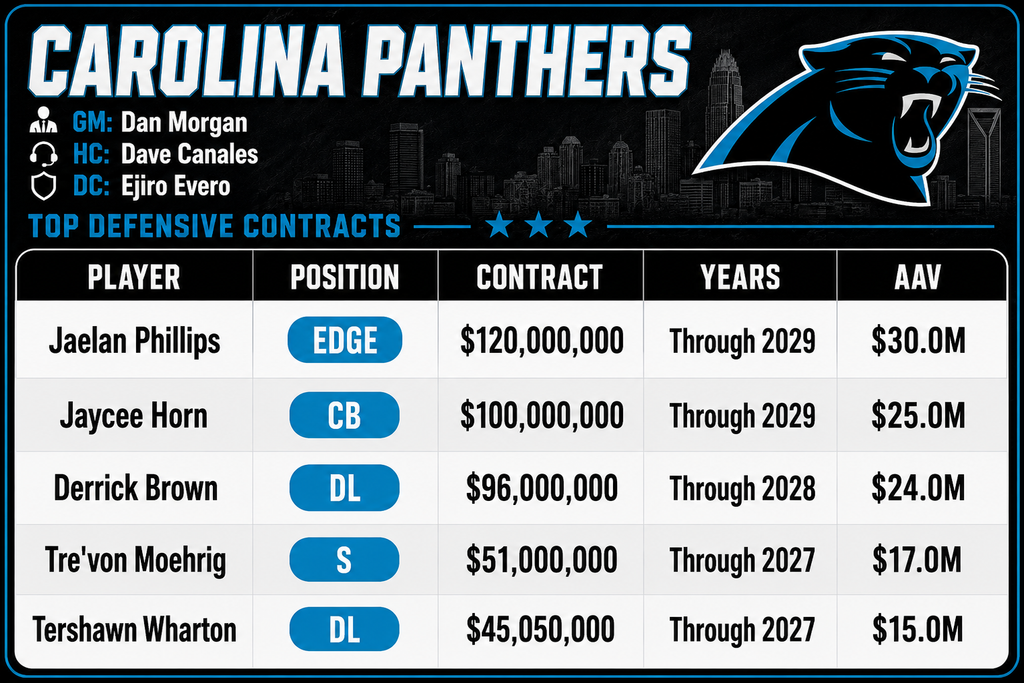
The Carolina Panthers enter 2026 in a much different position than they were just a year ago. While the offense continues building around Bryce Young, the defense has quietly undergone one of the larger makeovers in the NFC South. Carolina added established veterans such as Jaelan Phillips and Devin Lloyd while continuing to invest premium draft capital into young defenders who could eventually become the next foundation of the unit. Unlike Tampa Bay or Atlanta, where several young players have already carved out significant roles, many of Carolina’s developmental defenders are still fighting to establish themselves, making this one of the more intriguing defenses for dynasty IDP managers.
The Panthers also have one of the healthier mixes of veteran leadership and youthful upside in the division. Derrick Brown and Jaycee Horn remain the cornerstones of the defense, but several younger players are now positioned to compete for meaningful snaps around them. The result is a defense with plenty of long-term upside, even if many of those fantasy pathways are still developing.
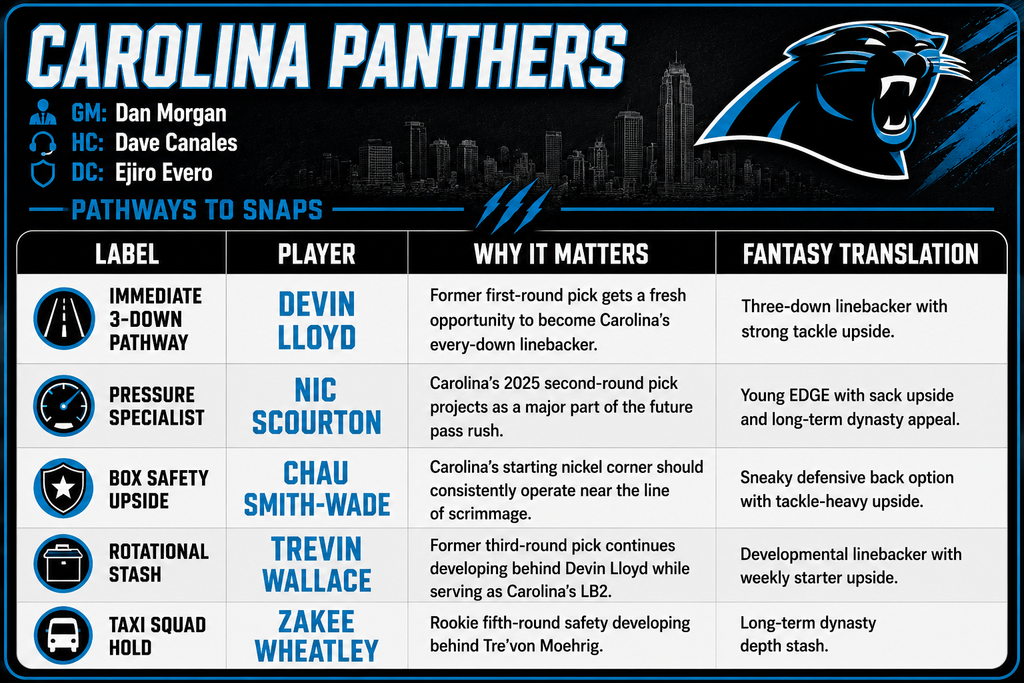
Carolina’s biggest fantasy storyline may revolve around Devin Lloyd. After spending the first part of his career in Jacksonville, the former first-round pick now gets a fresh start in Ejiro Evero’s defense with a legitimate opportunity to become an every-down linebacker. The Panthers invested in Lloyd because they believe he can still develop into the player many expected coming out of Utah, and if he settles into a full-time role, the tackle production should quickly follow.
The pass rush also received a significant boost with the addition of Nic Scourton. The former second-round pick already finds himself learning behind veteran Jaelan Phillips while possessing the upside to become one of Carolina’s long-term building blocks off the edge. His combination of power and athleticism gives the Panthers another young pass rusher to develop, while fellow 2025 third-round pick Princely Umanmielen adds even more depth to a position group that suddenly looks much stronger than it did a year ago.
One of the more underrated fantasy pathways belongs to Chau Smith-Wade. As Carolina’s projected starting nickel defender, Smith-Wade should consistently align near the football, giving him more tackle opportunities than many outside corners receive. Nickel defenders often become overlooked IDP contributors, but Smith-Wade has the chance to quietly provide steady production if he maintains that role throughout the season.
Trevin Wallace remains another linebacker worth monitoring. The former third-round pick currently projects as Carolina’s second linebacker behind Lloyd and continues developing within Evero’s system. Whether he eventually pushes for a larger workload or simply becomes one of the defense’s primary rotational linebackers, Wallace possesses enough athletic ability to remain firmly on the dynasty radar.
Additional names worth monitoring include fourth-round cornerback Will Lee III, who enters the league with an opportunity to develop behind Mike Jackson and Jaycee Horn, along with fifth-round safety Zakee Wheatley, who will begin his career behind Tre’von Moehrig. Fourth-round safety Lathan Ransom also provides developmental depth in the secondary, while seventh-round linebacker Jackson Kowatch faces an uphill climb but could eventually carve out a role on special teams before competing for defensive snaps. Defensive tackle Lee Hunter, Carolina’s second-round selection in 2026, is another player worth remembering in defensive tackle premium and True Position leagues as he develops behind Bobby Brown III and alongside Derrick Brown and Tershawn Wharton.
Carolina may still be a year away from fully realizing the potential of this defense, but the foundation is beginning to take shape. Lloyd gets the opportunity to revive his career, Scourton headlines the next generation of pass rushers, and several young defensive backs and linebackers are positioned to compete for larger roles over the next few seasons. For dynasty managers willing to be patient, the Panthers offer one of the deeper collections of developmental defensive talent anywhere in the NFC South.
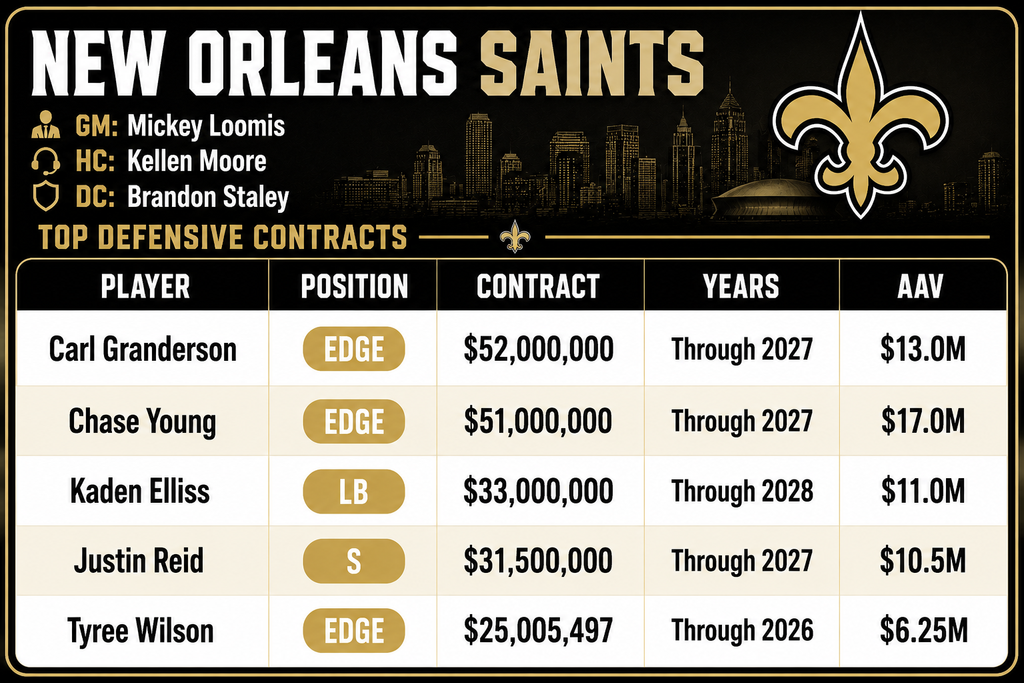
The New Orleans Saints enter 2026 in unfamiliar territory. For nearly two decades, this defense was built around household names like Cameron Jordan, Demario Davis, Marshon Lattimore and Tyrann Mathieu. While a few veteran leaders remain, this roster is clearly transitioning toward a younger core under new head coach Kellen Moore and defensive coordinator Brandon Staley. The Saints still expect to compete, but much of their long-term success now depends on whether their recent draft classes can develop into the next wave of impact defenders.
Unlike some of the other teams in this division, New Orleans doesn’t have a large collection of first- through fourth-year defenders ready to step into starring roles immediately. Instead, several young players are being asked to grow alongside established veterans before eventually taking over larger responsibilities. That makes this one of the more interesting developmental defenses in the NFC South.
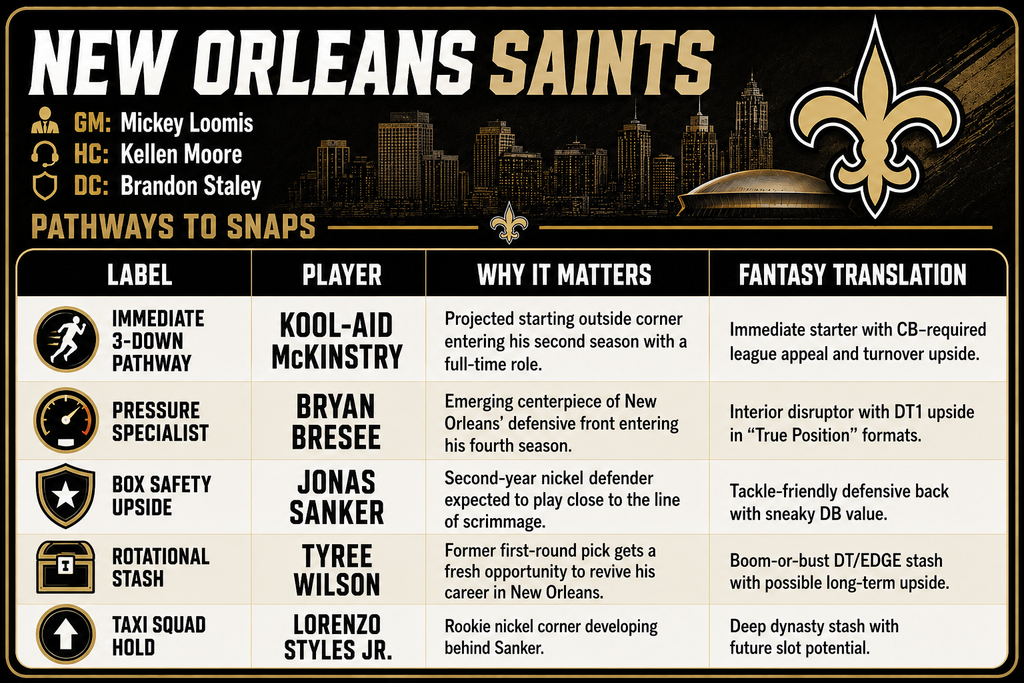
Bryan Bresee has quietly become the centerpiece of New Orleans’ defensive front. The former first-round pick enters 2026 with expectations of continuing his ascent as one of the better young interior defensive linemen in the conference. Brandon Staley’s scheme should continue creating opportunities for Bresee to attack upfield, making him one of the more appealing defensive tackle options in DT-premium and True Position leagues.
The secondary is where most of the Saints’ young talent resides. Kool-Aid McKinstry enters the season as a projected starter after spending his rookie year developing within the defense, while 2025 fourth-round pick Quincy Riley appears positioned to start opposite him. New Orleans has clearly committed to getting younger at cornerback, and both players should have every opportunity to establish themselves as long-term starters. For fantasy managers in cornerback-required formats, both deserve attention entering the season.
Jonas Sanker is another player to monitor at DB. The third-round pick projects as New Orleans’ starting nickelback, a role that often puts defensive backs around the football and creates tackle opportunities. While Justin Reid remains the veteran leader at safety, Sanker’s alignment could make him one of the more underrated rookie defensive backs in IDP leagues if he secures consistent snaps early in the year.
Tyree Wilson also finds himself with an opportunity to reset his career after a rough start. After failing to fully establish himself with the Raiders, the former first-round pick now joins a Saints edge room led by Carl Granderson and Chase Young. His pathway to a starting role isn’t immediate, but his draft pedigree alone makes him worth monitoring in deeper dynasty formats if he can earn a larger rotational workload.
Additional names worth monitoring include fourth-round linebacker Danny Stutsman, who currently sits behind Pete Werner and Kaden Elliss but has the instincts to eventually push for a larger defensive role. Third-round defensive lineman Vernon Broughton adds developmental depth behind Bresee, while 2026 second-round nose tackle Christen Miller is a player to remember in defensive tackle premium and True Position leagues as he develops into the rotation. Rookie cornerback T.J. Hall will look to secure a backup role during training camp, and fifth-round safety Jordan Howden continues providing valuable depth in the secondary.
The Saints are no longer built around the veteran stars that defined this defense for so many years. Instead, the next chapter will be written by players like Bresee, McKinstry, Riley, Sanker, and several other young defenders who now have an opportunity to become the faces of New Orleans’ future. Their development may ultimately determine how quickly the Saints return to fielding one of the league’s top defensive units.
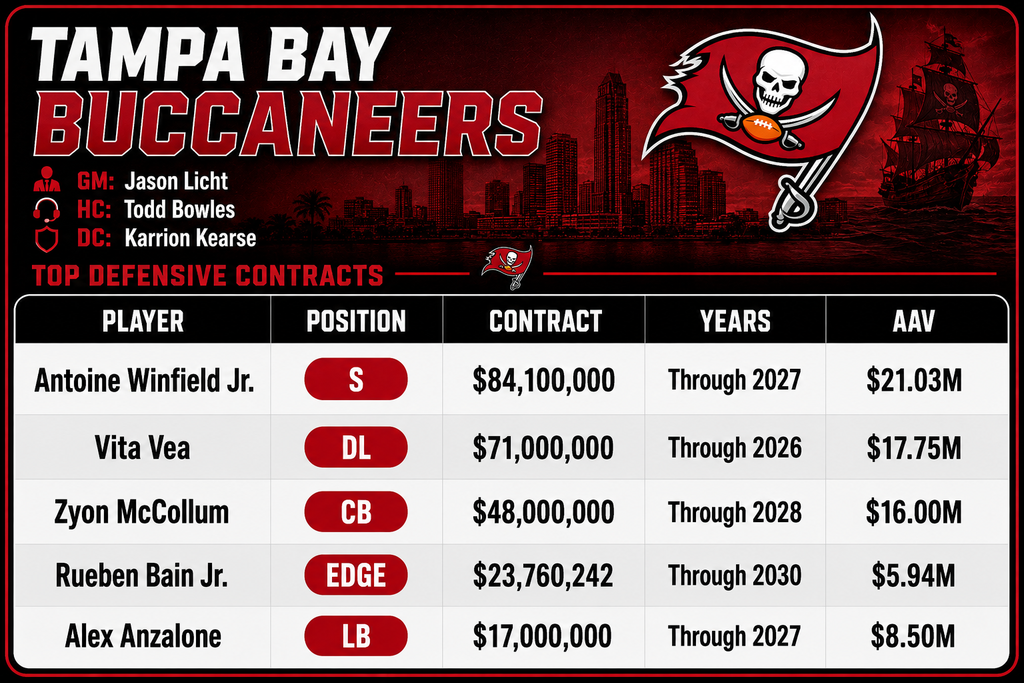
The Tampa Bay Buccaneers enter 2026 with one of the NFL’s most complete rosters, but unlike previous seasons, this defense is beginning to take on a much younger identity. Todd Bowles has spent the past several years relying on veterans like Lavonte David, Vita Vea, Antoine Winfield Jr., and others to anchor the unit, but the next wave has officially arrived. Tampa Bay has aggressively invested premium draft capital to replace its aging linebacker corps, strengthen its pass rush, and rebuild the secondary, giving the Buccaneers one of the more exciting collections of young defensive talent in the league.
What makes Tampa Bay different from many teams featured in this series is that these young defenders are not simply waiting for opportunities. Several are already projected starters, while others are expected to play meaningful rotational roles from Day 1. The Buccaneers have positioned themselves to remain contenders for the division while simultaneously transitioning to a younger core, making this one of the most appealing defenses for both redraft and dynasty IDP managers.
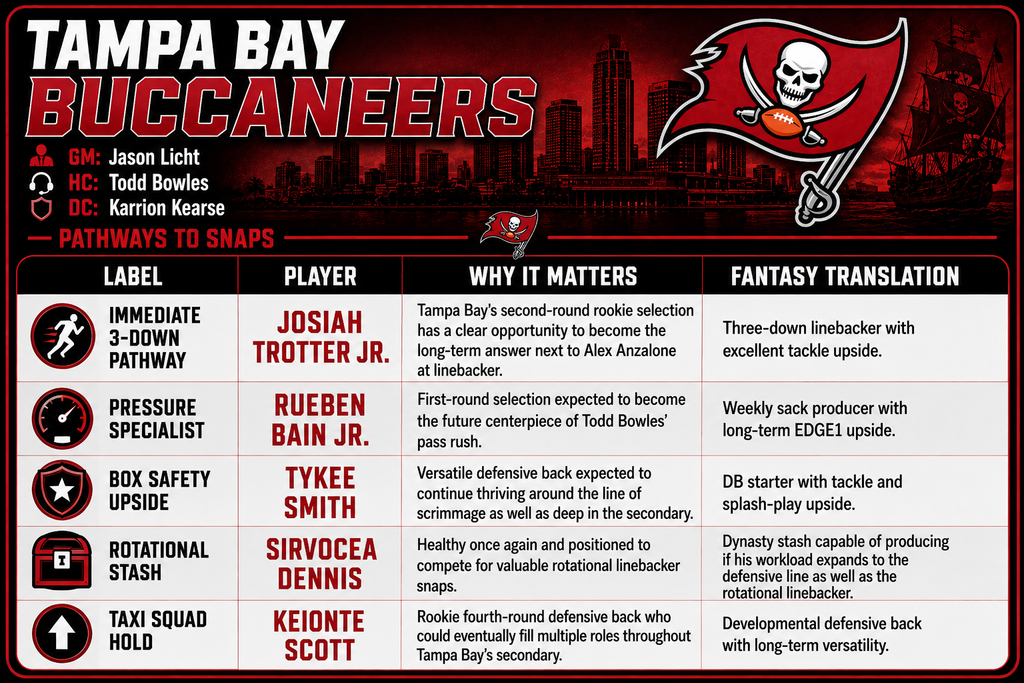
The Buccaneers’ biggest offseason storyline centers around the linebacker position. With Lavonte David no longer leading the room, Tampa Bay immediately invested in Josiah Trotter Jr., selecting him in the second round with the expectation that he can become one of the next leaders of the defense. Veteran Alex Anzalone provides stability and experience, but Trotter has a legitimate pathway toward becoming an every-down linebacker as he develops within Todd Bowles’ system. His instincts, physicality, and football IQ make him one of the safest projections among the young linebackers featured throughout this series.
Tampa Bay’s future pass rush now belongs to Rueben Bain Jr. The first-round selection immediately steps into one of the league’s better developmental environments under Bowles and joins a room that already includes Yaya Diaby, Anthony Nelson and veteran Al-Quadin Muhammad. Bain possesses the tools to become the next featured edge defender for the Buccaneers, and while his role should continue growing throughout the season, his long-term ceiling makes him one of the premier dynasty assets in this division.
The secondary has also undergone a significant youth movement. Tykee Smith enters his second season after proving he can be deployed all over the defense, and his ability to align near the line of scrimmage should continue creating tackle opportunities for IDP managers. Outside, Benjamin Morrison immediately steps into the starting lineup opposite Zyon McCollum, while Jacob Parrish projects as Tampa Bay’s starting nickel corner. Together, Morrison, Parrish and Tykee Smith give the Buccaneers one of the youngest and most promising defensive back groups in the NFC.
SirVocea Dennis remains another player worth monitoring after injuries slowed the beginning of his career. When healthy, Dennis has flashed the athleticism to contribute as both a rotational linebacker and sub-package defender, making him an intriguing dynasty stash behind Trotter and Anzalone. Rookie defensive back Keionte Scott also deserves attention after being selected in the fourth round of the 2026 NFL Draft. His versatility should allow Tampa Bay to experiment with multiple alignments throughout training camp and the preseason as the coaching staff determines where he fits best.
Additional names worth monitoring include Chris Braswell, who continues developing behind Tampa Bay’s veteran edge rotation, along with fifth-round nose tackle DeMonte Capehart, who could eventually carve out snaps behind Vita Vea in defensive tackle premium and true-position formats. Calijah Kancey has already established himself as one of the league’s better young interior defenders and should continue producing as one of the focal points of Tampa Bay’s defensive front, even though he has already graduated beyond the developmental stage highlighted throughout this series.
The Buccaneers are no longer preparing for the future. That future is already taking the field. Trotter, Bain, Tykee Smith, Morrison and Parrish all project to play significant roles as Tampa Bay continues its transition to the next generation of defensive stars. For a team with legitimate Super Bowl aspirations, successfully blending those young contributors with established veterans may ultimately determine whether the Buccaneers remain among the NFC’s elite defenses for years to come.