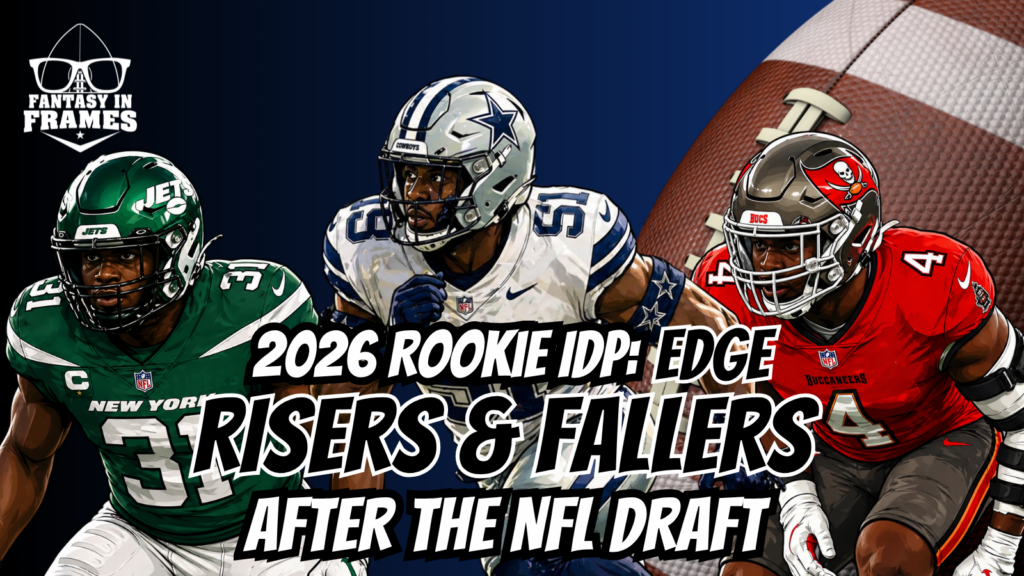
Welcome to our breakdown of 2026 Rookie IDP EDGE Risers & Fallers After The NFL Draft!
Every NFL Draft introduces a little chaos into the league’s ecosystem. Depth charts shift, roles evolve, and players who once looked secure suddenly find themselves fighting for snaps. Then, of course, the land spots happen and change our entire draft board. Like Nirvana once said, “Here we are now. Entertain us.”
The NFL Draft is like a massive chess match being played out across the entire league. Every selection moves a piece on the board, creating opportunities for some players while putting others squarely in danger. As philosopher René Descartes suggested, to understand a system, you must examine how all of its parts interact.
When teams invest in new pass rushers, they aren’t just adding to their team’s talent… they’re actually reshaping the entire ecosystem and how defensive schemes will be played. With the draft now complete, the board has been reset. It’s time to reevaluate the EDGE landscape and determine which players have seen their dynasty and IDP value rise… and which ones just lost ground.
Landing spots, draft capital, and depth chart competition can dramatically shift a pass rusher’s outlook overnight. Some players suddenly find themselves with a clear runway to snaps and sacks, while others see their path to production blocked by new competition.
Now that the dust has settled, it’s time to reassess the EDGE position for dynasty and IDP leagues.
Edge Rankings
Tier One
David Bailey, New York Jets
David Bailey steps into a New York Jets defense that desperately needed a lift and takes flight off the edge. After finishing 31st in sacks and famously failing to generate an interception in 2025, a retooling was needed. When a team spends premium draft capital this early, at this position, the message is clear: they envision Bailey as a potential three-down contributor regardless of any concerns. Pairing him with Will McDonald IV, a former 2003 first-round pick, gives New York an explosive edge duo capable of creating the pressure that was missing last season.
That said, this will be an athletic passing duo, but there are fair questions about how this pairing holds up against the run, as both players are on the lighter side. For Bailey in particular, run defense has been a frequent talking point. Let’s take a look under the hood and at the engine here.
What I’m seeing is that most of the tackling concerns showed up earlier in his career. The data helps clarify that progression. PFF shows real improvement in his run defense, highlighted by a 9.0% run-stop rate (85th percentile). At the same time, the overall consistency still isn’t there yet, as reflected in a 76.4 run-defense grade (164th among edge defenders) and a missed tackle rate of 15.8%.
In short, it’s not the best, but he’s become far more disruptive, even if not fully reliable on every snap. He’s definitely made aware and improved upon this. The film backs that point, too, especially in the Orange Bowl, where he arguably looked like the best tackler on the field.
As you could guess, Bailey’s value lies in his ability to affect the quarterback. He brings an explosive first step, a lethal spin move, and the ability to convert speed to power. He can win inside, outside, or straight through offensive tackles, and his closing burst is elite. All of that showed up in a dominant 2025 season: 14.5 sacks, 19.5 tackles for loss, and a nation-leading 74 pressures. Add in 31 quarterback hits and a 23.7% pressure rate, and you’re looking at one of the most productive and disruptive pass rushers in this class. That’s why you draft David Bailey here. Based on your scoring, he’ll be a 1.01-1.03 in your IDP draft.
Rueben Bain Jr., Tampa Bay Buccaneers
The Tampa Bay Buccaneers, led by head coach Todd Bowles, build their defensive line around versatility, aggression, and constant disruption. Rather than locking players into rigid roles, Bowles values linemen who can move all over the formation.
Shifting assaults from the edge as well as the interior, while still operating within hybrid fronts that blended techniques of both 3-4 and 4-3 formations. In a system like this, concerns like arm length become far less significant, making it an ideal landing spot for a player like Rueben Bain Jr. to do what he does best: beat his man and win on passing downs. (30.3% win rate on true sets)
If you read our previous articles and kept up on this player, Bain entered the process widely viewed as the top defensive lineman in the class, and he fills a major need for Tampa Bay. He backed that up with 83 pressures last season. Tape reveals he got the majority of those pressures using strength and leverage, and as we have said previously, a player with this arm length would not affect his IDP profile.
Pairing him with a front that includes Josiah Trotter, Alex Anzalone, Yaya Diaby, Calijah Kancey, Vita Vea, and A’Shawn Robinson gives Tampa Bay the makings of a fast, physical, and disruptive front seven, one that should look vastly improved this season.
Tier Two
Akeem Mesidor, Los Angeles Chargers
At first glance, it felt like this might take a year to fully develop—but that assumption doesn’t really hold up once you dig a little deeper. Let’s walk through both sides. If this were truly a long-term stash, I’d still be more patient with an elite defensive lineman than a linebacker (see my Jacob Rodriguez take or any Dynasty Startup breakdowns).
The Chargers are getting a potential three-down player who can rotate in early while already bringing a polished pass-rush skill set. According to PFF, Akheem Mesidor posted a 21.3% pass-rush win rate in 2025, which ranks in the 94th percentile. That efficiency is further supported by his production, including 71 total pressures and a 92.5 PFF pass-rush grade, reinforcing just how consistently disruptive he was as a rusher that season. Still, questions remain about how to get him on the field. I’ll explain.
With Khalil Mack entering the final year of his deal and weighing retirement, this becomes an ideal situation for Akheem Mesidor to grow alongside Tuli Tuipulotu. There may be more opportunity here than meets the casual eye.
IDP Fun Nugget: Tuipulotu often kicks inside on passing downs, and we saw how effective that type of role shift can be with Odafe Oweh last season. That inside movement could be the key to getting Mesidor on the field earlier than expected. Plenty of managers might not be aware of this.
Defensive coordinator Chris O’Leary, along with coaches like Mike Elston and Dylan Roney, has a history of creating more flexible fronts, using inside edge rushers to attack weak gaps and collapse the pocket. That kind of deployment could accelerate Mesidor’s timeline to get on the field quicker than people would expect.
Even with a solid pass-rush group that includes Tuipulotu, Mack, Bud Dupree, and Kyle Kennard, adding Mesidor at 22nd overall signals intent on what’s to come. He’s not just depth, he’s a 25-year-old (in the prime of his life) and successor to Mack, and could carve out a meaningful role sooner than initially assumed.
Malachi Lawrence, Dallas Cowboys
Malachi Lawrence was selected 23rd overall in the first round of the 2026 NFL Draft by the Dallas Cowboys. A four-year starter at UCF, he finished his college career with 20 sacks, which ranks 10th all-time in program history, earning First-Team All-Big 12 honors in 2025.
Early in the draft process, he was largely viewed as an unknown by many evaluators, but a strong showing at the Shrine Bowl followed by an impressive Combine performance quickly changed that perception. His measurable traits, highlighted in the tweet above, stand out in ways that project well to the NFL. Combined with strong draft capital, that’s a key reason we’re higher on him than the consensus at this stage.
Dallas lands a high-upside, explosive athlete who fits the prototype of a modern 3-4 edge defender. It’s a move that immediately raises the ceiling of their pass rush and signals a clear investment in speed and disruption off the edge. A 4.5 forty-yard dash is exactly the kind of trait that turns heads and forces defensive coordinators to take notice. I have him projected as a third-round selection, and one of the top three or four edge rushers taken in your IDP Combo leagues.
The opportunity is there, too. Outside of Rasul Gary and Donovan Ezeiruaku returning from injury, the depth chart isn’t particularly intimidating. That opens the door for Lawrence to earn rotational snaps early and potentially carve out a meaningful role sooner rather than later.


Tier Three: Three Down Players That Could Crack Lineups
Derrick Moore, Detroit Lions
The Lions moved up to select Derrick Moore with the 44th overall pick in the second round, adding a 6’3”, 255-pound edge defender with clear pass-rush upside. Moore enters the league as a refined rusher who posted a 92.4 pass-rush grade, ranking inside the top 10 in FBS.
For those expecting him to immediately step in as the long-term running mate opposite Pro Bowl edge Aidan Hutchinson, it’s worth tempering that roar early.
First, He’ll have to earn snaps in a rotation that includes DJ Wonnum, and early playing time, especially on early downs, won’t be handed to him. Historically, Detroit has leaned on more Veterans with run support experience, meaning Moore will need to prove he can hold up consistently against the run before locking in a full-time role.
That said, the IDP sleeper appeal is very real. If a player like Al-Quadin Muhammad can reach an eight-sack season in a favorable role, Moore has a similar path given his athletic profile and landing spot. It won’t be an instant fit. In fact, he profiles more as a late-round flier in IDP drafts right now, likely a fourth-round stash, but one with clear upside worth betting on.
Zion Young, Baltimore Ravens
Zion Young is one of the more speculative stashes in this draft class but was a bit of a late bloomer, totaling just five sacks through his first three seasons before breaking out in 2025 with 6.5 sacks and 17 quarterback hurries. He carried that surge into Senior Bowl week, where he boosted his draft stock even further and finished as the game’s MVP.
Measuring in at 6-foot-5, 267 pounds, Young projects as a prototypical three-down edge who can pair well with Trey Hendrickson by adding size, length, and alignment versatility across multiple fronts. The Baltimore Ravens clearly believe in his upside, having used significant draft capital to deepen and diversify their edge rotation, which also features Tavius Robinson and Mike Green—both expected to take on larger roles this season.
Young will still need to earn his snaps, but there’s a legitimate opportunity for him to break into the rotation early if he outperforms expectations in camp and shows he can consistently handle a full-time role.
T.J. Parker, Clemson
IDP Fun Fact: If T.J. Parker had come out in the 2024 draft class, he was widely viewed as the top edge prospect in the class.
Instead, he stayed, and in a much deeper and more competitive edge group, he now sits in the middle of a loaded tier. He joins a Bills team in the second round, to a defense transitioning 4-3 looks into 3-4 usage. Getting that Draft Capital isn’t the only thing to like about him: 116 pressure, 22 sacks, 6 forced fumbles. Expectations will be extremely high.
From an IDP perspective, he will be on a wait-and-see approach, behind the depth chart with players such as Bradley Chubb and Greg Rousseau ahead of him. He is one of the last three down defenders and will go in the fourth round of IDP combo drafts because he is often forgotten about.
Gabe Jacas, New England Patriots
The New England Patriots selected Illinois edge rusher Gabe Jacas with the No. 55 overall pick in the second round of the 2026 NFL Draft. Jacas brings a wrestling background and a strong competitive profile, pairing it with a 25% win rate on true pass-rush downs and solid production (11 sacks, 3 forced fumbles, 13.5 TFLs).
He enters the roster initially as depth, but there’s a clear path for him to earn a larger role as the season progresses. With Harold Landry aging and Dre’Mont Jones already in the mix, Jacas has a realistic opportunity to work his way into rotational snaps if he performs well in camp and early-season packages.
His bull rush stood out as one of the best in the class, something that showed up consistently at the Senior Bowl. He also flashes a reliable club move and enough bend to win on the edge, giving him some schematic flexibility as an outside rusher. Jacas should be one to monitor closely through training camp, as he fits the profile of a developmental pass rusher who could quickly turn into a productive stash in IDP formats.
Keldric Faulk, Tennessee Titans
When a trade happens, particularly for a first-round pick at No. 31, you would expect the IDP community to show a bit more respect, but that hasn’t really translated in early drafts. He is not known for his pass-rushing polish, but he brings everything else to the table, and the real question is whether he can be schemed into consistent impact plays. With Robert Saleh, that answer could be yes. I know what you are thinking, but the fact remains, Robert Saleh clearly made a deliberate move (and traded up) to get his guy.
The case for Faulk is one of the most intriguing and, honestly, fun profiles in this class, and he already stands out as one of the best run defenders at the position. At 6’6” with a developing frame, he already looks the part of an NFL edge, though this archetype can be volatile at the next level and does carry some bust risk. IDP managers will need patience as he develops.
Schematically, this aligns well with what Saleh typically prefers up front. He often leans toward versatile 4i and 5-technique defenders who can reduce inside or kick outside depending on the situation. That is where the Calais Campbell comparison comes into play. Faulk projects best as a 5-technique with rare length, strength, and alignment flexibility, allowing him to move across multiple fronts.
He is also a strong run defender, posting an 85.2 PFF run-defense grade, which gives him legitimate three-down appeal. While he may not have the same burst as someone like Bain, Faulk makes up for it with his ability to anchor, stay on the field, and contribute in every phase of the defense.
There is also a belief that his best football is still ahead of him. The vision is simple: kick him inside on early downs, move him back outside in passing situations, and let him grow alongside players like Jermaine Johnson.
Because of that draft capital, upside, and role projection, he should absolutely be in the IDP conversation, typically as a late third-round to early fourth-round target in combined formats. Just don’t swing too early on this selection.
Honorable Mentions: Designated Pass Rushers
Note: The Designated Pass Rushers (DPR). The way I play the game is I don’t draft these players. I prefer to be lean at the Edge position. But know your scoring formats, as there is no wrong way to play; these players may be important to you in big-play or best-ball formats, for example.
You might want to based on your platforms.
Cashius Howell, Cincinnati Bengals
He profiles as one of the most efficient pass rushers in the class. His 2025 breakout season, finishing with 11.5 sacks, a 91.4 PFF pass-rush grade, and, for his career, a 28.2% pass-rush win rate over his last two seasons at Texas A&M.
But the same concerns on size (6-2 and 253 pounds) hit him the hardest. In fact, he has some of the smallest arms (31 inches) in this draft class. Now compute that with the other Bengals edge, they have Boye Mafe (6’4″, 261 lbs), Shemar Stewart (6’5″, 281 lb), and Myles Murphy (6’5″, 275 lbs)
As mentioned, this is the part of the list where players are built more as designated pass rushers, which carries risk in IDP formats since he may not play three downs. While it’s true, his win rate, spin move, and counters scream production on third down, early downs require holding the edge, stacking blockers, and playing with length areas where he’s still developing. It stands to reason the Bengals have three other options to do that. That’s why he projects more as a high-end pressure specialist early in his career.
R Mason Thomas, Kansas City Chiefs
Excellent landing spot. Steve Spagnuolo has a proven track record of maximizing edge rushers, and this is the kind of player he can deploy creatively. R. Mason Thomas (6’2″, 241) may be on the lighter side, but his production jumps off the page with a whopping 22 tackles for loss, 15.5 sacks, and four forced fumbles over his final 23 games, along with back-to-back All-SEC honors. He also averaged 2.7 pressures per game across the last two seasons.
Thomas wins with explosiveness and twitch, backed by a track background that shows up in his ability to convert speed to power. His 2024 breakout season (9 sacks, 12.5 TFLs) put him firmly on the radar, and even while dealing with injuries in 2025, he continued to produce at a high level.
If utilized properly, he’s the type of player who can climb quickly. His knack for splash plays, timely sacks, and forced fumbles consistently shows up on tape. The concerns center on durability, size, and length, as well as inconsistent edge setting against the run. Because of that, he projects best early on in sub-packages where he can attack rather than read and react, fitting the mold of a designated pass rusher while he continues to develop into a more complete player.
Romeo Height, San Francisco 49ers
San Francisco didn’t bring Romeo Height in to be a full-time, three-down edge right out of the gate. The vision is much more specific: they see him as a “juice” player off the bench, someone who can step into obvious passing situations and hunt the quarterback. That designated pass-rush role has been a clear need for them, and Romello Height fits it naturally.
Height is one of the clearest examples in this class of a player whose strengths and limitations shape his role. At around 240 pounds, he’s undersized, but the production is real; he had the 7th most pressures amongst EDGE rushers in 2025. Added 10 sacks and 11.5 TFL, he just doesn’t consistently hold up at the point of attack, but that’s okay because they have Mykel Williams, who specializes in run support, to handle early downs.
This makes him a better fit as a situational rusher who can pin his ears back and make an impact play. Heights’ landing spot makes him an option in the deepest of leagues.
Joshua Josephs, Washington Commanders
Joshua Josephs was selected by the Washington Commanders with the No. 147 overall pick in the fifth round. It’s a landing spot that makes sense from a scheme perspective and offers upside, but it’s not the plug-and-play three-down role right out of the gate as you might expect.
An explosive edge with massive arm length (34 1/4) and wing span (84 inches), Joseph’s game rests on penetrating, having a 34.3% win rate on true pass sets, resulting in 15 TFLs over the last two seasons, making his appeal here fairly clear: traits plus splash plays. If it all comes together, he has the ceiling to push into the top tier of edge rushers from this class. Only draftable in the deepest of leagues at the moment, as he has a roster battle to get on the field.
Dennis-Sutton, Green Bay Packers
IDP Fun Fact:
The only EDGE prospects since 2015, with an RAS better than 9.89 and a pressure rate greater than 17.0% in at least one college season, are: Myles Garrett, Aidan Hutchinson, T.J Watt, Montez Sweat, Malachi Lawrence, and now Dani Dennis- Sutton.
One thing about this draft class, it’s deep at the position. Dani Dennis-Sutton sits firmly on that long list of elite edge defenders this season. He posted a 15.9% pressure rate, generating 49 pressures, which ranked 34th out of 852 players.
He’s a long, athletic edge with natural bend and strong finishing ability—exactly the archetype Jonathan Gannon tends to favor in his front. Gannon has a clear track record of leaning into this mold (see Josh Sweat). While there are moments of inconsistency, there’s a real path for him to compete early.
He’ll be battling names like Lukas Van Ness and Barryn Sorrell for that dream job lining up opposite Micah Parsons. He’ll be one of my last targets in deeper leagues, or off waivers, depending on the format.
Honorable Mentions II: Players That Could be Streamed
Keyron Crawford, DL, Las Vegas Raiders
Scheme-versatile rusher but known as a speed rusher, who has played multiple alignments. Best utilized as a sub-package pass rusher.
LT Overton, Dallas Cowboys
Former Five-Star recruit is a raw, traits-based edge defender who is still developing into consistent production. Overton wins with size and disruption, but remains a projection as a full-time contributor
Max Llewellyn, Miami Dolphins
High-motor rotational pass rusher with solid bend and burst. Projects as a situational contributor early.
Mikail Kamara, San Francisco 49ers
Undersized but explosive pass rusher with elite twitch and bend. Liability in run defense, but a strong situational pass-rush weapon.
Anthony Lucas, UDFA
Update 4/26/2025: UDFA signed by the Detroit Lions. Toolsy developmental edge with length and athletic traits. Still refining pass-rush consistency and technique.
Trey Moore, Miami Dolphins
Refined 3-4 edge defender with excellent get-off and hand usage. Natural pass-rush instincts and upside.
Eric O’Neill, Detroit Lions
Long, athletic developmental edge with improving technique. Late-round rotational upside
Patrick Payton, New York Jets
Long, athletic developmental edge with rotational pass-rush upside.
Tyler Onyedim, Denver Broncos
Depth piece with a nose for the football.
UDFA (UNDRAFTED FREE AGENTS)
These players went undrafted but remain developmental/camp prospects:
- Tyreak Sapp, UDFA: A powerful former interior defender now playing edge. Strong run defender with heavy hands but limited pass-rush upside.
- Dontay Corleone, UDFA: once considered a top- five DL prospect. Big stats in college, but medical concerns.
- Kalil Alexander, UDFA: Hybrid defender with strong production and win rate. The level of competition raises questions, but offers special teams and rotational value.
- TJ Guy, UDFA: Explosive designated pass rusher who thrives in obvious passing situations. Rotational pass-rush specialist projection.
- Arden Walker, UDFA: Power-based edge defender with a strong bull rush. Depth developmental piece.