
2026 ROOKIE IDP Mock Draft v2.0

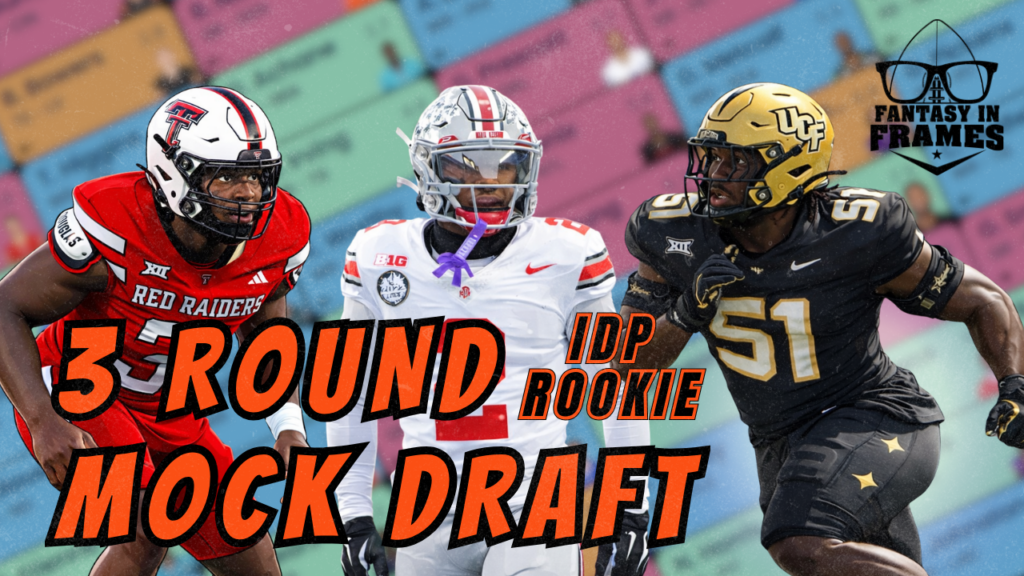
Welcome to our 2026 ROOKIE IDP Mock Draft v2.0!
When it comes to rookies, there’s always a crap ton of focus on talent, rankings, and where players “should” go. Of course, all of that matters, but you want the full picture when you’re actually sitting in a fantasy draft, sifting through players in order to fill holes on your fantasy team’s roster in hopes of making it better for the future.
Now, what matters more than talent is how a player’s position on the depth chart looks, how said player is going to be used in a certain scheme, how often they’re on the field in their first few seasons, and whether their role gives them a real chance to produce fantasy points for your lineup.
So, for this article, I wanted to build it out like a real IDP draft. Three rounds, 12 teams, IDP style. The first two rounds walk through the picks and the thinking behind them, and the third round is more about players to keep in mind once the board starts to thin out, the deeper you go down the rabbit hole. I have also listed deeper dart throws after the three rounds for my like-minded sickos out there in the extra deep leagues.
The goal here is to make the process a little clearer for you, giving some knowledge about these soon-to-be NFL rookies, and giving you more ammo when thinking through these decisions when it’s your time on the clock.
This is my first article with Fantasy In Frames, and I couldn’t be more excited, so enough with the intro, let’s get into the article.
Setting the Board: What to Expect by Position
Before getting into the draft, it’s important to understand what each position group actually brings to your roster. (Blah, more precursor article, foundational work)
Not all linebackers are the same. Not all edge rushers are used the same way. Defensive backs can vary based on alignment and usage. If those differences are not part of the evaluation, the draft becomes guesswork.
Linebackers
Linebacker is the most role-dependent position in IDP. A player who wears the green dot and stays on the field is going to produce differently than someone rotating in sub-packages and, more than likely, spend more time on the field as the green dot linebacker is the quarterback of the defense.
The priority with this position group is finding players with a path to consistent snaps and a role that naturally leads to production. Outside of that, you are dealing with specialists, whether that is coverage players, downhill attackers, or hybrids that depend heavily on how they are used.
EDGE
Edge defenders bring upside, but the role determines how quickly that shows up on an NFL field. Some players are every-down defenders, while others are used primarily in pass-rush situations early on in their careers until they fully adjust and develop at the NFL level.
Traits and moves are great, but they aren’t everything. A player can win as a pass rusher, but if the player’s snaps are limited, the production will be affected as well.
Defensive Interior
The interior defensive line is tied to disruption and to forcing offensive players to attack the outer parts of the line. Players who can consistently generate pressure have value, but most rotate early or handle responsibilities that do not translate cleanly to fantasy production.
That is why they tend to come off the board later unless the pass-rush ability is clear. Now, in true position leagues, I would maybe consider moving some of the players in this category up the board into the middle of the second round in IDP drafts.
Defensive Backs
Defensive back production is driven by alignment. Safeties closer to the line of scrimmage tend to be more involved, while deeper players rely on big plays like interceptions or multiple pass deflections.
Slot defenders can build value through tackle opportunities underneath, and hybrid players can shift between roles depending on usage. That flexibility can help, but it can also create inconsistency. Look for players at this position who can rotate in multiple positions. The more versatility a player has, the more opportunities that player will have to make his way onto the field.
Round 1
1.01 – David Bailey, EDGE (Texas Tech)
Bailey’s production is hard to ignore. Eighty-one pressures and fifteen sacks show consistent disruption, not just flashes. The question is how quickly he earns a role that keeps him on the field across situations. If that happens early, the upside is clear. He is one of the names who could be the first EDGE called on draft night.
1.02 – Caleb Downs, S (Ohio State)
Downs fits the type of safety who can produce through involvement rather than relying on big plays. If he is used closer to the line, the tackle opportunities follow, and that usage is what drives the value here, though his landing spot will ultimately dictate how he’s used. Even still, Downs is a great player who can line up in multiple spots, whether that’s in the box or deeper in the secondary, and still find ways to impact the game.
The production and recognition back that up, being a back-to-back consensus All-American while also taking home the Jim Thorpe Award and the Lott Trophy, which speaks to both his play and the way he carries himself. He plays with high-level instincts, consistently closes on the ball in space, and limits yards after the catch, which is where you see him separate from most players at the position.
There are still some things to clean up, mostly tied to how aggressively he plays, because going full speed all the time can lead to the occasional missed tackle or bad angle, and there are times where he’ll go for the hit instead of the turnover. Even with that, the combination of instincts, versatility, and involvement makes him one of the safer projections in this class, depending on how he’s used.
1.03 – Arvell Reese, EDGE/LB (Ohio State)
Reese brings versatility, but that also creates some minor uncertainty. He can play EDGE and is an aggressive linebacker with some of the best athletic traits in this NFL Draft class, and that shows up both in how he moves and how he’s been used. After working mostly on special teams early in his career, he took a major step forward over the last two seasons, finishing with 69 tackles, 10 tackles for loss, and 6.5 sacks this past year while earning All-American honors and being named the Big Ten Linebacker of the Year.
Players who move between roles do not always have a clear path in the NFL early in their careers, so the landing spot and scheme of the team that selects Reese will have a big factor in where he aligns on a defense at the next level. He has the speed to play in space, the length to work off blocks, and the ability to rush off the edge with multiple moves already showing up, which is where the intrigue really comes from. His testing backs that up as well, running in the mid-4.4s with a strong first step, so the tools are not in question.
The upside depends on how he is used and whether the role is defined. His athleticism and versatility make him one of the most intriguing names in this draft.
1.04 – Sonny Styles, LB (Ohio State)
Sonny Styles was used all over, but the bulk of his work came in the box, with over 450 snaps, which tells you exactly where he was living most of the time. He wasn’t just stuck there either; Ohio St. trusted him in coverage with over 300 snaps, so you’re looking at a player who stayed on the field and handled multiple responsibilities in college. His production aligns with his usage, over 70 tackles and only two missed all of 2025, which is about as clean as it gets for a guy in college.
When you pair that with a PFF coverage grade pushing into the 90s, it’s a pretty clear picture of a guy who wasn’t just out there; he was involved on a consistent basis. He seems like a generational athlete and is expected to be a top-10 pick on draft day.
1.05 – Malachi Lawrence, EDGE (UCF)
In my personal opinion, Lawrence has the potential to become the EDGE1 of the draft class.
He’s been productive for multiple years, but this past season is where it really started to come together for him. He handled over 200 pass-rush snaps and turned them into 40 pressures and 7 sacks, with a PFF pass-rush grade pushing into the high 80s, which tells you he’s doing more than just getting there; he’s winning consistently and finishing. The role he had in college is exactly what you’d like to see him have at the next level. Living on the line and being used heavily as a pass rusher gives him a real path to early production.
There are still some inconsistencies in his run defense and tackling that show up on tape, but that’s not what you’re drafting him for. You’re betting on the pass rush translating, and with the way his usage and production have trended, there’s a real chance he grows into one of the more impactful EDGE players in this class.
1.06 – Rueben Bain Jr., EDGE (Miami)
Bain has been consistently productive, and this past season backed that up with 80+ pressures and double-digit sacks. That’s not just a one-year spike; we see real disruption emerging over time. Bain is lining up on the edge and getting true pass rush work, which is what you want to see out of a projected first-round pick. There isn’t much projection needed here; it’s more about whether that role carries over and how quickly he earns those same opportunities.
1.07 – CJ Allen, LB (Georgia)
Allen fits cleanly into that green dot/MIKE role. He can also play downhill, processes plays quickly, and stays around the ball without trying to do too much. He is also one of the best coverage linebackers in the class. If he lands on a team in rebuild mode, he could find himself on the field faster than most of the other guys at his position in the class.
1.08 – Jacob Rodriguez, LB (Texas Tech)
Rodriguez has been one of the more consistent producers at the position with back-to-back seasons of over 120 tackles. The instincts show up well on tape, the involvement has been more than steady, and he plays like someone who can handle a full-time role at the next level. Phenomenal at punching the ball out of the runner’s hands as well, this guy is the real deal at linebacker. The 2025 Butkus award winner should be one of the top three linebackers off your IDP board.
1.09 – Akheem Mesidor, EDGE (Miami)
Mesidor is a five-year player who started at West Virginia before transferring to Miami, and he was productive at both schools. This past season was when the workload really jumped, and he “broke out,” playing over 800 snaps with more than 400 pass-rush reps, turning that into 67 pressures and 13 sacks. He finally put the pieces together and had a monster last year.
Now, he did miss most of the 2023 season with an injury, but coming back and handling the kind of volume that he did while still improving and producing shows he can hold up in a full role. He’s also being talked about as a potential first-round pick, and that kind of draft capital usually means teams are going to put him on the field early and invest in developing him. It doesn’t guarantee production, but it does give him a clearer path to opportunity than most.
1.10 – Cashius Howell, EDGE (Texas A&M)
Howell has been productive across multiple stops, starting at Bowling Green before transferring to Texas A&M, and that production followed him with little drop-off, which is always something you want to see when a player makes that jump in competition. This past season he finished with 41 pressures and 12 sacks on just under 300 pass rush snaps, which comes out to around a 14 percent pressure rate, so the efficiency shows up consistently when he’s given chances to rush, and it feels more like a confirmation than a true breakout, considering he was already producing before the transfer.
At Texas A&M he was part of a defensive line room that included players like Nic Scourton and Shemar Stewart, which meant he wasn’t the focal point and wasn’t going to dominate snaps the way some other players in this range might, but even with that he still found ways to produce, and that matters because it shows he can win without everything being built around him. He was mostly working off the edge, with a small amount of inside alignment in passing situations, so the role wasn’t overly complex, but it did show some flexibility in how he was used.
He’s also being talked about as a potential first-round pick and is very much in play to be one of the first EDGE players off the board, which matters because that kind of draft capital usually comes with early opportunity and a team invested in getting him on the field.
1.11 – Keldric Faulk, EDGE (Auburn)
Faulk is a three-year player whose production really took off in 2024, and that’s the season you point to as the breakout. He finished that year with 45 pressures and 9 sacks on just over 300 pass rush snaps, which comes out to around a 14.5 percent pressure rate, and that’s where you started to see him consistently win instead of just flash. This past season, the production dipped a bit to 30 pressures and 2 sacks on a similar workload, which brings the pressure rate closer to 9.5 percent, so it wasn’t a usage issue as much as it was a drop in finishing.
His usage along the line is actually more varied than it might look at first glance. He played all over the defensive front with a mix of snaps outside the tackle, over the tackle, and a noticeable amount kicked inside, so this isn’t just a wide EDGE who never moves around. That flexibility matters because it shows he can handle different alignments, even if he’s still primarily winning as a pass rusher off the edge.
He’s another player who’s being talked about as a potential first-round selection, and that kind of draft capital usually means a team is going to invest in getting him on the field early. The upside is tied to what he showed in 2024, and if he can get back to that level of production with a consistent role, there’s a path for him to outperform this spot.
1.12 – Dillon Thieneman, S (Oregon)
Thieneman is one of the more complete safeties in this class, and the production backs that up over multiple seasons. He started at Purdue before transferring to Oregon, and across those three years, he put up over 300 tackles with 8 interceptions, so he’s been around the ball consistently, no matter where he’s been. This past season, he handled over 800 snaps, with a heavy split between the box and deeper alignments, as shown in his usage: over 400 snaps in coverage and another 200+ in the box. That assortment of deployments tells you he wasn’t locked into one role; he was being asked to do a little bit of everything.
The athletic profile lines up with that usage too, running in the mid-4.3s with a 40-inch vertical, so the range is there to play deep, and the ability is there to come downhill and be involved in the run game. He finished with over 70 tackles this past season while keeping his missed-tackle rate under control, and that balance is important because it shows he can stay involved without being a liability. His teammates and coaches can trust that he will bring down the ball carrier.
The appeal here is his flexibility as a safety. He can play deep, he can play closer to the line, and he’s shown he can produce in both roles, but like most safeties, it’s still going to come down to how he’s used at the next level and where he’s lining up on a consistent basis.
Round 2
2.01 – T.J. Parker, EDGE (Clemson)
Parker has put up solid production, including a season with over 40 pressures. He’s been involved enough as a pass rusher to show he can win, and the role projection feels a little more stable compared to others in this range.
2.02 – Zion Young, EDGE (Missouri)
Young has shown he can generate pressure with a season around the 50+ range. The flashes are there; now it’s about consistency and whether he can earn enough snaps to keep that going. Look for him to be a part of a rotation earlier in his rookie season.
2.03 – Gabe Jacas, EDGE (Illinois)
Jacas has been productive, recording over 40 pressures and double-digit sacks, showing he can finish plays. Like most in this tier, the question isn’t ability; it’s how the role translates and how often he’s on the field, and if he will earn an every-down role coming out of his rookie year of training camp.
2.04 – Jake Golday, LB (Cincinnati)
Golday’s background as an EDGE/LB hybrid shows up in how he’s used. He can move around, but that also means the role isn’t always defined. If he lands in a spot that gives him a clear job, the value becomes easier to trust. He could also come in handy as a player you can slot in either DL or LB roster spots.
2.05 – Josiah Trotter, LB (Missouri)
Trotter is at his best when running downhill, handling run responsibilities. That shows up consistently on tape, but the question is how often he’s used on passing downs. That’s what will determine how steady his production is. If he can prove to be more than just an aggressive linebacker, he could find himself with a long-term role at linebacker for a team. Love his ceiling for fantasy purposes.
2.06 – Dani Dennis-Sutton, EDGE (Penn State)
Dennis-Sutton has produced around 50 pressures and shown he can win as a pass rusher. The role hasn’t fully expanded yet, so this is more about waiting for that next step in usage.
2.07 – Kyle Louis, LB (Pittsburgh)
Louis has been productive in multiple ways, even if the profile isn’t typical for the position. The production is there, but it comes down to how often he’s on the field. One of the most athletic linebackers in the draft class. Hes going to be a name to watch in camp, as he would be an immediate LB3, rotational linebacker on most teams out of the gate.
2.08 – Anthony Hill Jr., LB (Texas)
Hill’s value comes from what he can do as a blitzer, and that shows up in the numbers. Over the last two seasons, he’s been used consistently in that role, turning around 70–80 pass rush snaps into production with 6 sacks in 2024 and 3 more this past season, so this isn’t something that just popped up; it’s part of how he was used.
Outside of that, the overall production is steady with 70+ tackles in 2024 and just under 50 this past season, while keeping the missed tackles down, so he’s still involved even when he’s not rushing. The coverage isn’t going to stand out, but it’s also not a weakness that forces him off the field, which is really what matters for projecting his role.
The question is how that translates at the next level, because the value here is tied to that pass-rush usage, and if he lands somewhere that keeps that part of his game involved, there’s more upside here than most linebackers going in this range.
2.09 – Romello Height, EDGE (Texas Tech)
Height has taken a long path, with stops at Auburn, USC, Georgia Tech, and now Texas Tech, and this past season was when his production finally matched the workload. He played close to 600 snaps with around 350 pass-rush reps, turning those into 62 pressures and 9 sacks, which comes out to roughly a 17 percent pressure rate and shows he can consistently generate disruption when given snap volume.
He’s mostly worked as a true edge rusher, lining up outside the tackle with very little inside usage, so the projection is pretty straightforward in terms of where he fits, likely starting out as a rotational pass rusher who earns more as he proves it. Height’s earlier production was more uneven, but the jump this past season came with a larger role and more defined pass rush usage, which makes it easier to see where his game can translate at the next level.
2.10 – Emmanuel McNeil-Warren, S (Toledo)
McNeil-Warren fits the profile of a safety who can contribute through involvement, especially if he’s used closer to the line, and that shows up in how he’s been used over four years at Toledo. He’s been a steady presence in that defense with his snaps split between the box and deeper alignments, and the production followed that role with back-to-back seasons over 50 tackles before dipping into the 40s this past year while still handling over 600 snaps. He was used mostly as a box safety with over 400 snaps there, but also rotated to free safety and saw some slot work, so he’s not locked into one role and has experience moving around the secondary.
He improved year over year in most areas as a starter, particularly in coverage, where the grades climbed into the 80s and 90s, but the tackling took a step back in 2025 with 13 missed tackles and a higher miss rate compared to previous seasons, which stands out when you look at the full progression. That doesn’t erase the overall growth, but it is something to note when you’re projecting consistency.
The role is going to matter here more than anything else, because if he’s playing closer to the line and staying involved around the ball, the tackle production should be there, but if he’s asked to play deeper more often, it’s going to be less steady from week to week.
2.11 – LT Overton, EDGE (Alabama)
Overton is still more projection than production, and the numbers back that up when you look at his full career. He’s played a good amount of snaps at both Texas A&M and Alabama, but the production never really took off, with his best season being 2024, when he had 39 pressures and 3 sacks, followed by 24 pressures and 5 sacks this past year on a similar workload. The opportunities have been there, the consistency just hasn’t followed.
What keeps him in this range is how he’s been used and what he looks like physically. He’s lined up all over the defensive front, with over 300 snaps outside the tackle this past season, another 100+ working over the tackle, and around 30–40 snaps kicked inside, so this isn’t just a one-spot EDGE. That kind of usage shows up against the run where he can hold up and set the edge, and there are flashes as a pass rusher when he wins with power or quickness depending on the matchup.
The problem is he still leans on those traits more than anything else, and that shows up in the production not matching the volume of snaps he’s getting. He’s going to get opportunities because of the size and versatility, but this is a developmental bet where you’re hoping the technique catches up to everything else.
2.12 – Kayden McDonald, DI (Ohio State)
McDonald spent the majority of his time lined up as an interior defensive lineman, primarily working as a 1-tech or shaded inside presence, and that shows up clearly in both his usage and production. This past season, he played over 400 snaps with more than 200 coming against the run, and the impact there was real, with over 40 tackles, 30+ stops, and a run defense grade over 90, which lines up with what you see on tape when he’s anchoring at the point of attack and forcing everything to stall out in front of him.
The strength profile is easy to spot because he’s built to control the line, consistently holding his ground, locking out blockers, and finding the ball through traffic instead of just eating space, and that’s where most of his value comes from. He’s not just big; he plays with real power and timing, and you can see flashes of movement ability when he’s asked to slant or stunt, even if that’s not the core of what he does.
The issue comes when you get into passing situations, where the pass rush is limited and mostly built off power, and when that first move doesn’t land, there isn’t much of a counter, which shows up in the numbers with only 15 pressures on the year despite the snap count.
The bigger picture here is that he only has one full season of real production, so this is a smaller sample compared to others, and while that season shows exactly what his role is supposed to be, it doesn’t fully answer whether there’s more to his game beyond that. He projects as a true interior presence who can control gaps and handle the run at a high level, but unless the pass rush develops and the consistency tightens up, especially with pad level and block recognition, you’re looking at a player whose value is tied heavily to that early-down role rather than someone who impacts every phase.
Round 3
3.01 – Bryce Boettcher, LB (Oregon)
3.02 – Aiden Fisher, LB (Indiana)
3.03 – Keyshaun Elliott, LB (Arizona State)
3.04 – Kaleb Elarms-Orr, LB (TCU)
3.05 – Jack Kelly, LB (BYU)
3.06 – Eric Gentry, LB (USC)
3.07 – Scooby Williams, LB (Texas A&M)
3.08 – Derrick Moore, EDGE (Michigan)
3.09 – Mason Reiger, EDGE (Wisconsin)
3.10 – Max Llewellyn, EDGE (Iowa)
3.11 – Peter Woods, DI (Clemson)
3.12 – Gracen Halton, DI (Oklahoma)
Deep Dart Throws
Defensive Interior
Kaleb Proctor, SE Louisiana
Caleb Banks, Florida
Christen Miller, Georgia
Lee Hunter, Texas Tech
EDGE
Anthony Lucas, USC
Caden Curry, Ohio State
Ethan Burke, Texas
Jack Pyburn, LSU
Nadame Tucker, Western Michigan
Linebackers
Harold Perkins Jr., LSU
Jimmy Rolder, Michigan
Justin Jefferson, Alabama
Kendal Daniels, Oklahoma
Owen Heinecke, Oklahoma
Red Murdock, Buffalo
Taurean York, Texas A&M
Wade Woodaz, Clemson
Defensive Backs
A.J. Haulcy, LSU
Bishop Fitzgerald, USC
Bud Clark, TCU
Cole Wisniewski, Texas Tech
Genesis Smith, Arizona
Isaiah Nwokobia, SMU
Jalen Stroman, Notre Dame
Kamari Ramsey, USC
Lorenzo Styles Jr., Ohio State
Michael Taaffe, Texas
VJ Payne, Kansas State
Zakee Wheatley, Penn State
Final Thoughts
Rookie drafts come down to understanding where opportunities are likely to arise and how they translate into production. Talent plays a role in the evaluation process, but usage and role determine how often a player appears in a lineup. Look for these players and their landing spots, as a player’s talent is only half of the evaluation when it comes to IDP. Depth charts and NFL draft rounds have a lot to do with how much and when a player plays.
Also, be sure to stay like water and watch out for injuries during training camp. As we get closer to the season, some lesser-known or later-round draft picks may gain more opportunities, thereby increasing their value in IDP leagues. Best of luck with your drafts, everyone, and thank you for reading.