2026 NFC North Pathways To IDP Fantasy Relevance

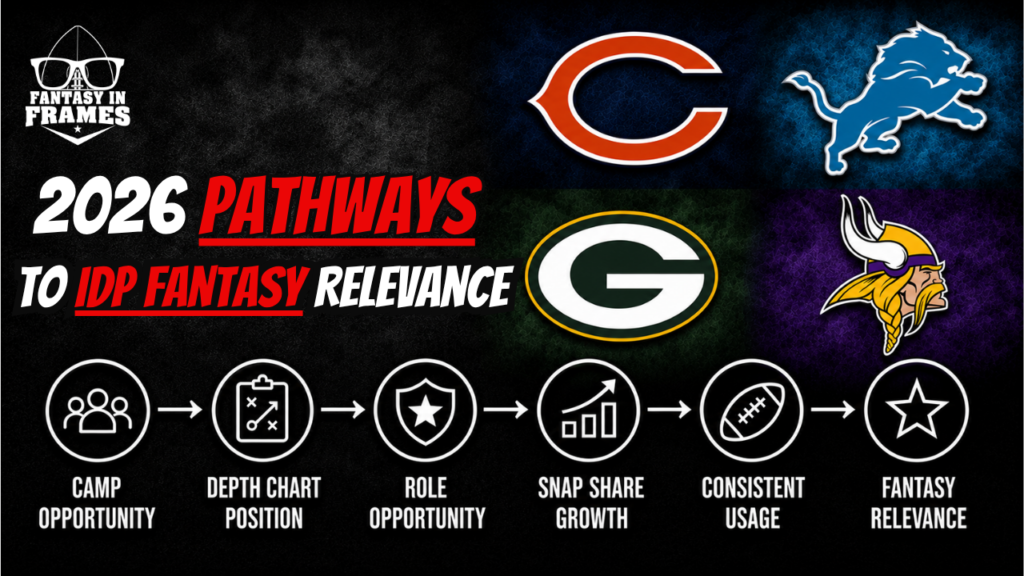
Welcome to our 2026 NFC North Pathways to IDP Fantasy Relevance breakdown, where we’ll be looking at first- through fourth-year defenders who have an opportunity to carve out fantasy relevance heading into the 2026 season.
Continuing on with the SEGA game trend, Sonic & Knuckles was one of those games that felt different before I even put it into my Sega Genesis. I got it as a reward for getting good grades and picked it out at the same video game store in the Fairfield, CA mall where I found several of the games I’ve talked about throughout this Pathways series. The first thing that caught my attention when I opened the game case in the car ride home wasn’t even the game itself; it was that weird cartridge with another cartridge slot sitting on top of it. I had never seen anything like it and didn’t know what it was.
At the time, the only Sonic game I owned was the original Sonic the Hedgehog that came with my Genesis, so naturally that was the first cartridge I tried sticking into the top. I was expecting it to somehow add Knuckles to the original game. It didn’t. Instead, I eventually figured out that I could access the Blue Sphere game, which was based around collecting blue spheres while avoiding the red ones. I got pretty damn good at it, mostly because I kept experimenting with the cartridge, trying to figure out what else this thing could do.
What I didn’t understand at the time was how ambitious Sega’s Lock-On Technology actually was. Sonic & Knuckles could combine with Sonic the Hedgehog 2 and allow you to play through that game as Knuckles, while connecting Sonic the Hedgehog 3 created the much larger Sonic 3 & Knuckles adventure. Other compatible Genesis cartridges could also unlock variations of the Blue Sphere stages. It was basically a game cartridge that could change depending on what you plugged into it, which was completely foreign to me as a kid.
The actual game was what really pulled me into Sonic, though. Sonic & Knuckles begins in Mushroom Hill Zone and works its way through Flying Battery, Sandopolis, and Lava Reef before reaching Hidden Palace, Sky Sanctuary, and eventually the Death Egg. Players who collected the Chaos Emeralds could also reach the Doomsday, giving Sonic one final battle in space.
More importantly for me, this was the game that introduced me to Knuckles as more than just another Sonic character. Sonic and Knuckles approached levels completely differently from the games that preceded them. Sonic was built around speed and jumping, while Knuckles could glide through the air, climb walls, and break through certain barriers, opening routes Sonic couldn’t use. I immediately gravitated toward Knuckles. The dude had spikes on his fists, could climb basically anything, and could glide across huge sections of a level. As a kid, that was all I needed to know to embrace Knuckles as a character; I wasn’t sure whether he was a good guy or a bad guy.
Their stories were different, too. Sonic spends the game chasing Dr. Robotnik while Knuckles initially stands in his way because Robotnik has manipulated him into believing Sonic is the enemy. Eventually, Knuckles realizes he’s been played, but by then Robotnik’s plan involving the Master Emerald and Death Egg has already created a much bigger problem. Playing as Knuckles gives you a different perspective and different routes through several of the same environments, which made going back through the game with the other character actually feel worthwhile.
That was also probably the first time I really started paying attention to the larger Sonic story instead of simply running fast, collecting rings, and trying not to die. I started understanding who Knuckles was, why the Chaos Emeralds mattered, and what Robotnik was actually trying to accomplish. More than anything, I kept playing. Sonic & Knuckles eventually became the first Sonic game I ever beat.
That idea of different paths leading toward the same goal fits the NFC North heading into 2026. Detroit, Green Bay, Chicago, and Minnesota aren’t building their defenses the same way, and their young players aren’t all entering identical situations. Some already have starting jobs waiting for them. Others need to climb past veterans on the depth chart, find a different route onto the field, or simply wait until an opportunity opens.
That’s what made Sonic & Knuckles work so well as a game. Sonic could reach places Knuckles couldn’t, Knuckles could find paths Sonic couldn’t take, and plugging another game into the cartridge could change the experience altogether.
For IDP managers, the NFC North works much the same way. The goal is to find those young defenders before their pathway fully opens, whether that’s an immediate three-down role, an opportunity rushing the passer, snaps around the box, or a developmental player sitting behind an established starter. Sometimes all it takes is adding the right piece to completely change what you already have.
Before diving into each NFC North roster, here is a quick breakdown of the labels used throughout the article:
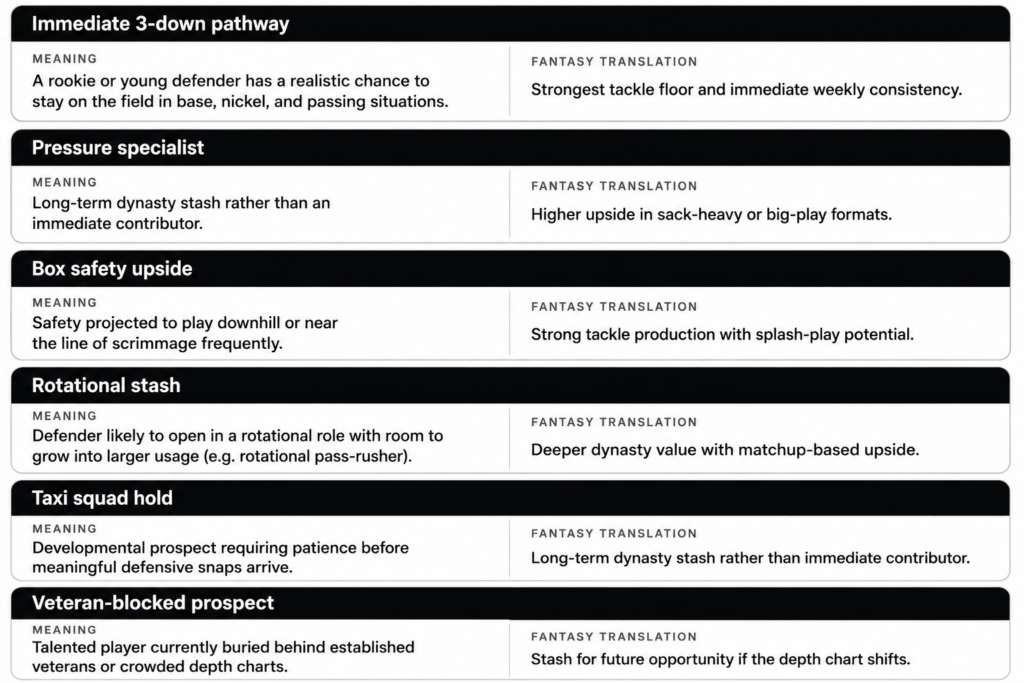
Now that we have the terminology down, let’s go down the 2026 NFC North Pathways to IDP Fantasy Relevance.
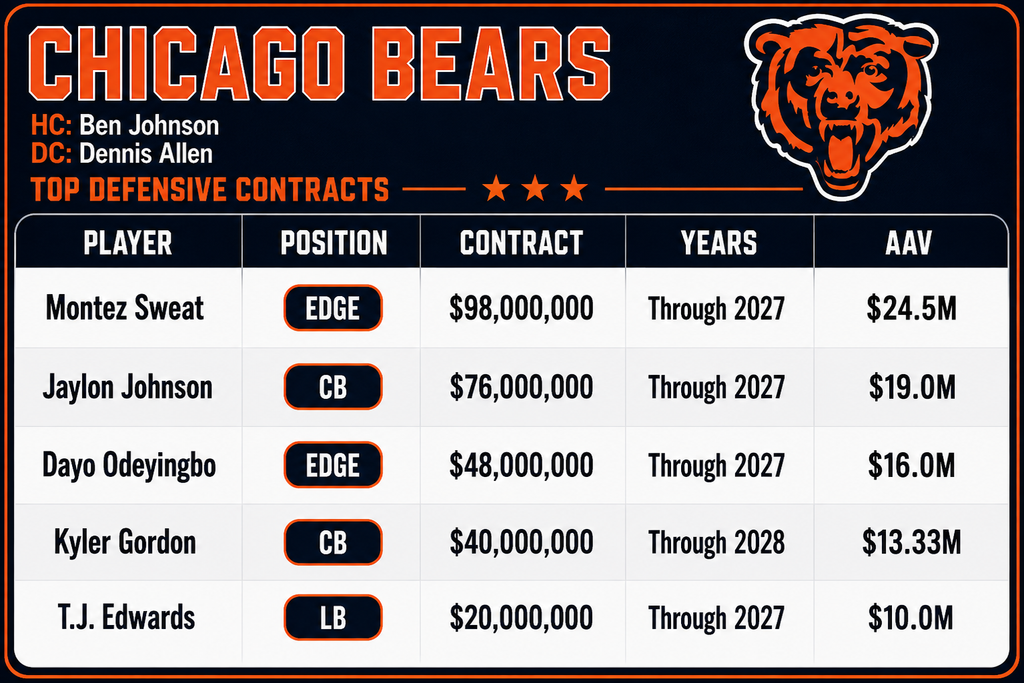
The Chicago Bears enter 2026 with a defense that is beginning to look much different than the one Ryan Poles inherited. There are still established veterans throughout the unit, but Chicago has continued to add younger pieces at every level of the defense, while losing much of last year’s secondary to free agency. Now the Bears need some of those younger investments to turn into legitimate contributors. Dennis Allen has a mixture of proven starters and developmental talent to work with, creating several interesting pathways for IDP managers heading into the season.
Chicago’s youth movement is especially noticeable on the right side of the defensive line and in the secondary. Austin Booker has an opportunity to take another step forward, while first-round safety Dillon Thieneman immediately walks into a starting job. Behind them are several recent draft picks who may not be ready for major roles yet, but could quickly become relevant if injuries or performance create opportunities.
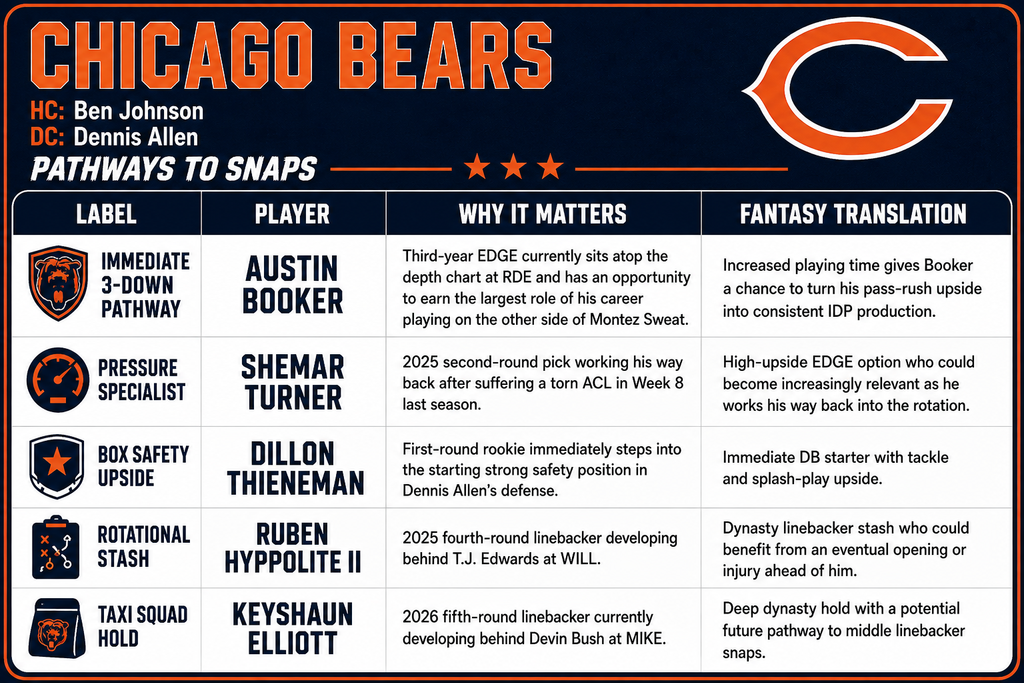
Austin Booker enters Year 3 with perhaps the biggest opportunity of his young career. The former fifth-round pick currently sits atop the depth chart at right defensive end, although Chicago has plenty of competition behind him with veteran Dayo Odeyingbo and 2025 second-round pick Shemar Turner. Booker doesn’t have the position locked down simply because his name is listed first, but the pathway is there for him to earn a substantial role opposite Montez Sweat. For IDP managers, this is the type of camp battle worth monitoring closely because a significant increase in snaps could quickly change Booker’s fantasy outlook.
Turner presents a much different situation. His second season will begin with his health being the primary concern after suffering a torn ACL in Week 8 of 2025. Chicago invested a second-round pick in him, so the long-term opportunity remains intriguing, but expectations need to be tempered while he works his way back. Once healthy, Turner has an opportunity to become another piece of the Bears’ pass-rush rotation and is worth keeping on the radar in deeper dynasty leagues.
Dillon Thieneman may have the cleanest immediate fantasy opportunity of any young defender on the roster. Chicago used a first-round pick on him and currently has him positioned as the starting strong safety. That puts Thieneman in a potentially productive spot within Dennis Allen’s defense, especially if Chicago allows him to spend significant time closer to the line of scrimmage. For IDP managers, his combination of draft capital and immediate playing time makes him one of the more interesting rookie defensive backs entering 2026.
The linebacker room offers more long-term options than immediate ones. Ruben Hyppolite II enters his second season behind T.J. Edwards at weakside linebacker after Chicago selected him in the fourth round of the 2025 NFL Draft. His current pathway is blocked, but he’s exactly the type of player worth stashing in deeper leagues because an injury or future roster change could suddenly create snaps. Rookie Keyshaun Elliott faces a similar situation after being selected in the fifth round this year. He currently sits behind Devin Bush at MIKE and will likely need developmental time before becoming a realistic fantasy option.
There are several other young Bears worth monitoring. Gervon Dexter Sr. enters Year 4 as the starting defensive tackle and remains one of Chicago’s more established young defenders. Tyrique Stevenson is also still within our first through fourth-year window and remains atop the depth chart at outside corner. Behind him, 2026 fourth-round pick Malik Muhammad II will have an opportunity to establish himself as the next man up during training camp and the preseason.
For managers playing in DT-premium or True Position leagues, sixth-round rookie Jordan van den Berg is another name to file away. He begins his career behind Grady Jarrett and isn’t someone who needs to be drafted in most formats, but his development is worth tracking given the age of the veterans currently ahead of him.
Chicago has enough established veterans that its young defenders aren’t being asked to carry the defense immediately, but several pathways are beginning to open. Booker has the opportunity right now, Thieneman has already been handed a starting job, and players like Turner, Hyppolite and Elliott could become much more interesting as their situations develop. The Bears don’t need every one of these players to hit at once, but a few successful additions could change the complexion of this defense quickly.
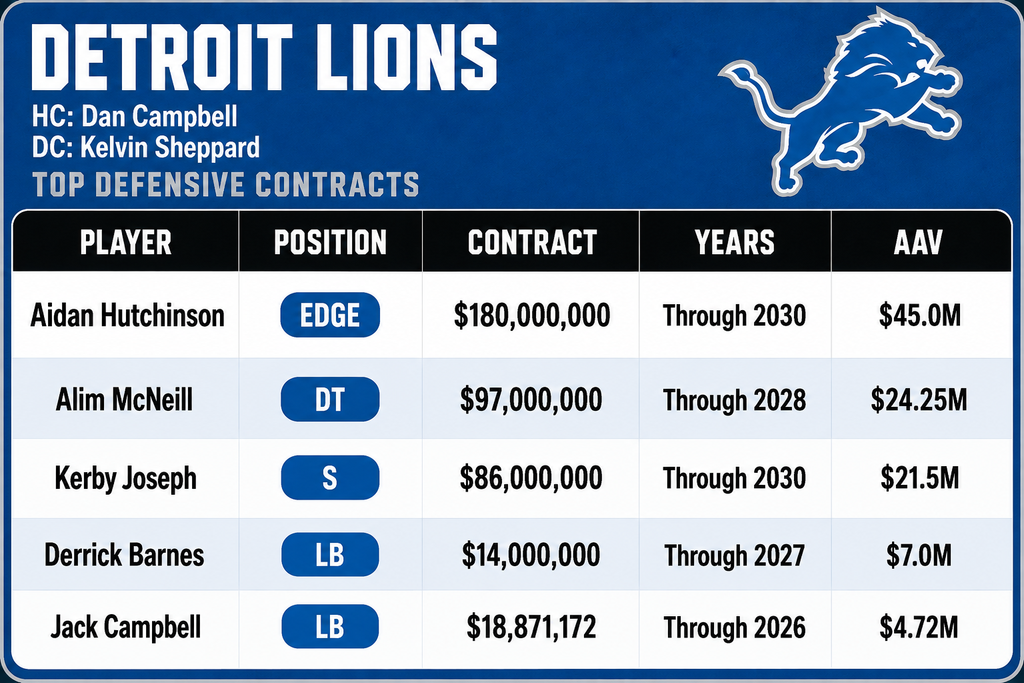
The Detroit Lions enter 2026 with a defense that already has several young players firmly established as building blocks, but injuries and another wave of draft picks have created some interesting opportunities behind them. Aidan Hutchinson remains the face of the defensive front, Jack Campbell controls the middle of the defense, and Brian Branch and Kerby Joseph have developed into two of Detroit’s most important players in the secondary. For IDP managers, the question is less about whether those players belong in lineups and more about which defenders could emerge around them.
Detroit spent another draft investing in its defense, including a second-round pick on EDGE Derrick Moore and three more selections on that side of the ball on Day 3. The secondary is also worth watching closely with Branch and Joseph working their way back from injuries. That combination gives Detroit both established IDP production and several developmental pathways that could open during training camp.
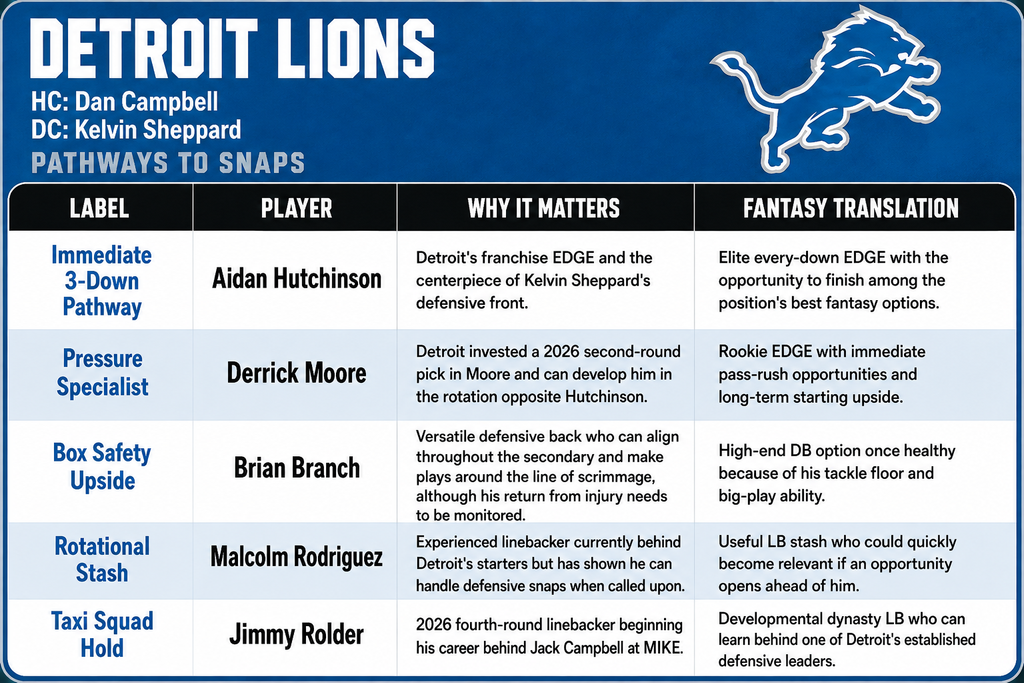
Aidan Hutchinson doesn’t necessarily need a “pathway” to fantasy relevance anymore because he has already arrived. However, he still qualifies for this series as a 2022 first-round pick entering Year 4, and leaving him out would ignore the most important young defender on Detroit’s roster. Hutchinson is the centerpiece of the Lions’ pass rush and has developed into the type of three-down EDGE that IDP managers can build their defensive lineup around. Detroit’s continued investment alongside him should only help prevent opposing offenses from consistently dedicating everything toward stopping No. 97.
One of those investments is Derrick Moore. Detroit selected Moore in the second round of the 2026 NFL Draft, and unlike Hutchinson, his pathway begins with earning his place in the rotation. D.J. Wonnum currently sits atop the depth chart at right defensive end, giving Detroit the ability to develop Moore rather than immediately forcing him into a massive workload. That doesn’t eliminate his fantasy potential. It could allow him to begin as a situational pass rusher before earning more snaps as the season progresses.
Brian Branch remains one of the most interesting defensive backs in IDP because Detroit can use him in so many different ways. He is listed at strong safety, but his value has never been limited to lining up at one position. Branch can operate closer to the box, cover from the slot and move throughout the secondary depending on what Kelvin Sheppard wants to accomplish. The immediate concern is his recovery from the Achilles injury he suffered late last season. Detroit has been encouraged by his progress, but his status will remain something fantasy managers need to follow throughout camp.
Kerby Joseph’s injury adds another wrinkle. His availability for the beginning of the season remains uncertain as he works his way back from a knee injury, which could force Detroit to lean further into the versatility of its secondary. Christian Izien becomes especially interesting in that situation. The fourth-year defensive back entered the league as an undrafted free agent in 2023 and has experience playing safety and nickel. Even when Branch and Joseph are both healthy, Izien’s versatility gives Detroit the option of incorporating three-safety packages rather than limiting him to a traditional backup role.
Malcolm Rodriguez provides similar insurance at linebacker. He enters Year 4 without a guaranteed three-down role, but Detroit already knows what it has in him. Rodriguez can provide relief snaps behind the starters and gives the Lions an experienced option if injuries strike the linebacker room. That makes him more valuable as a dynasty stash than his current position on the depth chart might suggest.
Detroit also added fourth-round linebacker Jimmy Rolder, who begins his career behind Jack Campbell at MIKE. There isn’t an obvious route to immediate playing time with Campbell controlling the middle, making Rolder a much better taxi-squad candidate than a redraft option. His first season should be about special teams, development, and establishing himself as Detroit’s next linebacker off the bench.
The later rounds of the draft provided several more names worth tracking. Fifth-round corner Keith Abney II currently sits behind Roger McCreary at nickel and should get plenty of opportunities during camp to show where he fits in the secondary. Sixth-round defensive tackle Skyler Gill-Howard and seventh-round EDGE Tyre West face longer climbs, but both have an opportunity to fight their way into Detroit’s defensive line rotation during the preseason.
The Lions already know who their defensive cornerstones are. Hutchinson, Campbell, Branch and Joseph have given this defense a young core that doesn’t need to be projected several years into the future. The intrigue comes from what Detroit can build around them. Moore has the draft capital to eventually become Hutchinson’s running mate off the edge; Rolder provides developmental depth behind Campbell; and injuries at safety could create opportunities for Izien and Detroit’s other defensive backs earlier than expected. For IDP managers, this is a roster where established production and the next wave of talent are beginning to overlap.
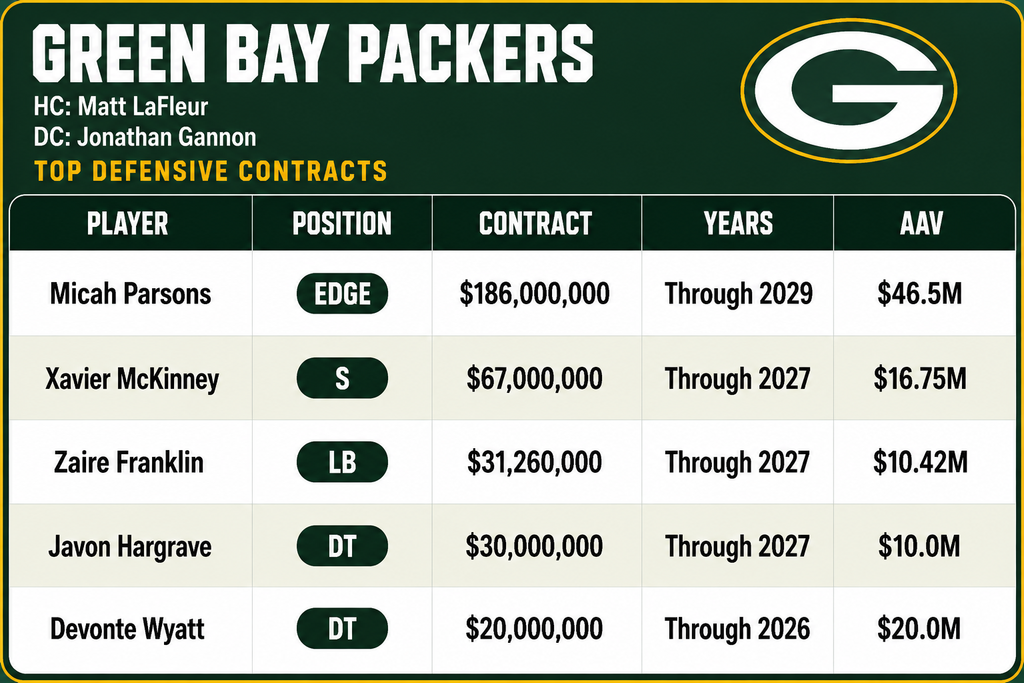
The Green Bay Packers enter 2026 with a defense that looks much different than it did just a few seasons ago. Micah Parsons now commands the attention of opposing offenses off one edge, Zaire Franklin has been brought in to stabilize the middle of the defense, and Xavier McKinney remains the veteran centerpiece of the secondary. Around those established players, Green Bay has quietly assembled one of the deeper collections of young defensive talent in the NFC North.
For IDP managers, the Packers provide several different avenues to attack. Edge rusher Edgerrin Cooper has already developed into an important part of the linebacker room, Lukas Van Ness has another opportunity to establish himself opposite Parsons, and Green Bay continues to invest draft capital in its defensive front and secondary. There may not be a single massive opening on this defense, but there are several young players whose roles could expand considerably in 2026.
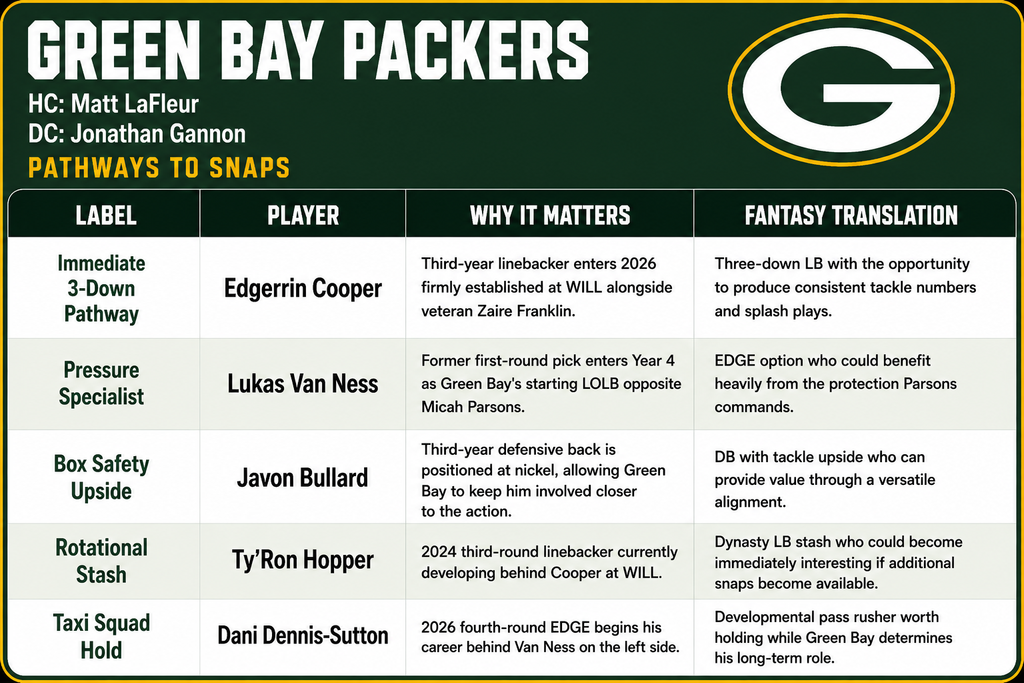
Edgerrin Cooper enters Year 3 in a much different position than when Green Bay selected him in the second round of the 2024 NFL Draft. He’s no longer a developmental linebacker waiting for his opportunity. Cooper sits atop the depth chart at WILL and now has veteran Zaire Franklin beside him in the middle. For IDP managers, the pathway is straightforward. If Cooper maintains a three-down workload, the combination of tackle opportunities and his ability to attack downhill gives him one of the better fantasy situations among Green Bay’s young defenders.
Lukas Van Ness has reached an important point in his development. The 2023 first-round pick enters Year 4 as the starting outside linebacker opposite Micah Parsons. That placement alone creates an intriguing opportunity. Offenses have to account for Parsons on every passing down, which should create situations where Van Ness sees fewer protections tilted in his direction. The Packers have waited for Van Ness to develop into a consistent edge presence, and 2026 gives him another opportunity to turn his physical talent into steady IDP production.
The secondary gives Green Bay another interesting fantasy wrinkle with Javon Bullard. Rather than lining him up as a traditional deep safety, the Packers currently have the third-year defender atop the depth chart at nickel. Xavier McKinney and Evan Williams occupy the traditional safety positions behind him. That alignment can be useful for Bullard’s IDP value because it allows him to operate closer to the football, where tackles, pressures, and other splash plays become more attainable.
Williams shouldn’t be forgotten in that equation. The 2024 fourth-round pick enters Year 3 as Green Bay’s starting free safety alongside McKinney. With Bullard working from the nickel, the Packers have three defensive backs who can be used in different ways depending on the opposing offense. Williams may not consistently play as close to the box as Bullard, but a full-time role still keeps him firmly on the radar in deeper DB formats.
Ty’Ron Hopper represents the longer-term play at linebacker. Green Bay used a third-round pick on him in 2024, but Cooper and Franklin currently occupy the primary roles ahead of him. That limits Hopper’s immediate ceiling without an injury or personnel change. However, linebackers can go from buried to fantasy-relevant quickly, making him exactly the type of player worth holding at the back of a deep dynasty roster.
The Packers also continue building their defensive line through the draft. Chris McClellan was selected in the third round this year and already sits atop the depth chart at nose tackle. His position will make him more valuable in True Position or defensive tackle-premium formats than traditional IDP leagues, but the immediate opportunity is noteworthy. Devonte Wyatt also remains an important part of the equation. The 2022 first-round pick enters Year 4 as an established starter on Green Bay’s defensive front, giving the Packers an experienced interior presence while McClellan develops next to him.
Dani Dennis-Sutton faces a different developmental path. The 2026 fourth-round pick currently sits behind Van Ness at LOLB and doesn’t need to be rushed onto the field with Parsons and Van Ness handling the primary EDGE roles. That makes Dennis-Sutton more appealing as a taxi-squad hold. His value could look considerably different a year from now depending on what happens with the veterans ahead of him.
Green Bay also invested a second-round pick in Brandon Cisse, who currently sits behind Keisean Nixon at outside corner. Cornerbacks can be difficult to stash in standard IDP formats, but Cisse’s draft capital makes him much more interesting in leagues that require the actual CB position. Training camp should provide an early indication of how quickly Green Bay wants to work him into the secondary.
The Packers have built this defense in layers. Parsons, McKinney and Franklin provide the established veteran foundation, while Cooper, Van Ness, Bullard and Williams are entering important stages of their development. Behind them, McClellan, Dennis-Sutton and Cisse represent another wave waiting for opportunities. For IDP managers, Green Bay offers both immediate production and several players worth getting ahead of before their roles become more obvious.
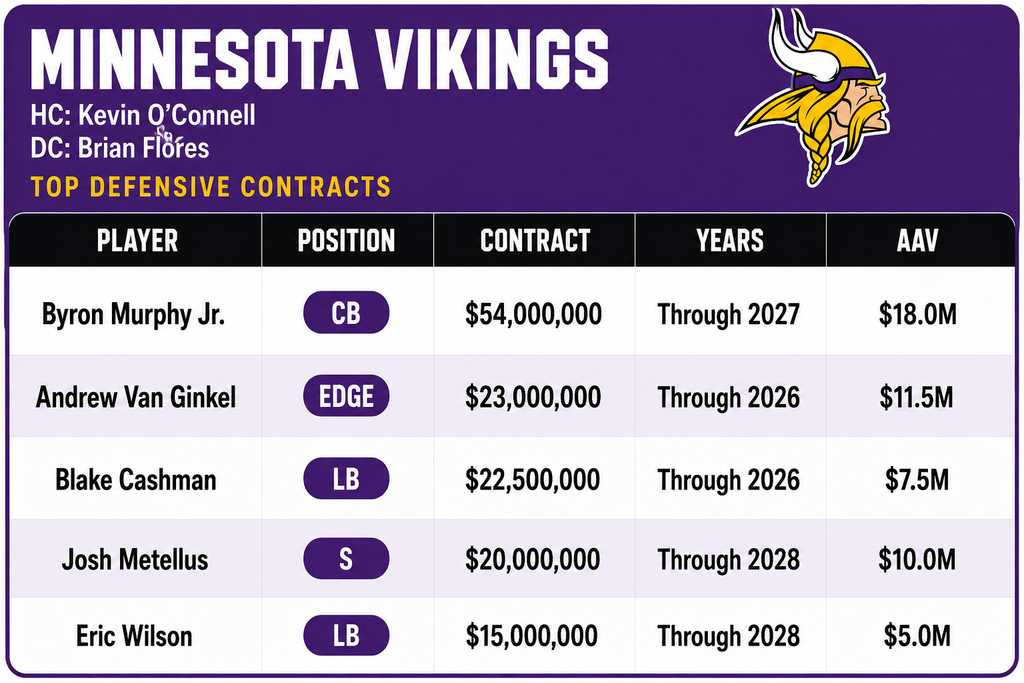
The Minnesota Vikings enter 2026 with one of the more interesting defensive groups in the NFC North because Brian Flores continues to build a defense around versatility. Minnesota has established veterans throughout the unit, but several young defenders are now being placed in positions where they can become significant pieces of the defense. Dallas Turner is entering an important third season, while Minnesota went right back to the defensive side of the ball early in the 2026 NFL Draft with Caleb Banks and Jake Golday.
For IDP managers, Minnesota is a defense where simply reading the depth chart may not tell the entire story. Flores can move his linebackers, safeties, and pass rushers around depending on the package, and Golday may be the best example of that entering 2026. The Vikings have several young defenders who can play multiple roles, creating both opportunity and some uncertainty when projecting exactly where their fantasy production will come from.
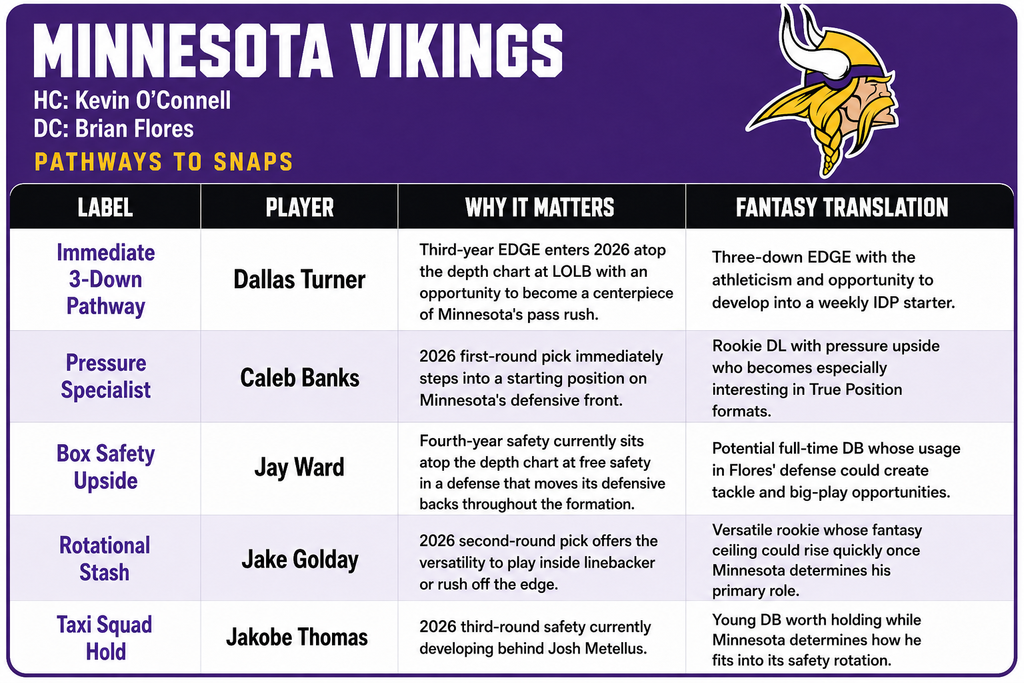
Dallas Turner enters Year 3 with an opportunity to become one of the defining pieces of Brian Flores’ defense. The former first-round pick sits atop the depth chart at outside linebacker, while Andrew Van Ginkel occupies the opposite side. Turner has already moved beyond the developmental stage where simply getting onto the field is the goal. Now the question is whether he can turn a significant workload into the consistent pressure and sack production IDP managers expected when Minnesota originally invested a first-round pick in him.
Caleb Banks gives Flores another weapon up front. Minnesota used its 2026 first-round pick on Banks and currently has him positioned as the starting defensive end. His size and alignment make him particularly interesting in True Position formats, but his value shouldn’t be limited to leagues requiring defensive tackles or interior defenders. If Minnesota allows Banks to attack from different spots along the front, there should be opportunities for him to generate pressure while Turner and Van Ginkel force offenses to account for the edges.
Jake Golday might be the most difficult young Viking to project, but that’s also what makes him interesting. Minnesota selected him in the second round this year, and while the depth chart lists him behind Blake Cashman at MIKE, his role doesn’t necessarily have to remain there. Golday can work as an off-ball linebacker or be moved toward the edge, giving Flores another defender who can disguise where pressure is coming from.
Ivan Pace Jr. factors heavily into that equation. Pace could effectively operate as Minnesota’s third linebacker behind Cashman and Eric Wilson, which could push Golday toward more of a hybrid role early in his career. That isn’t necessarily bad for Golday’s long-term value. It could actually help Minnesota get him onto the field earlier by moving him between inside linebacker and EDGE rather than waiting for a traditional starting linebacker job to open. For fantasy managers, his positional designation and snap distribution will be important to monitor throughout camp.
The secondary offers another group of movable pieces. Jay Ward enters Year 4 atop the depth chart at free safety, while Josh Metellus remains at strong safety. Ward now has an opportunity to establish himself as a larger part of a Flores defense that isn’t afraid to move its safeties around. That versatility creates some sneaky IDP appeal if Ward is consistently allowed to work closer to the action rather than living exclusively as a deep defender.
Minnesota also invested a third-round pick in Jakobe Thomas. He begins his career behind Metellus, so there isn’t an obvious immediate path to starting, but that doesn’t mean he has to remain glued to the bench. Flores’ willingness to rotate defensive backs and use different safety combinations gives Thomas a chance to earn a package-specific role while developing behind the veterans. For dynasty managers, he’s a player who makes more sense on a taxi squad than someone who needs to produce immediately.
The interior defensive line provides another rookie worth monitoring in Domonique Orange. Minnesota selected the nose tackle in the third round, and he currently sits behind Levi Drake Rodriguez. Orange may not offer much immediate value in traditional IDP formats, but his draft capital and pathway into the defensive line rotation make him much more interesting in True Position and DT-premium leagues.
Bo Richter is another name to keep tucked away. The former Air Force defender entered the NFL as an undrafted free agent in 2024 and remains behind Van Ginkel in Minnesota’s EDGE rotation. He isn’t someone fantasy managers need to prioritize, but continuing to hold a rotational spot in a Flores defense gives him a chance to see situational pass-rushing opportunities.
Minnesota’s young defensive talent fits the identity Flores has established. Turner has developed into a major piece off the edge, Banks gives the front another first-round talent, and Golday provides the type of positionless versatility this scheme can take advantage of. Behind them, Thomas and Orange give Minnesota another developmental wave. The Vikings may not always make projecting individual snap counts easy, but for IDP managers willing to follow how these players are deployed, that unpredictability can create opportunities before the rest of the fantasy market catches up.