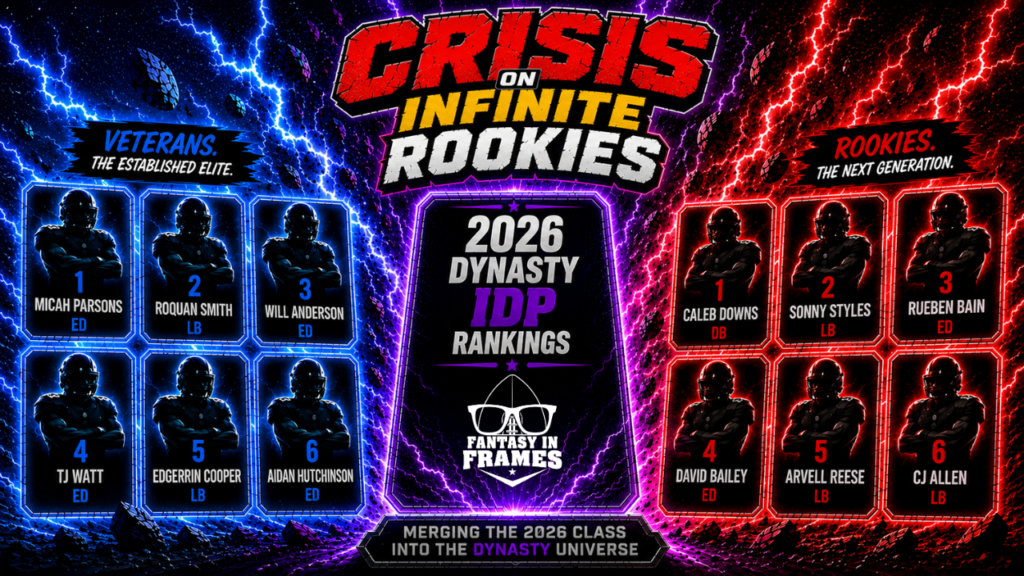
Crisis on Infinite Rookies: Merging the 2026 Class Into the IDP Dynasty Universe….enough said.
Now that we ranked the entire top 50 positional IDP groups, we decided to add “the rookies”. In Crisis on Infinite Earths, multiple universes collided into a single reality. That’s essentially what we’re doing here.
Without the benefit of snap counts, usage data, or statistical production, the rankings below represent a one-year outlook for IDP rookies. As David Bowie says on his 1977 album Heroes, “We can be heroes, just for one day.”
These rankings focus on immediate impact and rookie-year fantasy value rather than long-term dynasty projections.
For months, we’ve explored the rookie universe on its own, evaluating prospects against one another. But dynasty managers don’t draft in a vacuum. Rookies don’t just compete with other rookies—they compete with established veterans for roster spots, draft capital, and dynasty value.
Welcome to the new multiverse.
We’ve breached the Anti-Monitor’s archives and merged the rookie landscape with the larger dynasty universe, creating one reality where every player fights for their place in the rankings. Some rookies will rise. Others will disappear into the timestream. Only the strongest assets survive the crisis. Some of these projections are easier to see landing; others have floors and ceilings all over the place (this is why we left off Arvell Reese, Jacob Rodriguez, and Akeem Mesidor for now)
So grab your cosmic tuning fork, prepare for the collision of worlds, and let’s see where this year’s rookie class lands in the overall dynasty landscape.
And if you’ve enjoyed the journey through the multiverse, be sure to subscribe. We raided the Anti-Monitor’s archives to bring you the best dynasty content in any universe.
Why Sonny Styles Belongs in the Top 15 Dynasty Linebackers
You don’t need Flash to run around the world to tell you this. If you’re looking for the rookie linebacker most capable of crashing the established dynasty hierarchy, look no further than Sonny Styles.
The case for Styles starts with something dynasty managers often overlook: elite athletic traits create elite opportunity. Styles, who broke the fantasy earth at the Combine, will translate into a three-down role day one with the Commanders and serve as his team’s Green Dot. Expect 90% of snaps to enter the NFL.
That versatility showed up all over the field at Ohio State. Styles wasn’t just a tackle collector. He made plays behind the line of scrimmage, rushed the passer, covered tight ends, and operated in space like a defensive back trapped inside a linebacker’s body. In today’s NFL, those are the exact traits teams covet in every-down defenders.
The upside scenario is particularly enticing. If Styles develops as expected, you’re looking at a player capable of producing 120+ tackle seasons while also contributing impact plays as a blitzer and coverage defender. That’s the type of profile that can challenge the elite tier occupied by names like Roquan Smith, Fred Warner, and Foyesade Oluokun.
When evaluating rookie linebackers, dynasty managers often ask one question: “Can this player become a long-term LB1?” For Sonny Styles, the answer is yes. The athleticism is elite. The three-down profile is present. The age advantage is significant. And the fantasy ceiling is high enough that ranking him outside the Top 15 dynasty linebackers may actually be too conservative.
The Crisis has arrived, and Sonny Styles looks like one of the few rookies capable of surviving the merger of worlds as an immediate Top 15 dynasty linebacker.
C.J. Allen has a strong case of being a Top 24 Dynasty Linebacker
Every dynasty ranking exercise eventually comes down to one question: Are you ranking what a player has done, or what he’s about to become?
That’s where C.J. Allen enters the conversation. Granted, the team hasn’t promised him the Green Dot (not yet), but he’s playing every down and, in OTAs, is showing he’s a Leader on the field. Some teams likely don’t want to hand roles to rookies, so it’s only a matter of time.
Unlike some linebacker prospects who rely solely on athletic upside, Allen’s case is built on production, instincts, and the ability to stay on the field. Throughout his collegiate career, he consistently demonstrated the traits dynasty managers should prioritize: tackle efficiency, pursuit skills, football intelligence, and three-down potential.
The biggest predictor of fantasy success at linebacker isn’t highlight plays; it’s opportunity. Allen projects as the type of linebacker coaches trust to handle every situation. He’s comfortable playing downhill against the run, capable in coverage, and rarely looks out of place when asked to diagnose and react. Those traits create the pathway to elite snap volume, and snap volume creates fantasy points.
When projecting dynasty value, it’s important to remember that many linebackers currently ranked in the LB2 range are there because of proven production, not necessarily superior talent or long-term outlook. Allen offers something many of those veterans do not: youth, a tackle-generating ability, and the potential to grow into a centerpiece of an NFL defense.
The tackle floor is what makes the argument compelling. Allen has the skill set to become a 100-plus tackle producer annually if he secures a full-time role. In tackle-heavy scoring systems, that’s often enough to finish comfortably inside the Top 24 linebackers. Add in the possibility of increased splash plays as he develops, and the ceiling becomes even more attractive.
Dynasty managers are often willing to rank rookie edge rushers aggressively because of future potential. The same logic should apply here. Allen possesses the instincts, athletic profile, and three-down traits necessary to become a long-term fantasy starter. While he may not carry the same name recognition as some of the more hyped linebacker prospects, his pathway to LB2 production is every bit as realistic.
In a dynasty landscape where aging veterans continue to occupy valuable real estate, Allen represents the type of asset managers should be targeting before the breakout happens. The combination of youth, opportunity, and tackle upside makes a strong case that he already belongs in the Top 24 dynasty linebacker conversation. I can make the case to place him above Spillane, Carter, Queen, and Bernard types, so a top 24 seems very realistic.
When the rookie universe merges with the veteran universe, C.J. Allen doesn’t look out of place. He looks like one of the next linebackers ready to claim a permanent spot among the dynasty elite.
Anthony Hill: Top 30–40 Dynasty Linebacker Status Incoming
When evaluating Anthony Hill Jr. in a dynasty context, the conversation isn’t whether he’s talented; it’s how quickly that talent translates into full-time NFL volume. Right now, he is moving ahead of Cody Barton in OTAS, and if that stands, he could jump as high as ten more spots on this list.
In the “Crisis on Infinite Rookies” framework, Hill is one of those prospects who doesn’t just survive the merge between rookie and veteran universes… he actively pushes veterans off the map.
The argument for a Top 30–40 dynasty linebacker ranking starts with one foundational trait: three-down projection. Hill has already shown the profile of a modern NFL off-ball linebacker capable of staying on the field in all situations. His combination of speed, range, and functional explosiveness gives him sideline-to-sideline impact that defensive coordinators trust early in his career. If he gets the three-down role at mid-30, it’s more than fair; if he ends up being this team’s SAM LB, then push back to the 40 range. Seems about right.
At Texas, Hill produced like a player already operating near NFL pace. His tackle production, backfield disruption, and splash plays (sacks, forced fumbles, and interceptions) show a linebacker who is not just cleaning up plays, but actively creating them. That matters in IDP formats where volatility and big-play upside can separate LB2s from replacement-level assets.
From a dynasty lens, the key is not just ceiling; it’s pathway. Hill’s path is unusually clean for a young linebacker prospect. He has the athletic profile teams build modern defenses around, especially in schemes that prioritize speed at linebacker over traditional thumpers. That gives him multiple routes to early playing time: weak-side LB, dime linebacker, and eventual green-dot candidate if development continues. The concern is refinement, not capability. Like most young, highly athletic linebackers, Hill still has room to further develop his upside over the next few months.
Why Jeremiah Trotter Jr. and Jake Golday Belong Outside the Top 50 Dynasty Linebackers
The purpose of this exercise isn’t to rank rookies against rookies. It’s to determine where they belong in the overall dynasty universe. When veteran producers, ascending young linebackers, and rookie prospects all occupy the same reality, difficult decisions have to be made.
For Jacob Golday and Jeremiah Trotter Jr., the biggest obstacle isn’t talent; it’s opportunity.
Jeremiah Trotter Jr.
Trotter remains one of the more recognizable names among young linebackers, but dynasty value isn’t built on name recognition. It’s built on snaps, opportunity, and production.
While Trotter has shown flashes and possesses strong instincts, he has yet to establish himself as a locked-in every-down linebacker. The coverage will be a work in progress, with Alex Anzalone as the team’s Green Dot, limiting his impact on playing time. The path to elite fantasy production requires consistent snap volume, and that’s still a projection rather than a certainty. Dynasty managers are betting on what Trotter could become rather than what he currently is.
When compared to linebackers already logging 85-100% snap shares, producing triple-digit tackle seasons, or holding clear long-term starting roles, Trotter simply falls behind. The upside remains intriguing, but the floor is far less secure than many managers want to admit.
Jake Golday
Golden’s ranking comes down to uncertainty.
Like many rookie linebackers entering the league, Golden has traits worth developing, but dynasty managers must separate developmental upside from projected fantasy production. The reality is that Golden enters the NFL as a potential replacement for either Blake Cashman or Andrew Van Ginkel.
As a College prospect, Golday started his career off the edge. This kind of versatility is hard to project for. It’s possible the Vikings decide it’s cheaper to keep Cashman at linebacker than to re-sign an edge, which is expensive in today’s NFL. Despite that not being the obvious route, both possibilities could materialize when the merge happens, which is why he’s a bit lower.
That’s a difficult hurdle when competing against veteran linebackers already producing and younger players who have established roles. Dynasty managers often overvalue potential while undervaluing opportunity, and opportunity remains the lifeblood of IDP scoring.
Without a clear path to every-down snaps, Golden becomes more of a taxi-squad investment than an immediate Top 50 dynasty linebacker.
The Bottom Line
Both players have futures worth monitoring. Both could eventually outperform expectations. But dynasty rankings should be based on the probability of production rather than best-case scenarios.
When the rookie universe collides with the veteran universe, Jacob Golden and Jeremiah Trotter Jr. simply don’t have the combination of proven production, snap security, and role certainty necessary to crack the Top 50 dynasty linebackers today.
In the aftermath of the Crisis, they’re survivors—but they’re not yet among the elite.
AJ Haulcy & Dillon Thieneman: Why the DB Rookie Tier Has Top 24 Upside
In the merged dynasty universe, defensive backs are often treated like background characters: replaceable, interchangeable, and rarely worth early attention. But every so often, a rookie class produces players who force their way into the Top 24 conversation through one simple mechanism: full-time usage combined with tackle-access roles.
This year, that conversation starts with AJ Haulcy and Dillon Thieneman.
AJ Haulcy: The Hybrid Chaos Piece
A.J. Haulcy brings one of the more intriguing modern safety profiles in this rookie DB group. His value is built on alignment versatility; he’s not locked into a deep-free role that limits fantasy scoring, but instead plays closer to the box where tackles are manufactured.
That alignment matters more than raw athletic testing for IDP purposes. Box safeties live in the scoring zone: underneath routes, run support, and designed blitz looks. Haulcy’s physicality and willingness to trigger downhill give him access to consistent tackle opportunities, which is the foundation of any Top 24 DB season.
The upside case is simple: if he earns a full-time role with hybrid usage, he can function as a high-volume tackle safety with occasional splash plays. That combination is exactly how DB1 seasons are built in tackle-heavy formats.
Dillon Thieneman: The Volume Magnet
Dillon Thieneman offers a different but equally compelling path. With an empty Bears defensive back room left behind by Kevin Byard and Jaquan Brisker pure snap dominance.
Thieneman’s best trait for IDP is reliability. He profiles as a player coaches trust in every situation, which is the fastest route to 90–100% snap shares. In dynasty IDP, especially at DB, snaps are currency. Once a safety never leaves the field, tackle production naturally follows. He’s unique because he could play center fielder, and his Combine shattered all expectations
What separates Thieneman from typical “deep safety” archetypes is his willingness to insert into run fits and operate as a secondary tackler in space. Even without elite blitz usage or turnover spikes, that kind of steady involvement creates a strong weekly floor—exactly what DB2/DB1 managers chase.
Why Both Enter the Top 24 Conversation
The Top 24 DB threshold in dynasty isn’t about elite corner skills or ball production alone. It’s about predictable weekly tackle opportunities and stable snap-share projections.
Both Haulcy and Thieneman clear that bar in different ways:
- Haulcy: role versatility + box alignment = spike tackle upside
- Thieneman: full-time projection + steady involvement = tackle floor security
In a vacuum, neither needs to be an elite playmaker to matter. In IDP scoring systems that reward volume, both have realistic paths to 80–110-tackle seasons if their roles hit.
The Dynasty Reality Check
DB is the most volatile position in IDP. Veterans get displaced quickly, schemes change usage overnight, and “safe” projections often collapse.
That’s why rookie safeties with clear snap pathways matter more than pedigree. In a merged dynasty universe, Haulcy and Thieneman aren’t just rookies; they’re potential immediate entrants into the weekly starting DB pool.
And that’s all it takes to justify consideration for the Top 24.
The question isn’t whether they’re flashy. The question is whether they stay on the field.
And both profiles say: they likely will.
Camp Battle: Grant Delpit vs Emmanuel McNeil-Warren Could Unlock Top 50 Upside
Every dynasty universe has its collision point the moment where an established veteran is forced to share reality with a younger challenger who looks like the future. In Cleveland, that collision is forming in the secondary between Grant Delpit and Emmanuel McNeil-Warren.
On one side sits the proven veteran: Grant Delpit, a multi-year starter with a defined role by the previous Jim Schwartz’s defense. Delpit has already shown he can function as a high-volume tackler from the safety position, especially when deployed near the line of scrimmage. His value in IDP formats comes from stability—he’s seen both deep and box usage, but his most consistent production has come when he’s allowed to attack downhill and play as a secondary run defender rather than a pure centerfielder.
On the other side is the rookie disruptor: Emmanuel McNeil-Warren, a second-round addition the Browns clearly envision as more than a depth piece. McNeil-Warren enters the league with a profile built for modern IDP production: size, aggressiveness, and versatility to function in multiple alignments. He isn’t just competing for a roster spot—he’s competing for a defined role in sub-packages immediately.
In College, McNeil-Warren played 69% of his snaps in the box. If McNeil-Warren wins meaningful snaps quickly, he doesn’t just enter the lineup he enters the dynasty conversation as a Top 50 defensive back with immediate weekly relevance. If Delpit holds firm, he reinforces his status as a reliable DB2 anchor. Either way, Cleveland’s secondary just became one of the most important IDP battlegrounds in the rookie-veteran merger universe.
Can Any DL Rookies Crack the Top 50 Dynasty Rankings Year One?
Most likely no. But in most dynasty formats, defensive line is where hype goes to either explode or quietly fade into rotational snaps. But every so often, a rookie class produces true difference-makers who don’t need a year to “develop” because their talent forces coaches to play them immediately.
In the 2026 rookie multiverse, two names stand at the center of that debate: Rueben Bain Jr. (talent) and David Bailey (Snap appeal)
Rueben Bain Jr.: The Complete Chaos Engine
Rueben Bain Jr. is the safest argument in the entire rookie DL class for Top 50 dynasty consideration.
Bain’s appeal starts with his versatility. He isn’t a one-dimensional speed rusher who needs perfect alignment to win. He can play on the edge, reduce inside, and function as a power rusher in multiple fronts. That kind of schematic flexibility is what earns early snaps—and early snaps are what create IDP relevance.
What separates Bain from typical rookie defensive linemen is his ability to win without needing elite bend or pure athletic twitch. He plays with heavy hands, strong leverage, and a motor that keeps him involved even when the initial rush fails. That matters in dynasty formats where pressure opportunities often matter almost as much as sack totals.
The projection is simple: if Bain plays 70–85% of snaps as a rookie, he has a realistic path to low-end DL1 or high-end DL2 production immediately. That alone puts him in Top 50 dynasty territory because of how scarce consistent defensive line production actually is.
David Bailey: The Pure Pass-Rush Spike Case
David Bailey is the opposite argument but just as compelling.
Bailey is the “get to the quarterback now” profile. He wins with explosiveness, bend, and pass-rush creativity that translates directly to fantasy scoring spikes. When he wins, he doesn’t just create pressure—he creates negative plays.
The dynasty concern is less about talent and more about role translation. Bailey is the type of player who can deliver elite per-snap efficiency, but his ranking hinges on whether he becomes a true every-down defender or remains more of a situational edge specialist early in his career.
If Bailey lands in a system that allows him 600+ snaps and consistent third-down usage, the ceiling is enormous. He has the kind of pass-rush upside that can jump into DL1 territory quickly in sack-heavy formats.
The Reality Check
The risk is obvious. Defensive linemen are volatile, and rookie usage is never guaranteed. Even highly drafted edge rushers can end up in rotation-heavy roles that cap their fantasy ceiling.
The reason both players enter the Top 50 conversation isn’t just talent; it’s positional scarcity plus usage projection.
But in a merged dynasty universe where rookies are forced to compete immediately with veterans already declining in production, players like Bain and Bailey don’t need perfection. They just need snap share and pressure access.
That’s enough to crack the Top 50 conversation.
And in IDP, much like Super Girl and the Flash, respectively, the resurgence is only a matter of time, and that’s all it takes to matter.
I hope you enjoyed Crisis on Infinite Rookies: Merging the 2026 Class Into the IDP Dynasty Universe. For more action-packed adventures from The IDP Anti-Monitor, give me a follow here. To get access to our Premium IDP Content, click here.
And for more information about where the idea for this article came from, look below.