
Whether you’re a complete beginner or a seasonal fantasy football veteran looking to get into the Daily Fantasy Sports (DFS) space, this guide is built for you! At Fantasy In Frames, we aim to educate, and this guide will break down everything you need to know about DFS, including contest selection, roster construction, bankroll management, and more! This DFS Fantasy Football 101 guide will build a strong foundation and lay the groundwork for your introduction to DFS.
What is DFS?
Let’s start here. What exactly is DFS? Well, rather than drafting/selecting players for a full season, you are drafting them for that singular day. Your lineup will compete against other lineups, and depending on the contest, a person or persons will be paid!
So is it just like seasonal fantasy football, but condensed into one week?
Essentially, yes! Daily Fantasy Sports are for that particular day or week, and players earn points, just like seasonal fantasy football setups, based on their on-field performance!
Now that we have essentially defined DFS, we can move on to where you can play and the intricacies of the site.
Know Your Site
There are numerous daily fantasy sports sites out there, like Sleeper (more player prop-based), Underdog (Pick ‘ems and weekly snake drafts), FanDuel (salary cap style), and DraftKings (salary cap style). It’s important to know the site you’re playing on, so that you are aware of the gameplay, rules, scoring, etc. For this, let’s focus on DraftKings and FanDuel, since this style deviates a bit more from the traditional season-long drafting process.
On FanDuel and DraftKings, you are given a set budget to build your lineup. You have $60,000 on FanDuel and $50,000 on DraftKings. While that seems like a lot of money, the elite players at the skill positions, like RB and WR, can command around $9,000-$10,000, meaning one player could be taking up 15+ percent of your budget!
| DraftKings (Week 18) | FanDuel (Week 18) |

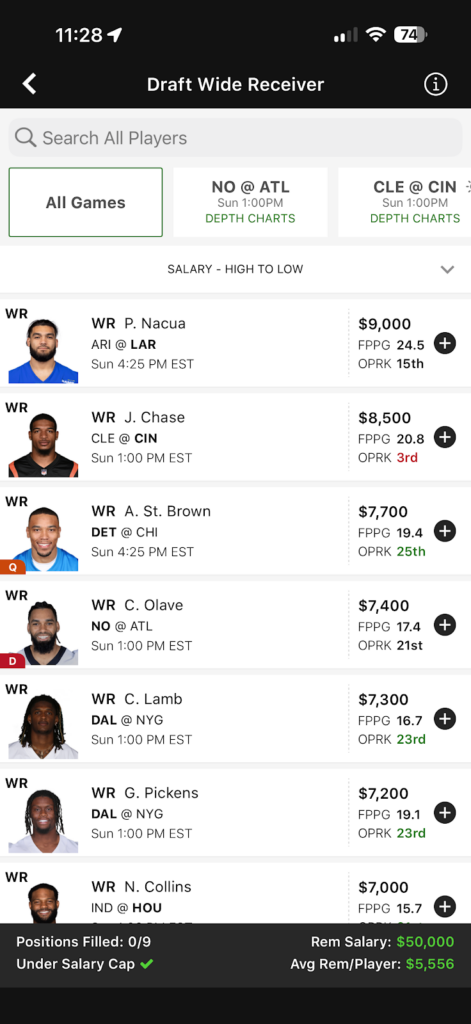
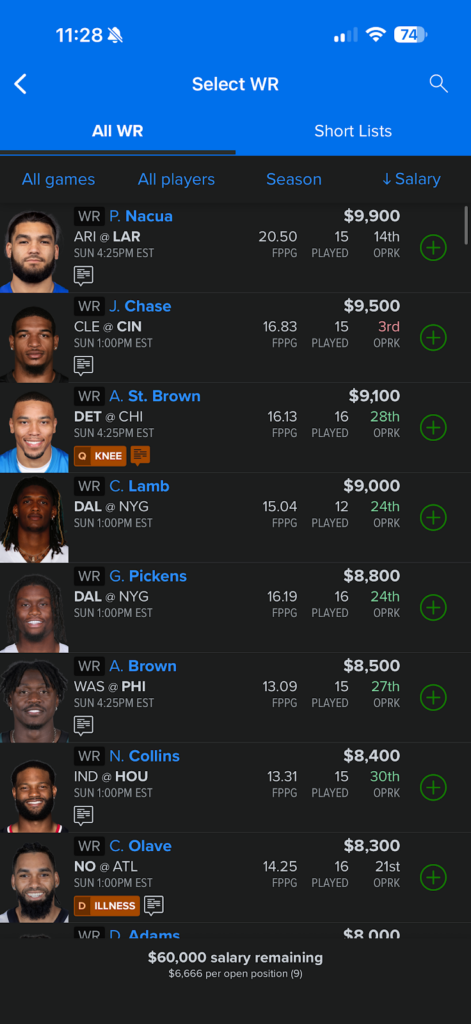
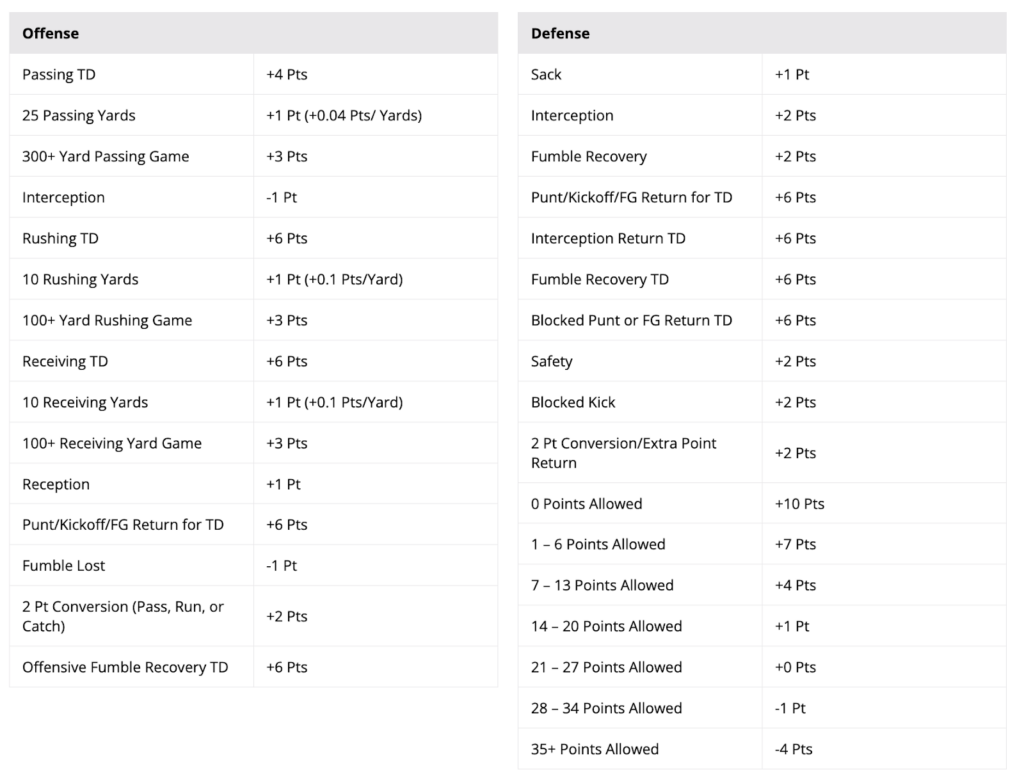
Yes, as well as the budget being two different between the two sites, players have different pricing, too. As you can see, Ja’Marr Chase is $8,500 on DraftKings (17% of budget), but $9,500 on FanDuel (15.8% of budget). Why would this be the case? Well, scoring is also different between the two sites, with one of the bigger differences being that DraftKings uses PPR scoring, whereas FanDuel is half-point per reception!
Here’s the scoring breakdown for DraftKings:

Here’s the scoring breakdown for FanDuel:

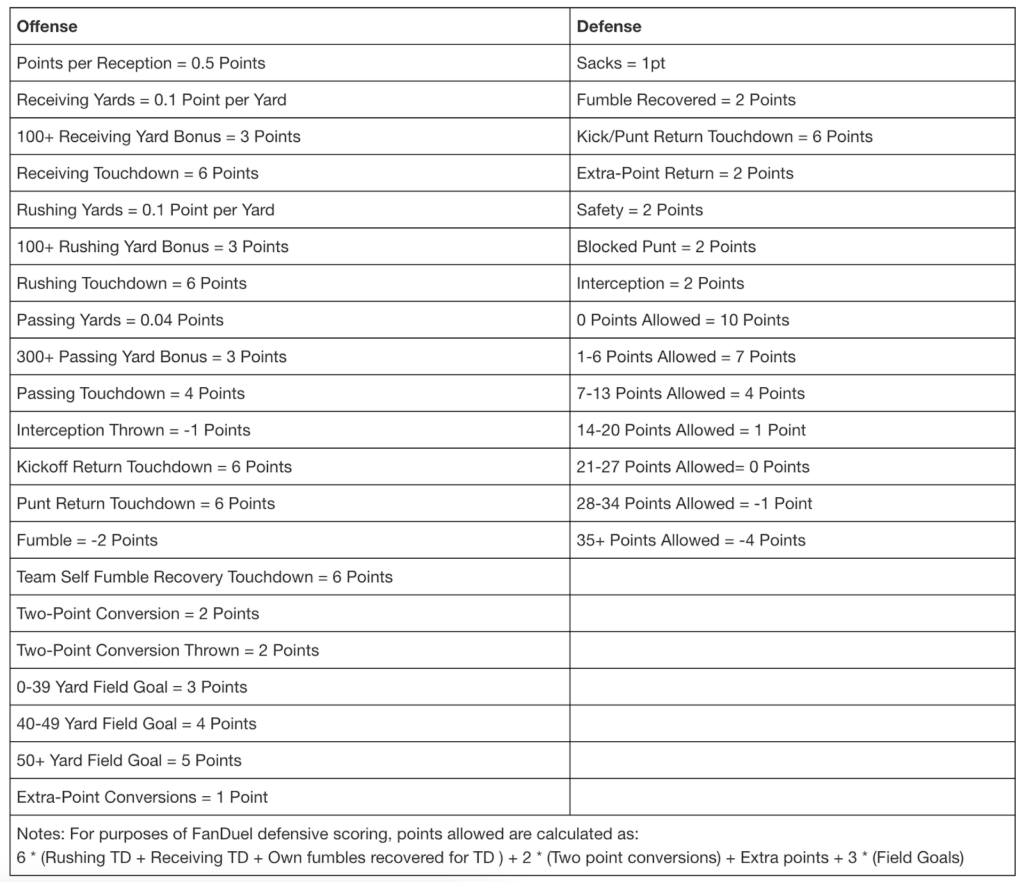
It’s not as simple as volume for receivers on DraftKings, and touchdowns for receivers on FanDuel, but you will tend to notice that big play/touchdown dependent receivers, compared to target hogs, tend to be priced down on DraftKings. For example, in Week 18, Wan’Dale Robinson comes in at $6,100 on DraftKings, higher than Tee Higgins ($6,000), Courtland Sutton ($5,900), and Christian Watson ($5,200). However, on FanDuel, Higgins ($7,400), Sutton ($7,000), and Watson ($6,600) are all priced higher than Robinson ($6,300). Understanding the nuances of the sites will help you build stronger lineups and increase your chances of finishing in the green!
The two utilize the exact lineup requirements, but due to the difference in budgets, you have an average of $5,555 per player on DraftKings and $6,666 per player on FanDuel.
Contest Selection
This is an incredibly important part of playing daily fantasy sports. The lobby will be filled with tons of contests with fun names and hyping up the big payouts. DraftKings has the Milly Maker where one lucky lineup will win a million dollars. There are plenty of head-to-head contests that aren’t as flashy or notable payouts, but they require you to beat fewer people to collect some cash. Depending on your reasons for playing daily fantasy sports, both of these types of contests can have a place in your strategy.
First and foremost, let’s dissect some of the available game types:
GPPs: Guaranteed Prize Pool contests are your giant tournaments, like the Milly Maker, as they’re large contests with fixed prize money spread among top finishers.
Cash Games: Think double-ups, 50/50s, and head-to-heads. These are better for long-term bankroll building in DFS, as payouts are typically lower, but you need to finish in/around the top half of entrants.
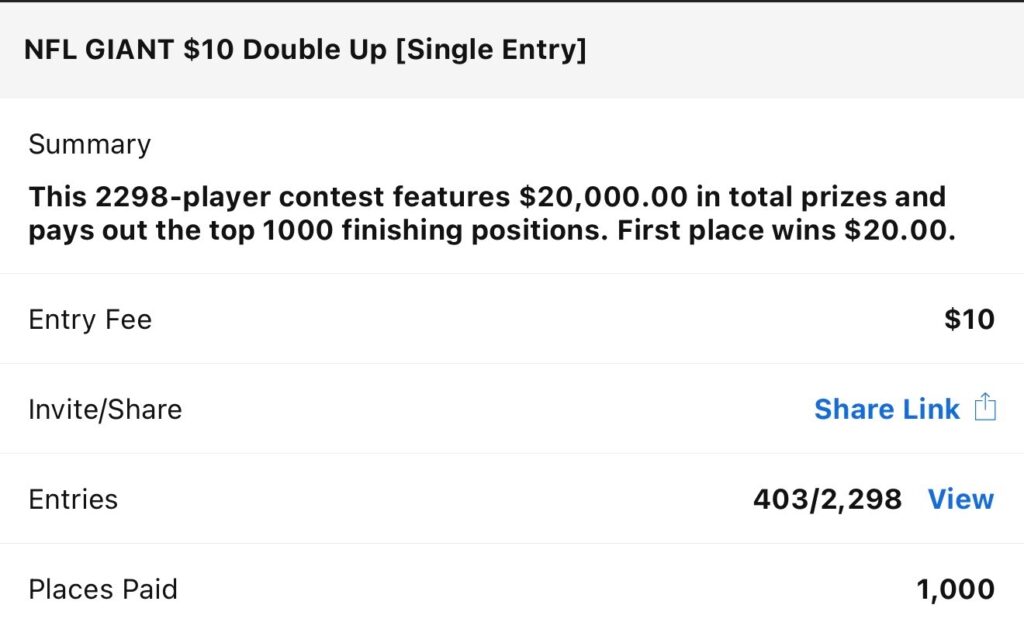
In 50/50s, the top half gets paid out, whereas in double-ups, it’s slightly less. For DraftKings’ NFL Giant $10 Double Up contest, 2,298 people will pay $10, and the top 1,000 finishers will receive $20 (top 43.5%).

There’s another key element when it comes to contest selection, and that’s related to the entry limit. No, I’m not talking about the total entries in the contest. I’m referencing how many entries a single person can make. Let’s look at the Milly Maker, where a person can enter up to 150 lineups! If you’ve heard of people complaining or referencing “lineup generators,” “lineup optimizer,” or “the computer,” it’s likely in regards to this. In these large tournaments, your one entry could be going up against someone who has 150 balls in the hopper ($3,750 total).
Yes, the big payouts are enticing, and how awesome would it be to win a million? However, simply entering tournaments is not a way to build a bankroll or achieve long-term success in daily fantasy sports. Sure, double-ups and 50/50s might be a bit boring compared to the flashy tournaments, but doubling your money by finishing in the top 50% is tried-and-true in building your bankroll. You could have a great lineup, but finishing in the top 25% doesn’t cash in some GPPs, including the Milly Maker, where only the top 20% wins money.
If you are going to play tournaments, I would recommend solely playing single-entry tournaments. This way, you aren’t competing against someone’s 10 lineups from their optimizer. Everyone has one shot to take down that particular tournament. I almost exclusively play single-entry tournaments (and contests) in daily fantasy sports.
Bankroll Management
So, with all that in mind, let’s say you deposit $100 into your account. How do you handle it? First and foremost, you shouldn’t play all $100 that week. Think of this as more of a marathon, not a sprint. I would recommend leaving money in the account, so even if everything goes wrong that week, you live to see another day. I think a good rule of thumb is no more than 20% of your budget in a given week, or, if you’re a bit more risk-averse/conservative like me, maybe 10%-15%.
So, of that $100, let’s say you are up at the 20% range, so you have $20 for the week. A common approach is an 80/20 split between cash games and tournaments. This would mean you’re playing $16 in cash games and $4 in tournaments, with an example like this:
- $5 Double Up
- $5 50/50
- $5 H2H
- $1 Double Up
- $3 Single-Entry Tournament
- $1 Single-Entry Tournament
Why is this the strategy? Well, assuming you don’t win the tournament but win all the cash games, you would net $30 ($ 10 + $9 + $9 + $2). That’s before you even calculate any potential tournament winnings!
Disclaimer: Should you find yourself or a family member struggling, most daily fantasy sports sites will have some responsible gaming resources that you can utilize.
Build Your Lineup
Alright, now it’s time to actually select the players that will hopefully lead you to money! As nice as it would be to select the best player at every position, that’s just not realistic with player pricing and your available budget. Some popular lineup strategies include:
Stars and Scrubs: Pay up for 3 or 4 elite players, and then whatever you can get after that, likely very inexpensive players who lack upside or reliable production.
Balanced Approach: Rather than dedicating, say, $25,000 to three studs to headline your lineup, you divvy that money out over four or five players. Sure, you may not have the name appeal or star power as the stars and scrubs lineup will, but you’ll likely have a “deeper” lineup overall.
Team Stack: Most lineup types, I.E. cash or tournaments, will feature a stack of sorts, usually a QB+WR or QB+TE. However, an all-out team stack lineup could look something like taking Matthew Stafford, Davante Adams, and Puka Nacua is an expected shootout.
Game Stack: These are similar to a team stack, but with an added element. In game stack lineups, you are really banking on one game to be the catalyst for the lineup. Generally, you would have multiple pieces from one side of the game, and a “bring-back” player or two on the other side. For example, if the Ravens and Bengals were playing, you might have Lamar Jackson and Derrick Henry from Baltimore (and maybe Zay Flowers), with Ja’Marr Chase, and even perhaps Chase Brown coming back.
The important thing with these lineups is that you have to tell a story. In the above, Baltimore plays with a lead thanks to Jackson, which fuels Derrick Henry’s rushing volume. On the other hand, Cincy will be playing from behind, and you have Joe Burrow’s No. 1 target and Brown, a solid pass-catcher, coming back.
Generally speaking, you chase upside when building tournament lineups, and build for a higher floor in cash games. “Ceilings win tournaments, but floors win cash games.” This mantra works for me, and maybe it will for you! Of course, I’m not saying that your cash game lineups are devoid of upside, because that won’t be the case. However, in cash games, you may not have multiple “boom-or-bust” guys, because, again, you don’t need to be in the top 10%; you need to be in the top half (or close to it).
One of the best things you can do for your success in DFS is to stay on top of injuries and reports, because that’s where you can open some real value when it comes to building your lineups. When Josh Jacobs unexpectedly went down, DFS players were gifted Emanuel Wilson at an optimal price that gave them solid expected production, but also a bunch of cash savings to fit another elite option in their lineup.
With DraftKings, pricing for the following week is set one week in advance, so exploiting pricing is key to building your lineups. If a player breaks out, DraftKings is usually a week or two behind the curve when it comes to pricing, so take advantage of that. At some point, the player will be priced appropriately, but for a week or two, you can usually get a really, really good bargain.
In terms of actual numbers, what are some things you should be evaluating? Well, their price obviously matters, because, like redraft season, you may love the player but hate the price. The same can ring true in daily fantasy sports! Furthermore, you’ll want to consider the following:
- Recent production
- This week’s matchup
- Fantasy points allowed to the player’s position
- Contest you are entering
- What’s Vegas saying? Check game total, projected winner/loser, team implied point total, player props, etc.
Generally, most of the same information you research to make your seasonal lineup decisions can be applied to daily fantasy sports, too. However, since DFS is for just one week and has the added price element, there are factors worth considering.
Conclusion
That’s DFS in a nutshell! It’s a really fun complement to playing seasonal fantasy football, but of course, do so smartly and responsibly. Long-term success in DFS comes from preparation and discipline, not from throwing money at large tournaments in hopes of hitting the big one. Understanding contest selection, lineup construction, and bankroll management are just as important as making the right choice between wide receivers or running backs in a given week! By playing within your means and focusing on sustainable growth, you’ll put yourself in the best position to have long-term success playing daily fantasy sports.
Don’t chase losses. Don’t go beyond your means. Please play responsibly, and remember, HAVE FUN!