Welcome to Personnel Matters, where I’ll be providing in-depth analysis meant to help in Finding Fantasy Football Targets Through NFL Personnel Usage for you this upcoming season!
Fantasy football research will focus on players and their stats, as well as the players who have come and gone since the team last stepped on the field. However, while the players are the ones who play, the coaches and playcallers create the structure, and within that framework, we can identify the players poised for fantasy stardom in 2026. Of course, that also means finding players whose fantasy value could take a hit.
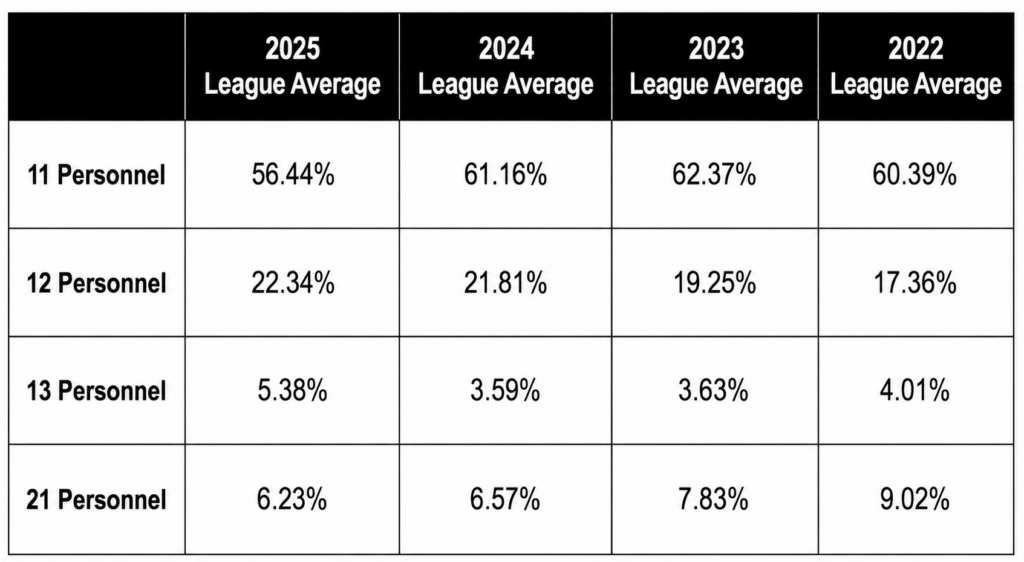
We have a few new offensive play callers around the league, but independent of the play callers, we are seeing a steady trend in personnel tendencies, headlined by Sean McVay and the Rams’ usage of 13 personnel in the 2025 NFL season. In this article, we’ll take a look at the trendline over the last four seasons and then identify some situations that fantasy football managers need to be aware of heading into fantasy football draft season. Whether you’re looking to identify the best 2026 fantasy football sleepers or breakout stars, identifying roles, personnel, and usage is crucial to hoisting your league’s trophy at season’s end.
Before we take a look at personnel usage, let’s just cover what each is before diving in:
11 personnel = 1 TE, 3 WR
12 personnel = 2 TE, 2 WR
13 personnel = 3 TE, 1 WR
21 personnel = 2 RB (usually 1 FB), 1 TE, 1 WR
Now, let’s take a look at the league average usage of these personnel packages dating back to the 2022 season, courtesy of Sumer Sports.

Wide receivers are all the rage come draft time, but we saw nine tight ends drafted in the first three rounds this year, which tied 2023 as the most in the last half-decade.

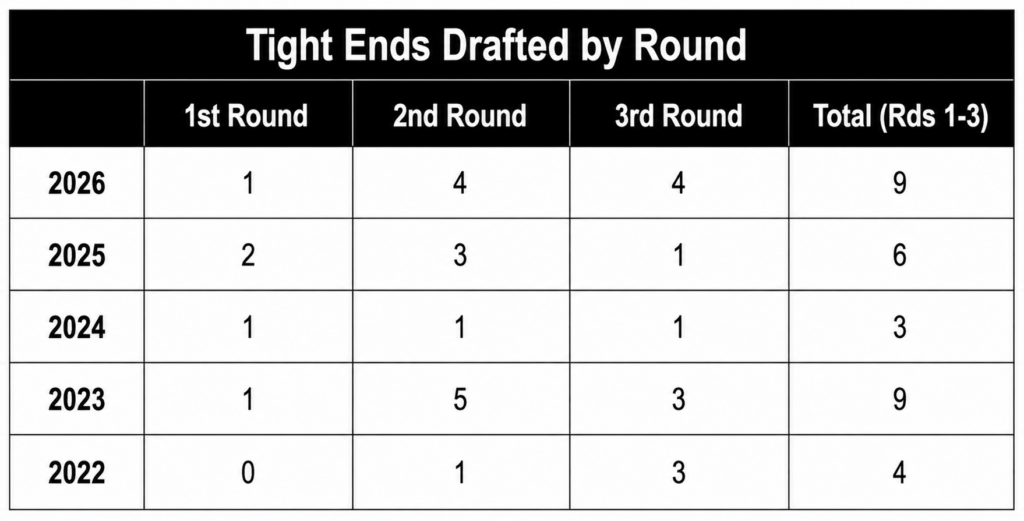
Is it a coincidence that this happened after McVay deployed 13 personnel at a high rate with ample success, and the fact that multi-TE sets have increased in recent years? Perhaps.
Is this because teams want to take advantage of teams who take a linebacker off the field for an extra safety/cornerback to deal with opposing pass offenses? Perhaps.
Is it merely a coincidence? Perhaps.
The NFL is a copycat league, so I honestly believe it’s a mix of the two. The Rams had a ton of success with it, and so did some other teams that leaned in. Other teams want to try to create mismatches on offense, and they seem to like their odds with a tight end up against a linebacker.
Ultimately, this does impact things from a fantasy perspective, and based on league tendencies and what I’m forecasting teams to do in 2026, here are some notable situations for fantasy football that could make or break your drafts.
Zay Flowers Could Have a Career Year… Again
Zay Flowers had his best season as a pro in 2025, posting career highs in receptions (86), targets (118), and receiving yards (1,211), while tying his previous career high in receiving touchdowns (5). Baltimore didn’t add any notable wide receivers to the mix, though I do like the rookies they added in Ja’Kobi Lane and Elijah Sarratt. However, Flowers is the WR1 and will far and away lead the team in targets in 2026.
Todd Monken is out, and Declan Doyle will get his first crack at calling plays for an NFL team. He worked with Sean Payton in 2023 and 2024 before serving as Ben Johnson’s offensive coordinator in Chicago last season. Doyle is on record as saying he wants to hunt explosive plays, but we’ve also seen Johnson want Caleb Williams to be great (and efficient) in the short game.
Flowers is an elite separator (3rd-highest separation score amongst WRs with at least 250 routes run last season), and he’s no stranger to big plays with Lamar Jackson. While he may not feel like a prototypical WR1, he’s exactly that in this offense, and he’ll be counted on as such.
Last year, the Bears ran 12 personnel at the sixth-highest clip in the league, per Sumer Sports, and 13 personnel at the fifth-highest rate. With Mark Andrews and Durham Smythe at the tight end spot, I’d expect Doyle to incorporate those packages at an above-average rate in his first season in Baltimore. Guess who also benefits? You guessed it! Zay Flowers!
In 12 and 13 personnel last season, Flowers posted a 10.2 average depth of target (aDOT), 0.26 targets per route run, and 2.82 yards per route run, per FantasyPoints Data. In 2024, his marks were 9.7, 0.29, and 2.59, respectively.
Flowers just feels like the type of receiver that would thrive in this offense, and a few more TDs thrown his way would easily push him into WR1 territory by season’s end.
I would be taking Flowers ahead of Tetairoa McMillan, Tee Higgins, and Garrett Wilson, all of whom are being drafted ahead of him per NFFC ADP at the time of writing.
Quinshon Judkins Could Thrive with Todd Monken
From Todd Monken’s old team to his new one! Monken will serve as the head coach and offensive play caller for the Browns in 2026, and he’s no stranger to pushing running backs to notable performances. Yes, he’s had the luxury of Derrick Henry the past couple of seasons, but even back in 2023, Gus Edwards was nearly a top-24 running back, and he had double-digit rushing TDs! Also in 2023, Justice Hill was the RB44, and Keaton Mitchell was the RB59.
As we saw during Monken’s time in Baltimore, he loves to use a fullback, and I’d expect the Browns to continue to operate in 21 personnel at a high clip this season. Michael Burton is a capable blocker, and last year, when running out of 12 personnel, Judkins posted 4.20 yards per carry, per FantasyPoints Data.
If there were any questions about whether or not Todd Monken wants to run the ball, go look at what the team did this offseason. They completely revamped their offensive line by acquiring Zion Johnson, Elgton Jenkins, and Tytus Howard, as well as drafting Spencer Fano in the first round. A strong defense, even without Myles Garrett, should keep Cleveland in close games, allowing for Judkins to receive a strong workload. Furthermore, of running backs with at least 150 carries last season, Judkins’ 1.36 yards before contact per attempt was the third-lowest mark in the league, per FantasyPoints Data. He’s elusive when he hits that second level, and a better-looking O-Line should only help him.
Early reports from OTAs are that he looks explosive, and if he’s ready to go for Week 1, he feels like a fringe RB1 this year, but he’s currently being drafted as a back-end RB2, per NFFC ADP at time of writing.
Ladd McConkey’s Rebound in 2026
After an impressive rookie season where he caught 82 balls for 1,149 yards and seven touchdowns, McConkey disappointed fantasy managers in 2025. Last year, his 0.34 fantasy points per route run was worse than DeAndre Hopkins (0.35) and Mack Hollins (0.35), per FantasyPoints Data.
However, there are some underlying numbers that point to optimism in 2026, even from his down 2025 season. His 12.2 expected fantasy points per game came in as WR29, and he posted a healthy 0.24 targets per route run against man coverage last season, per FantasyPoints Data.
Mike McDaniel comes in as the team’s Offensive Coordinator and playcaller in 2026, and so long as McDaniel sticks to his guns, we should be seeing a lot of 21 personnel from the Chargers in 2026, and the signing of Alec Ingold in the offseason essentially confirms that. Furthermore, McDaniel seems to really like what McConkey brings to the table:
Mike McDaniel on Ladd McConkey:
— Ian Hartitz (@Ihartitz) May 27, 2026
“I think he’s a guy that has some traits in his game that are similar to some very powerful, explosive, productive receivers that I’ve had in the past, namely like Julio (Jones) and Andre (Johnson) and so we’re pushing him.”
So, what does that mean for McConkey? It means that he’s going to be on the field with fewer wideouts to contend with for targets. He’s going to be out there all of the time for this offense, and back in 2024, when two or fewer wideouts were on the field, McConkey posted 3.59 yards per route run, per FantasyPoints Data!
McDaniel will also utilize a ton of motion (both pre-snap and at the time of the snap), and take a look at how McConkey has fared over the past two years, where there was motion versus when there wasn’t, per FantasyPoints Data:

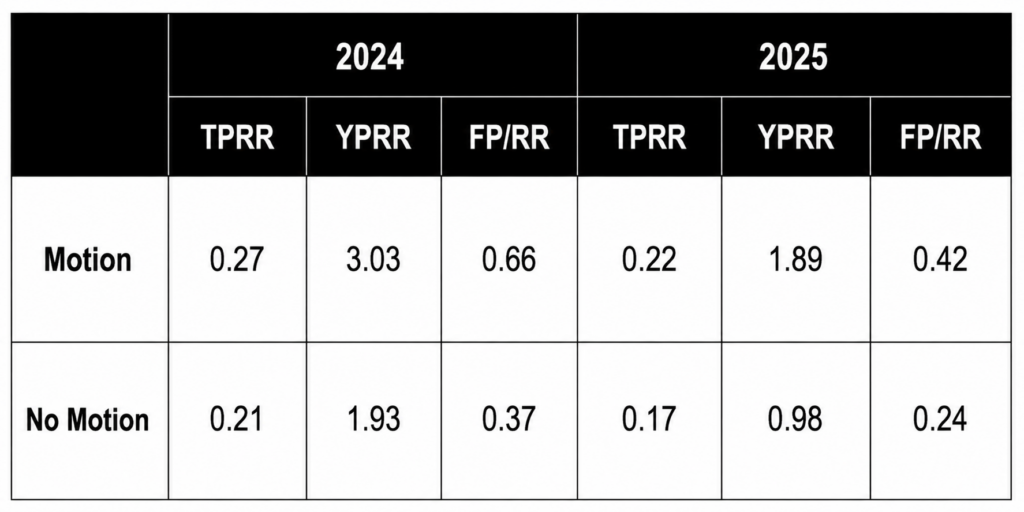
I love the talent and situation, and I can’t help but think that McDaniel will maximize everyone in this offense. It’s also McConkey’s third year in the league, and you know what they say about receivers in their third year…
What the Houston Texans’ Offseason Means for Polarizing Fantasy Assets
Recency bias will likely have people concerned for this Houston offense, and rightfully so. C.J. Stroud had a catastrophic collapse in the New England game (and postseason) to close out the season, and a porous offensive line never really allowed for much to get going. There were questions about the identity of the Houston Texans offense in 2025, but I don’t think the same can be said for 2026.
This team wants to run the ball. They’ve said it over and over and over and over and over this offseason! Furthermore, they talked the talk when it comes to wanting to be more physical and run the ball, but they walked the walk.
- They added Wyatt Teller, who has graded as a better run blocker than pass blocker in 4 of the last five seasons, per Pro Football Focus (PFF).
- They added Braden Smith, who has graded as a better run blocker than pass blocker in six of his eight NFL seasons, per PFF.
- They re-signed Ed Ingram, who had a 79.9 run block grade last year compared to a 52.4 pass block grade, per PFF.
- They added Foster Moreau, who gives them a competent blocker at the tight end spot.
- They drafted Keylan Rutledge in Round 1, who could be an option at center or one of the guard spots, and comes from a run-heavy collegiate program (Georgia Tech).
- They drafted Marlin Klein in Round 2, who Lance Zierlein said has “above-average grit” in his draft profile at NFL.com, giving the team another willing blocker at tight end.
- They traded for David Montgomery to add some power and vision to the run game.
This isn’t all by coincidence. Houston ran 11 personnel at the sixth-highest rate last season, but I don’t expect that to be the same in 2026. This is going to be a run-heavy team that will definitely utilize 12 personnel more this season, because they will be able to. They couldn’t last year, because outside of Dalton Schultz, they had NOTHING at tight end. They tried jumbo/heavy packages with Blake Fisher, but he’s shaping up to be another bust of a lineman drafted by the Texans.
They do have Cade Stover and British Brooks as options at fullback, so perhaps there’s some more 21 personnel in Houston’s future as well. Montgomery has averaged 4+ yards per carry out of 12, 13, or 21 personnel in each of the last two seasons.
That’s not the only reason, however, to be excited for Montgomery in 2026. He was particularly effective last year on man/gap concept runs, posting 5.36 yards per carry last season, per FantasyPoints Data, and Nick Caley’s offense ran these concepts at a top-7 rate in 2025.
Houston’s offensive line should be far better from a run-blocking standpoint in 2026, and Montgomery is going to be the leader in the clubhouse. Don’t just take it from me.
PHOENIX — #Texans coach DeMeco Ryans excited about new running back David Montgomery acquisition: 'I'm excited to work with him. First meeting him, he's all football. He's serious. He's locked in. He's eager for that opportunity to really be that guy, to really carry the load… pic.twitter.com/gwQRUBquEA
— Aaron Wilson (@AaronWilson_NFL) April 1, 2026
“.. be that guy.”
“..Carry the load.”
He’s the RB1 in Houston and should handle 65+ percent of the carries this season.
Now, let me caution you on one thing with the Texans. Outside of Nico Collins and Jayden Higgins, I’m not sure we can trust another wideout for fantasy purposes. Jaylin Noel could be tabbed as a breakout candidate this season, as he should be given every opportunity to win the starting slot role. However, if Houston does opt for more 12-person personnel, as I expect, he’s not getting regular playing time ahead of Nico Collins or Jayden Higgins, and the team is infatuated with Xavier Hutchinson’s blocking chops.
Noel did post an impressive 8.40 yards per route run out of 12/13/21 personnel last season, but it was on just two targets, and he ran a route on just five percent of the team’s dropbacks, per FantasyPoints Data. The upside could be there, but I’d temper expectations on a 2026 Jaylin Noel breakout.
Drew Petzing + Sam LaPorta = 2026 Fantasy Success
Drew Petzing will call plays for the Detroit Lions in 2026, and he’s no stranger to a tight-end-friendly scheme. He obviously had Trey McBride at his disposal the last three years, and even prior to McBride’s breakout 2025 campaign, he was a target hog, which seems to bode well for LaPorta!
Sure, Petzing won’t completely abandon the likes of Amon-Ra St. Brown and Jameson Williams, but his willingness to use 12 personnel will ensure LaPorta is on the field more frequently. Dan Campbell ran a lot of 11 personnel, and I’d expect Petzing to lean into more sets that utilize multiple tight ends.
Petzing and the Cardinals ran multiple TE formations at the 4th-highest rate in the league in 2025, per Sharp Football Analysis. In fact, per Sumer Sports, the Cardinals ran 12 personnel at a top-10 rate in each of the last two seasons, and 13 personnel at a top-3 rate in all three of his seasons as an OC in Arizona! Getting LaPorta on the field is key, and in multi-tight-end sets in years past, LaPorta has been really, really effective.

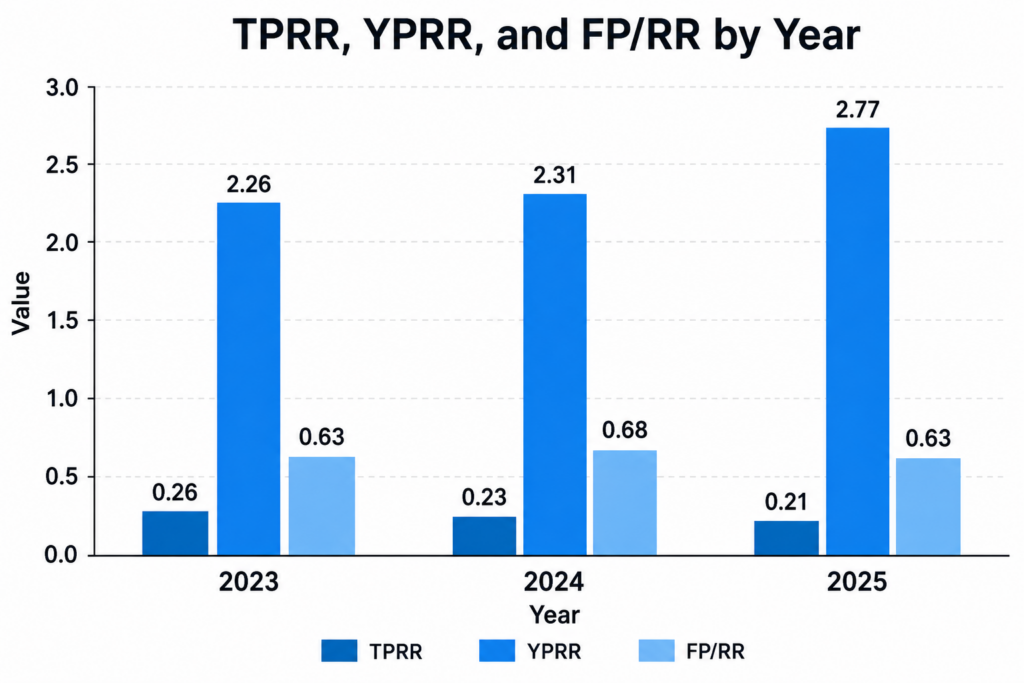
He did have offseason back surgery, which isn’t ideal, but it sounds like he should be back in pads by training camp. All signs point to him being ready for the start of the season, and while he is the TE8 at time of writing per NFFC ADP, he’s sort of being drafted in his own little tier, as he’s basically a round behind the tight end ahead of him (Kyle Pitts), and a round and a half ahead of the person behind him (Oronde Gadsden).
Jalen Nailor Emerges as Las Vegas’ WR1
Someone has to catch passes for the Raiders other than Brock Bowers and Ashton Jeanty this season, right? Right!? Why not Jalen Nailor? The team gave him $35M over three years with $23M guaranteed, and money talks, so I’d expect him to get every crack to lead this uninspiring receiver room. He’s no stranger to finding the end zone, as he’s found the end zone 10 times on just 57 receptions over the last two seasons, and for the first time in his career, he’s set for an expanded role.
Offensive mastermind Klint Kubiak comes to the Raiders this season, and his personnel usage is noteworthy, as we want, err, need to find the Las Vegas wideout who is going to stay out on the field.
When Kubiak was with the Saints in 2024, New Orleans ran 12-personnel at the sixth-highest rate, 13-personnel at the fourth-highest rate, 21-personnel at the fifth-highest rate, and 11-personnel at the second-lowest rate.
With the Seahawks in 2025, it was much of the same. Seattle ran 12 personnel at the eighth-highest rate, 13 at the 12th-highest rate, 21 at the fifth-highest rate, and 11 at the fourth-lowest rate.
In an expanded role, we could see Nailor be quite productive in 2026. He showed excellent separation numbers on the perimeter last year, actually finishing higher than Zay Flowers and Puka Nacua in that category, per FantasyPoints Data. Furthermore, he posted 2.07 yards per route run against man coverage last season, and that’s notable, given that his division features two man-happy defenses (Denver & Kansas City).
Don’t get me wrong. Nailor isn’t the flashiest pick of the bunch, but its high-floor options are key to balancing out your fantasy rosters. He’s currently being drafted as a WR6, and you could do far worse than him. How many other guys around him in ADP could see the same snap share I’m anticipating him seeing in 2026? Likely not many…
Summary
Knowing a team’s personnel usage, or likely personnel usage, is a key indicator for fantasy football success. Or, at the very least, identifying potential success factors. While many playcallers will have to adapt their scheme to the skillsets of their players, many of them have a core ideology that they won’t stray from. Identifying those core ideologies and the players who fit those best is where you can really find value in fantasy football drafts, whether it be by splitting hairs between wide receivers early on or finding the tight end that is being underdrafted.