
2026 FIVE-ROUND SUPERFLEX-IDP MOCK DRAFT

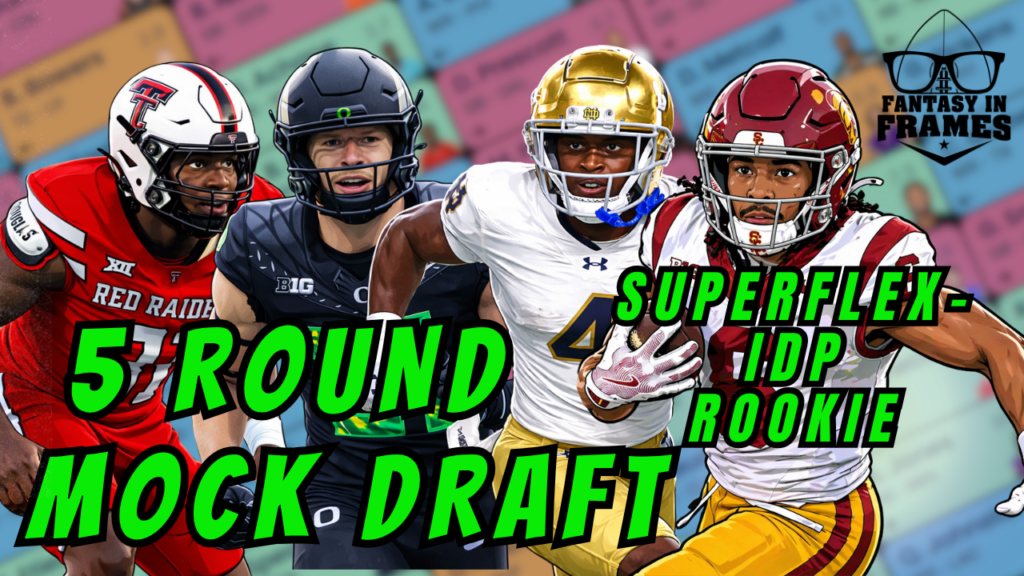
Welcome to our 2026 FIVE-ROUND SUPERFLEX-IDP MOCK DRAFT!
Every draft has two sides to it, and if you lean too far into one direction, you’re going to miss value sitting on the other side of the board. Offense is where things naturally start because positional scarcity shows up immediately in formats like Superflex, and ignoring that early usually puts you behind before the draft really gets going. At the same time, forcing IDP selections too early doesn’t really give you an advantage, because most defensive production comes from role, snap volume, and usage that aren’t always clear right away.
League scoring is what ties everything together, and it should be the first thing you’re evaluating before assigning any real value to a player in this format. A linebacker in one scoring system can carry your entire roster with tackle volume, while in another setup that same player is just filling a spot without separating from the pack, and that same principle applies across every position group.
The way this plays out across a draft is more about timing than forcing any specific approach, because you take advantage of offensive value early while it’s still clearly defined, avoid reaching on defensive players before roles become clearer, and then start attacking IDP once the board levels out and the value actually presents itself, which is usually where drafts like this are won or lost.
1.01 – Jeremiyah Love, RB (Notre Dame)
Love is considered to be one of the best offensive players in this draft class, and the production backs it up without needing to stretch anything. He carried the ball 199 times for 1,372 yards at 6.9 yards per attempt with 18 touchdowns this past season, and the year before that wasn’t far off with over 1,100 yards at the same efficiency, so this isn’t a one-year spike or a system-driven outlier.
He created a lot of that on his own in college, forcing over 50 missed tackles and averaging around 4.5 yards after contact per carry, which tells you he’s not dependent on perfect blocking to get going. The explosive plays are there too, with a breakaway rate over 50 percent, so you’re not just getting steady gains, you’re getting chunk production that flips field position.
He can handle a full workload, and even without heavy receiving usage right now, the rushing volume and efficiency give him a clear path to early production without needing everything to go perfectly around him. He’s going to be a great addition to an NFL team.
1.02 – Fernando Mendoza, QB (Indiana)
Superflex forces the issue here, and locking in a quarterback early keeps you from scrambling later when the position starts to thin out, and you’re left chasing uncertainty. The worst-kept secret in the NFL Draft is that Mendoza is going first overall to the Las Vegas Raiders. The bad news is that fantasy managers may have to wait a season before starting Mendoza, since he’ll be sitting behind Kirk Cousins and learning the ropes.
1.03 – Carnell Tate, WR (Ohio State)
This is where the receiver run starts, and while it could be any one of a few wideouts in this range, it lands on Tate because both production and usage support it. The former OSU Buckeye finished with 51 catches for 875 yards at 17.2 per reception and 9 touchdowns while catching over 77 percent of his targets, which already gives you efficiency and downfield impact in the same profile.
Over a quarter of his looks came 20+ yards down the field, where he turned 17 targets into 453 yards and 6 touchdowns while averaging over 26 yards per catch, and he was just as efficient in the intermediate range with another 70 percent catch rate and strong production. That kind of distribution tells you he’s not living off short-area volume or schemed touches; he’s being used to attack down the field and convert those opportunities at a high rate.
1.04 – Makai Lemon, WR (USC)
When you draft Lemon, you’re betting on usage and ability with the ball in his hands. Lemon is the most slippery wideout in the draft and has the ability to be a great return man in the NFL. He is effective from anywhere on the field, but will be an immediate problem out of the slot for most NFL defenses. He could be the WR1 off the board in fantasy drafts post-NFL draft if he gets a favorable landing spot.
1.05 – Jordyn Tyson, WR (Arizona State)
Another receiver comes off here because the tier still holds, but Tyson earns the spot based on how he distributes his targets and what he does with them. He saw 32 targets in both the intermediate (10–19) and short (0–9) ranges, converting 16 of those intermediate looks for 284 yards and 2 touchdowns and catching 26 of 32 underneath for 178 yards and 2 more scores, which shows he can handle volume while still producing efficiently. The catch rate sits at 50 percent in the intermediate area and jumps to over 80 percent underneath, so the production isn’t coming from one spot on the field.
His deep usage is more limited with 18 targets, but he still turned 5 of those into 170 yards and 3 touchdowns, averaging 34 yards per catch on completions, so the big-play ability is there even if the consistency isn’t. When you stack that together, you’re looking at a receiver who handled over 80 total targets across all depths, produced in each area, and didn’t rely on one type of usage to get there, which is enough to keep him in this early group without needing to project a completely different role at the next level.
1.06 – Kenyon Sadiq, TE (Oregon)
Even without a tight-end premium, getting ahead of the positional drop matters more than waiting and patching it later. Sadiq is the best tight end weapon in the class and will be in consideration around the 1.06-1.10 draft selections in rookie drafts. He’s more of an offensive weapon than a true tight end, but if he is an actual first-round draft selection, then expect Sadiq to get around 40-60+ targets in his first season.
1.07 – KC Concepcion, WR (Texas A&M)
Concepcion finished this past season with 61 receptions for 919 yards and 9 touchdowns while also adding 456 punt return yards and two scores, and that kind of all-purpose output points to a player who consistently finds ways to impact the game with the ball in his hands.
Concepcion’s profile leans into quick separation and short-area efficiency, which shows up in how he wins rather than relying on straight-line speed. He’s built to uncover early in routes, handle volume underneath, and create after the catch, and when you combine that with the production across multiple phases, it gives him a clearer path to staying involved early instead of needing a specific situation to unlock his value.
1.08 – Omar Cooper Jr., WR (Indiana)
This closes out the first round receiver run, and Cooper fits here because the production jump and role change both point in the same direction. After flashing as a big-play option earlier in his career with nearly 600 yards on just 28 catches, he moved into a heavier volume role in 2025 and responded with 37 receptions for 581 yards and 7 touchdowns through eight games while catching over 80 percent of his targets and limiting drops. That shift matters because it shows he’s not locked into one type of usage and can handle more responsibility when it’s there.
1.09 – Caleb Downs, S (Ohio State)
This is where the shift to defense begins, and we get our first IDP off the board. Downs comes off first because his DB role is a clean path to starts in the NFL, and his collegiate production already backs it up, giving you a player who can contribute right away from multiple alignments instead of being locked into one spot. DBs who are drafted early see the field faster than any other defensive position immediately after the draft, so I am expecting big things from Downs in fantasy.
1.10 – Jadarian Price, RB (Notre Dame)
There’s no need to force another IDP yet because the board still gives you value at running back, and Price fits the next tier with a path to touches. There’s no true RB2 in the draft class, but Price should be one of the first or second tier of running backs in the draft class.
1.11 – Ty Simpson, QB (Alabama)
We go back to quarterback here because the position dries up quickly depending on who you ask, and having that second option matters more than waiting too long. There isn’t a consensus QB2, but Simpson could utilize his legs in the NFL to get fantasy managers more points from the quarterback spot. He still will have to prove his worth in camp to secure a starting spot, depending on his landing spot in the 2026 NFL draft. This is a developmental pick that you may have to wait a year or two on, depending on his NFL landing spot.
1.12 – Denzel Boston, WR (Washington)
Boston lands here because the production is there without needing much projection, finishing his final season with 62 catches for 881 yards and 11 touchdowns while putting together over 1,700 yards and 20 scores across his career. The profile leans on size and contested catch ability more than separation, with consistent red zone production and success against man coverage, which gives him a clear path to early snaps, even if the ceiling depends on how much separation he can create.
Round 1 Summary: Jeremiyah Love, Fernando Mendoza, Carnell Tate, Makai Lemon, Jordyn Tyson, Kenyon Sadiq, KC Concepcion, Omar Cooper Jr., Caleb Downs, Jadarian Price, Ty Simpson, Denzel Boston.

2.01 – Eli Stowers, TE (Vanderbilt)
Stowers lands here because the production and athletic profile both translate cleanly without needing much projection. He started his career as a quarterback before transitioning to tight end, and over the last two seasons at Vanderbilt, he put up back-to-back strong years, finishing with 62 catches for 769 yards after a 50-catch, 644-yard season the year prior, earning top honors at the position along the way. That kind of growth in a short time matters because it shows how quickly he developed once he settled into the role.
His profile leans heavily toward receiving, backed by elite testing numbers for the position, including a 4.51 forty and top-end explosiveness, which lines up with how he’s used on the field. He’s moved around the formation, worked out of the slot and out wide, and consistently created mismatches against linebackers and safeties, even if the blocking side is still catching up. When you combine the production, the versatility, and the athletic ceiling, you’re looking at a tight end who can impact the passing game early without needing a full traditional role to get there.
2.02 – David Bailey, EDGE (Texas Tech)
Bailey brings proven production with 623 snaps, 380 pass-rush reps, 81 pressures, and 15 sacks, showing both volume and efficiency over a full workload, making this a bet on the role translating early. He’s the best true EDGE player in the class at the moment of the draft.
2.03 – Arvell Reese, LB/EDGE (Ohio State)
Reese handled over 650 snaps with a split between the line and the box, producing 27 pressures and 8 sacks, and that versatility creates both upside and uncertainty depending on how he’s used at the next level. The only real question is whether he will be an EDGE or a linebacker, so he could have dual eligibility for fantasy managers right out of the gate.
2.04 – Sonny Styles, LB (Ohio State)
Styles played 663 snaps, including over 450 in the box, finishing with over 70 tackles and strong stop numbers, indicating consistent involvement and a clear path to weekly production. One of the most athletic players in the draft class, he’s made a push through the draft process to become a consensus top-0 draft selection.
2.05 – Germie Bernard, WR (Alabama)
Bernard lands here because the production has followed him everywhere he’s been, and this past season at Alabama was the cleanest version of it, with 64 receptions for 862 yards and 7 touchdowns after leading the team the year prior, giving him over 2,200 career receiving yards across three programs. His profile leans heavily into the intermediate part of the field, backed by strong hands with minimal drops and a passer rating over 100 when targeted, while still showing enough downfield tracking ability and after-the-catch burst to add value beyond just chain-moving routes.
When you combine the route detail, alignment flexibility, and consistent production over time, you’re looking at a receiver who can step into an offense and stay involved without needing a very specific role to unlock his value.
2.06 – CJ Allen, LB (Georgia)
Allen fits the MIKE linebacker profile with a path to full-time snaps, and if that role hits, the tackle production will follow naturally. One of the best coverage linebackers in the draft class.
2.07 – Mike Washington Jr., RB (Arkansas)
Washington finished his lone season at Arkansas with 1,070 rushing yards and 8 touchdowns while adding 226 receiving yards and another score across 12 games. His college path wasn’t linear, with stops at Buffalo and New Mexico State before finally breaking out. At 6’1”, 223 with 4.33 speed, he brings size and straight-line burst that shows up when he gets into space, and the added receiving usage gives him a more complete profile than just an early-down runner.
2.08 – Kaelon Black, RB (Indiana)
Black produced 1,034 yards at 5.6 yards per carry with 10 touchdowns, and while the receiving role is limited, the rushing volume gives him value. He’s a guy who could work his way into an NFL role via training camp in his first season.
2.09 – Jacob Rodriguez, LB (Texas Tech)
Rodriguez fits the full-time linebacker mold and brings a steady path to snaps and production even without overly flashy traits. Still, Rodriguez is amazing at creating turnovers and has the tools needed to become a green dot linebacker at the next level.
2.10 – Malachi Lawrence, EDGE (UCF)
Lawrence projects as a penetrating edge with a strong pass-rush plan and rotational production, suggesting more upside if the role expands at the next level. He’s got the best potential in the class and will hopefully hit the ground running in the NFL, as he is one of the older prospects on the defensive side of the ball.
2.11 – Adam Randall, RB (Clemson)
Randall lands here because once Clemson fully committed to him at running back, the production followed, finishing with 814 yards on 168 carries and 10 touchdowns while adding 36 catches for 254 yards and 3 scores through the air. The background as a former wide receiver shows up immediately in how he’s used, especially in the passing game, where he’s more comfortable than most backs his size.
At over 6’3” and 230 pounds with 4.5 speed, the physical profile is different from most players in this range, and when he gets downhill, there’s enough burst to create chunk plays without needing perfect blocking. The issue right now is consistency, because the vision and pacing can get out of sync, but the combination of size, movement, and receiving ability gives him a path to value even before everything fully clicks.
2.12 – Emmett Johnson, RB (Nebraska)
Johnson closes this round because the 2025 season shows a complete workload without needing projection to fill in the gaps, putting up 1,451 rushing yards and 12 touchdowns on 251 carries while adding 46 catches for 370 yards and 3 scores through the air. The value comes from how that production is spread across both phases: he handled a full rushing load while still being heavily involved as a receiver, giving him more ways to stay on the field than backs who rely strictly on carries.
He’s not winning with elite top-end speed or power, but the consistency comes from his ability to find space, stay balanced through contact, and keep plays alive, and that combination of volume and versatility is enough to give him a clear path to early touches.
Round 2 Summary: Eli Stowers, David Bailey, Arvell Reese, Sonny Styles, Germie Bernard, CJ Allen, Mike Washington Jr., Kaelon Black, Jacob Rodriguez, Malachi Lawrence, Adam Randall, Emmett Johnson.
Round 3: Chris Brazzell II (WR, Tennessee), Kaytron Allen (RB, Penn State), Reuben Bain Jr. (EDGE, Miami), Zachariah Branch (WR, USC), Anthony Hill Jr. (LB, Texas), Max Klare (TE, Purdue), Dillon Thieneman (S, Oregon), Jake Golday (LB, Cincinnati), Elijah Sarratt (WR, Indiana), Garrett Nussmeier (QB, LSU), Chris Bell (WR, Louisville), Jonah Coleman (RB, Washington).
Round 4: Cole Peyton (QB, NDSU), Akheem Mesidor (EDGE, Miami), Malachi Fields (WR, Virginia), Skyler Bell (WR, Wisconsin), Nicholas Singleton (RB, Penn State), Antonio Williams (WR, Clemson), T.J. Parker (EDGE, Clemson), Emmanuel McNeil-Warren (S, Toledo), Cashius Howell (EDGE, Texas A&M), Josiah Trotter (LB, Missouri), Kyle Louis (LB, Pittsburgh), Zion Young (EDGE, Missouri), Michael Trigg (TE, Ole Miss).
Round 5: Bryce Boettcher (LB, Oregon), Aiden Fisher (LB, Indiana), Keyshaun Elliott (LB, Army), Kaleb Elarms-Orr (LB, TCU), Jack Kelly (LB, BYU), Eric Gentry (LB, USC), Scooby Williams (LB, Florida), Derrick Moore (EDGE, Michigan), Mason Reiger (EDGE, Wisconsin), Max Llewellyn (EDGE, Iowa State), Peter Woods (DI, Clemson), Gracen Halton (DI, Oklahoma).