Welcome to our 2026 NFC West Pathways to IDP Fantasy Relevance breakdown, where we’ll be looking at first- through fourth-year defenders who have an opportunity to carve out fantasy relevance heading into the 2026 season.
Welcome to the final installment of my NFL Pathways to Snaps series. In this article, I’ll be discussing the NFC West and one of my favorite SEGA games of all time. Streets of Rage was actually a game I tried to buy on the same day I ended up getting Comix Zone (a SEGA game I had previously mentioned in this series). I saw it at the video game store and immediately wanted it, but my mom took one look at it and decided it was too violent. So Streets of Rage stayed at the store and Comix Zone came home with me instead.
A couple of months later, though, I had a birthday party at the park, and one of my friends from school gave me Streets of Rage while we were out there playing basketball away from our parents. My mom never knew I had it, which probably wasn’t the best thing in the world, but as a kid, that also made the game feel like something I really wasn’t supposed to be playing, because I wasn’t.
I remember looking at Streets of Rage and thinking it was an adult video game. I would play it whenever my mom wasn’t home, was working, or was busy doing something else on the other side of our home in Fairfield, CA. I already loved the arcade-style side-scrollers where you just moved across the screen beating people up, especially games like Turtles in Time and The Simpsons, but Streets of Rage had a completely different feel. It was darker, the enemies felt meaner, and even something as simple as hearing guys yell when you knocked them down made the fighting feel more violent than most of the other games I had at the time.
The original Streets of Rage came out on the Sega Genesis in 1991 and followed three former police officers, Axel Stone, Blaze Fielding, and Adam Hunter. Their city had been taken over by a criminal syndicate that had corrupted much of the local government and police department, so the three of them quit the force and decided to take the organization down themselves. That simple setup was really all the game needed because from there you were basically fighting your way across the city, one group of enemies at a time, until eventually reaching the syndicate’s leader, Mr. X.
The game was built around eight stages, and the environments were a big part of its personality. You weren’t fighting through the same background over and over again. You moved through city streets, industrial areas, a beach, a bridge, a factory, and eventually deeper into the syndicate’s territory. The characters and enemies were all made from 2D sprites, but the artwork did a really good job of making the city feel bigger than it actually was. The neon signs, nighttime backgrounds, and different enemy designs gave it that gritty arcade look that made it stand out from something like Sonic, which was obviously much brighter and more cartoonish.
The three playable characters weren’t just different sprites either. Axel was the more balanced fighter, Adam brought more power, and Blaze was quicker and better in the air. You could punch, kick, grab, and throw enemies while also picking up weapons and other items throughout the stages. Pipes, bats, knives, and whatever else you could get your hands on made clearing a screen a little easier, and that was always one of my favorite parts of these games. You’d be fighting normally, and then suddenly somebody dropped a weapon, and the whole fight changed.
One of the coolest features of the game was the characters’ special attacks. Even though the characters had left the police force, you could call in backup and have a police vehicle unleash a huge attack onto the screen. It was basically your emergency button when too many enemies were surrounding you. Between that, the weapons, health pickups, and two-player co-op, Streets of Rage felt like one of those arcade machines that you could finally play at home without pumping quarters into it.
That’s also why I think Streets of Rage works so well for the NFC West. We’re looking at four defenses that aren’t necessarily built the same way, just like Axel, Blaze, and Adam didn’t fight the same way. Some of these young defenders are already starting and have their role figured out, while others are buried behind veterans and waiting for their chance to get onto the screen. There are first-round picks who should be ready to fight immediately, developmental players who might need another year, and some deeper names who could eventually become useful if the opportunity opens up.
As we work through Arizona, Los Angeles, San Francisco, and Seattle, we’re basically doing the same thing I did every time I secretly put that cartridge into my Sega: pick a fighter, see what they can do, and start clearing the screen.
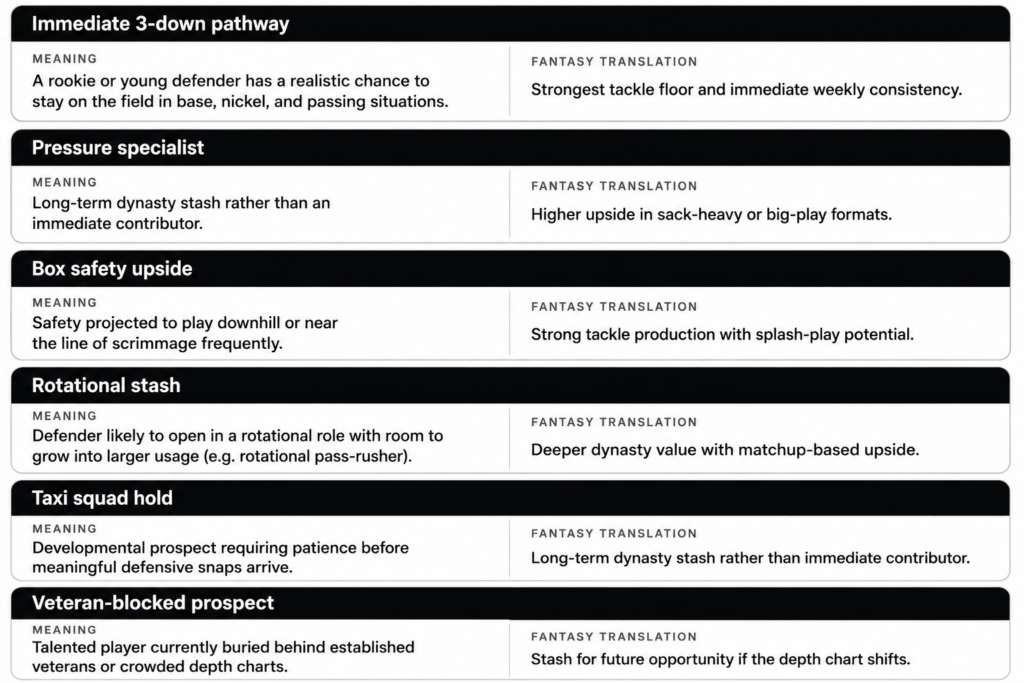
Before diving into each NFC West roster, here is a quick breakdown of the labels used throughout the article:

Now that we have the terminology down, let’s go down the 2026 NFC West Pathways to IDP Fantasy Relevance.
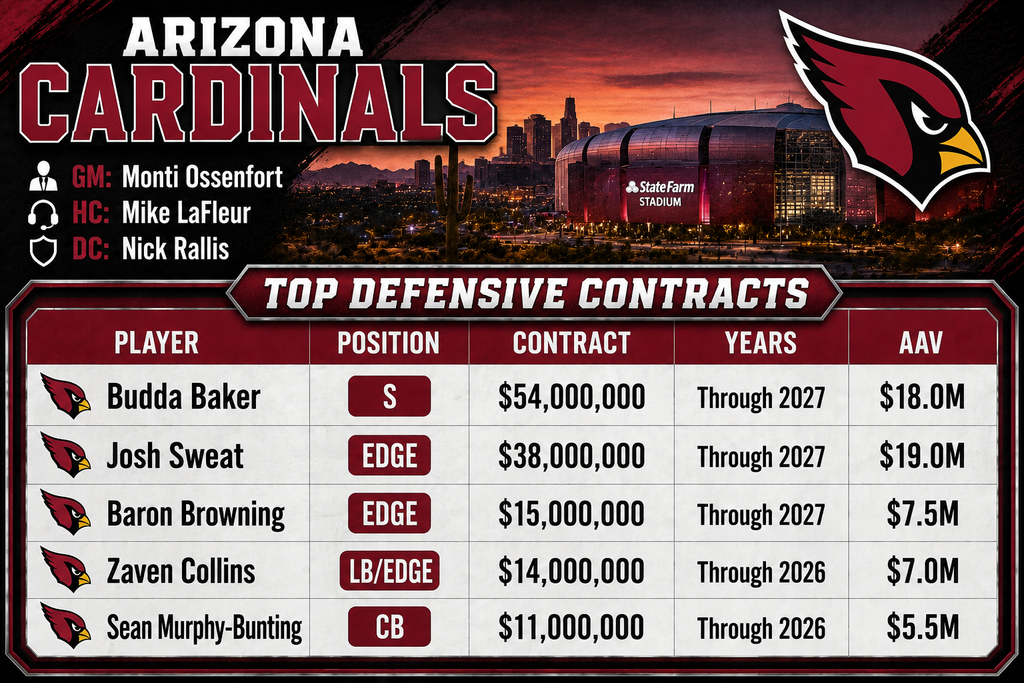
The Arizona Cardinals enter 2026 with more uncertainty than almost any team in the NFC West. Arizona is widely expected to sit near the bottom of the division, and after another rough season, there are very few defensive jobs that should be viewed as completely untouchable. For IDP purposes, though, that uncertainty creates opportunity. A new head coach in Mike LaFleur and another year under Nick Rallis give Arizona a chance to reset the structure of this defense, while several first- through fourth-year defenders are positioned to fight for meaningful roles.
That makes the Cardinals one of the more interesting teams in this series despite the low expectations. Cody Simon has a legitimate chance to establish himself at linebacker, Walter Nolen III and Darius Robinson give Arizona two recent first-round investments along the defensive front, and the secondary is filled with young players battling for starting jobs and rotational work. There may not be many proven fantasy stars outside of the veteran core, but there are enough open pathways here that one or two players could emerge much faster than expected.
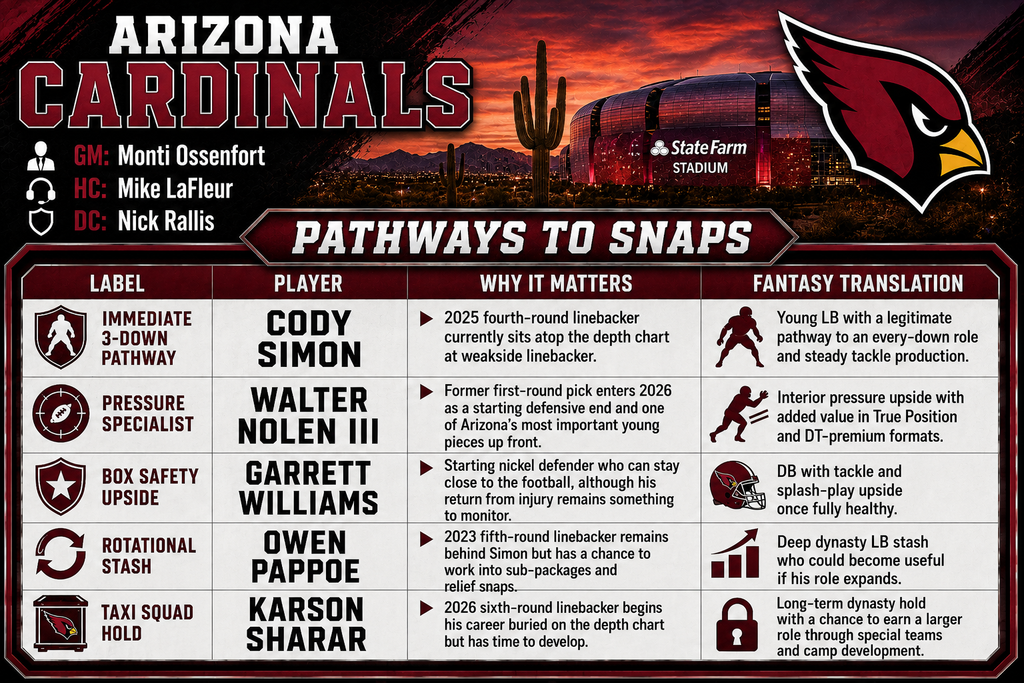
Cody Simon may have one of the clearest pathways to relevance on the entire roster. Arizona currently has him atop the depth chart at weakside linebacker, and there isn’t an established long-term player directly blocking him. That gives Simon a real chance to carve out a three-down role if he handles the responsibilities Nick Rallis gives him. On a defense that could spend plenty of time on the field, that type of opportunity can turn into steady tackle production quickly.
Walter Nolen III gives Arizona another young defender with an immediate role. The former first-round pick is already listed as the starting defensive end and should be one of the primary players Arizona leans on to create interior pressure. Darius Robinson, another recent first-round investment, starts on the opposite side and gives the Cardinals two young defensive linemen who could eventually become the foundation of the front. Dante Stills remains another rotational piece worth monitoring after entering the league in 2023.
The secondary is where things get especially crowded. Garrett Williams remains one of the more interesting IDP options because of his nickel alignment, but his injury recovery adds some uncertainty to the start of the season. If he returns healthy and reclaims his role, playing inside should keep him around the football enough to create tackles and splash plays. Behind Budda Baker, Kitan Crawford remains a developmental strong safety option, while Dadrion Taylor-Demerson is expected to battle Andrew Wingard for the free safety job.
Cornerback is another position where Arizona has accumulated young talent, though the hierarchy is not yet settled. Denzel Burke currently sits atop the depth chart on one side, while Max Melton remains a 2024 second-round pick still fighting for a larger role. Will Johnson also deserves attention after sliding into the second round of the 2025 NFL Draft following injury concerns. If he stays healthy, he still has the talent to push for a much larger role in a secondary that should be open to competition throughout camp.
The EDGE room could become one of the more interesting camp battles on the roster. Josh Sweat remains the veteran leader, but his injury status and offseason trade speculation add another layer of uncertainty. Behind him, 2025 third-round pick Jordan Burch and 2023 second-round pick BJ Ojulari are both trying to establish themselves as meaningful parts of the rotation. If Arizona eventually moves Sweat or simply spreads snaps around more aggressively, both players could see their fantasy outlooks change quickly.
Owen Pappoe fits better as a rotational stash than someone managers should expect immediate production from. He remains behind Simon at weakside linebacker, but he has enough experience in the system to remain useful if injuries or personnel changes open additional snaps. Karson Sharar is a much longer-term play. The 2026 sixth-round pick has several players ahead of him right now, making him a better taxi-squad option while he develops and tries to earn a special teams role.
Arizona may not have the same expectations as the rest of the NFC West, but that may actually make this one of the better teams to mine for unexpected IDP value. The Cardinals have young players competing for roles at nearly every level of the defense, and there isn’t enough established talent to close off every pathway. Simon, Nolen and Williams have the clearest immediate opportunities, while the secondary and EDGE rotation could change significantly as camp progresses. On a team with this many unknowns, opportunity may be the most valuable thing Arizona has to offer.
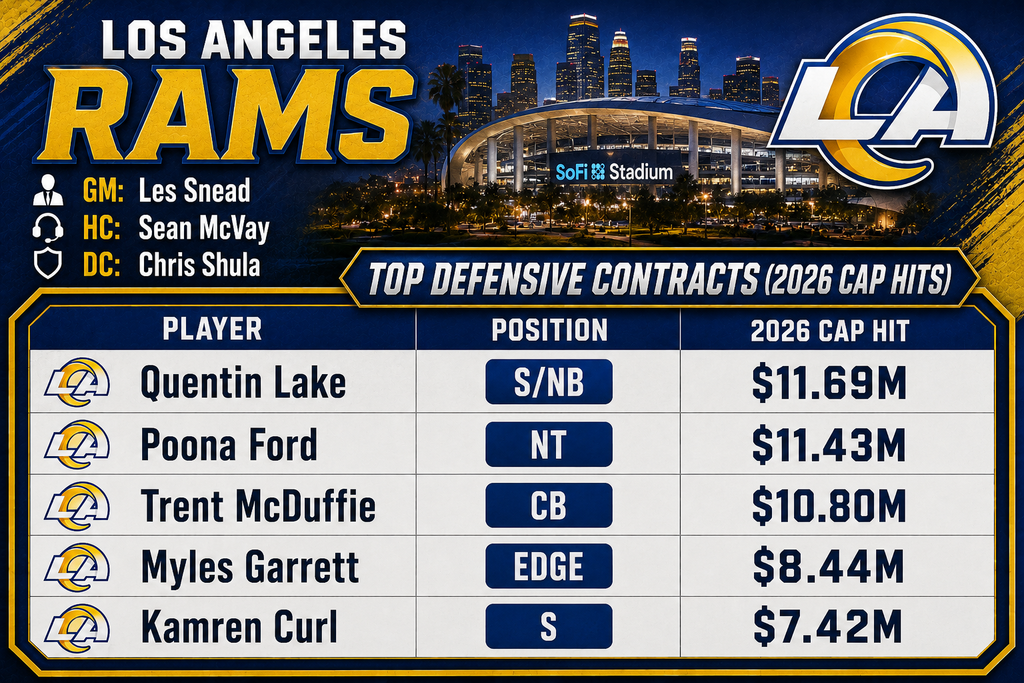
The Los Angeles Rams have undergone another major defensive transformation, but unlike some teams that are simply trying to get younger, Los Angeles has surrounded an already promising young core with serious veteran firepower. Myles Garrett completely changes the complexion of the front, while additions like Nate Landman, Trent McDuffie, and Poona Ford give Chris Shula proven players at every level. What makes this defense especially interesting for IDP managers, however, is how many of the Rams’ homegrown young defenders remain in prominent roles.
There is already a strong foundation here with Braden Fiske, Kobie Turner, Byron Young, Kamren Kinchens and Quentin Lake, but the depth chart also creates opportunities for some less established names. Linebacker is particularly interesting because the Rams have traditionally been willing to operate with a single primary inside linebacker for extended stretches. That makes the battle for snaps behind Landman important, while the arrival of Garrett could create favorable pass-rushing opportunities for Young and the rest of the Rams’ young edge group.
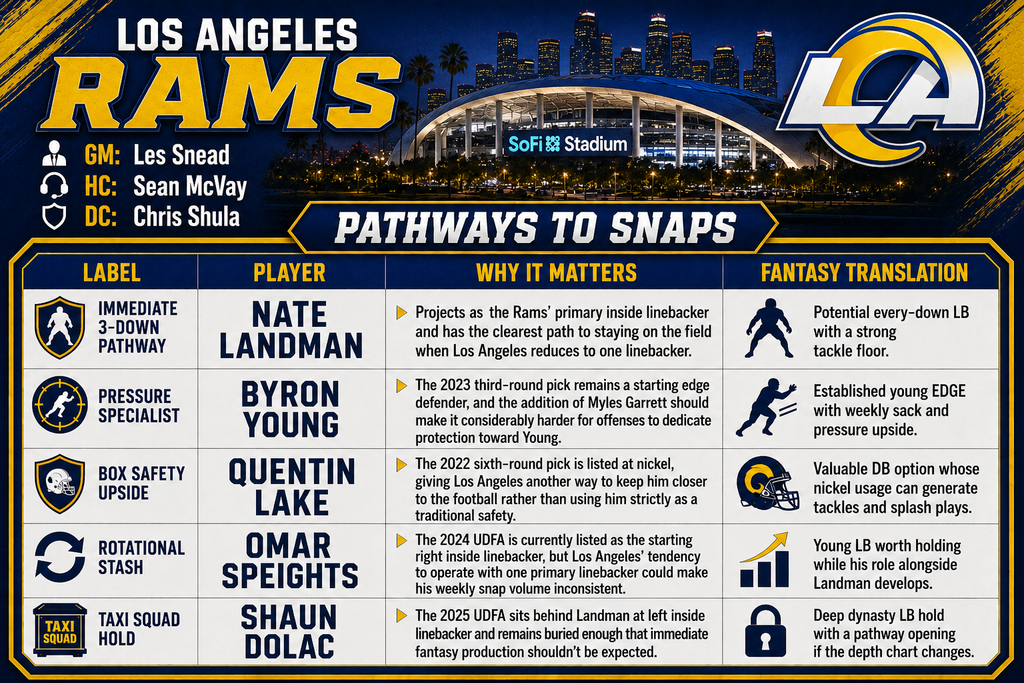
Los Angeles has built one of the more interesting combinations of veteran star power and young defensive talent in the NFC West. The arrival of Myles Garrett obviously commands most of the attention, but his presence could have just as much impact on Byron Young. The 2023 third-round pick already owns a starting role opposite Garrett, and offenses now have to determine how much protection they can realistically send toward Young’s side. Garrett is going to command attention regardless of the matchup, potentially creating more isolated opportunities for Young to attack.
The linebacker situation is where things become much more interesting for IDP managers. Nate Landman enters as the primary option on the inside and has the best pathway toward a true three-down role. Los Angeles has frequently been comfortable playing with one linebacker on the field, so simply seeing two names listed as starters on the depth chart doesn’t necessarily mean both will receive full-time workloads. If Landman becomes the linebacker who stays on the field regardless of personnel, he could quickly become a dependable tackle producer.
That uncertainty is also why Omar Speights belongs on the stash list. Speights emerged from the 2024 undrafted class and is currently listed as the starting right inside linebacker. The question isn’t necessarily whether he can get on the field, but how frequently Shula wants two traditional linebackers out there. Speights could have a meaningful defensive role without playing enough snaps to become a consistent fantasy starter. An injury to Landman or a shift toward more two-linebacker personnel would change that outlook quickly.
Shaun Dolac is even further down the linebacker hierarchy, but that’s exactly what the taxi squad category is for. The 2025 UDFA currently sits behind Landman and doesn’t need to produce immediately to remain interesting in deeper dynasty formats. With linebacker roles changing quickly due to injuries and personnel decisions, Dolac is the type of player who can be left on the taxi squad while we see how the room develops.
The defensive line shouldn’t be overlooked either. Braden Fiske could be headed toward a major season after arriving as a second-round pick in 2024. He already sits atop the depth chart at defensive end, and adding Garrett to a front that also includes Young and Kobie Turner creates considerably more problems for opposing offensive lines. Turner is especially interesting in True Position leagues because of his defensive tackle designation. Interior defenders who can generate production beyond simply eating blocks become much more valuable when DT is separated from EDGE.
The secondary gives Los Angeles another collection of young players who already have legitimate roles. Quentin Lake was only a sixth-round pick in 2022, but his development has taken him well beyond that original draft investment. With Lake listed as the starting nickel, his alignment should continue putting him around the football and give him more fantasy appeal than a safety consistently playing 15 or 20 yards off the line of scrimmage.
Kamren Kinchens is another name that shouldn’t disappear just because Lake gets our featured designation. The 2024 third-round pick currently sits atop the depth chart at free safety and remains part of the Rams’ long-term secondary. Between Kinchens, Lake, and veteran Kam Curl, Shula has enough versatility to move his defensive backs around rather than forcing each player into a single static assignment.
There are also a couple of deeper pass rushers worth watching. Josaiah Stewart, a 2025 third-round pick, is currently developing behind Young and represents one of the better dynasty stashes outside our five featured players. His immediate pathway is blocked, but that’s not necessarily a bad place for a young pass rusher when the two players ahead of him are Garrett and Young. Desjuan Johnson, the Rams’ 2023 seventh-round pick, provides additional depth on the opposite side behind Garrett. Neither needs to be a fantasy factor immediately, but both are worth monitoring if the Rams rotate their edge defenders heavily.
The Rams don’t have many easy snaps available because the top of this defense is already loaded, but that’s what makes their young players interesting. Landman has an opportunity to claim the one linebacker role we really want for fantasy, Young gets to rush opposite one of the league’s premier edge defenders, and Lake has developed from a sixth-round pick into a major piece of the secondary. Meanwhile, Fiske, Turner, Kinchens, Speights, and Stewart give Los Angeles another wave of young talent. For dynasty managers, this is a defense in which understanding the personnel packages could be just as important as understanding the depth chart.
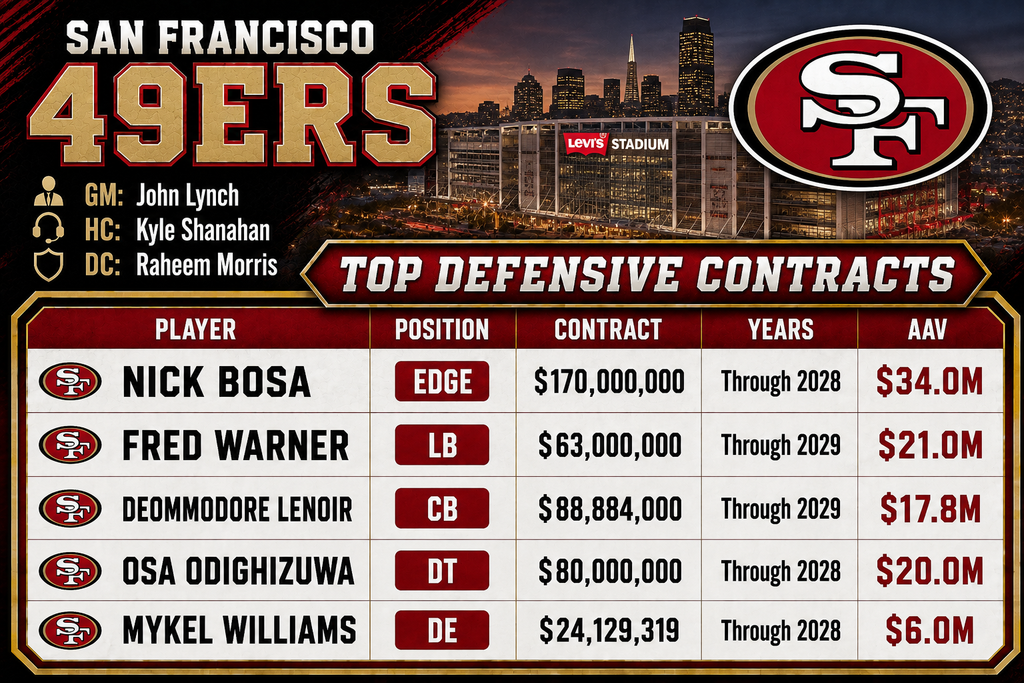
The San Francisco 49ers enter 2026 with plenty of familiar names on defense, but there has been a significant amount of turnover around them. Nick Bosa and Fred Warner remain the centerpieces, while the additions of Osa Odighizuwa and Dre Greenlaw give Raheem Morris proven veterans at multiple levels. What makes this defense particularly interesting for dynasty IDP managers, though, is how much young talent San Francisco has accumulated behind and alongside those veterans.
There are legitimate opportunities here for several first- through fourth-year defenders. Mykel Williams is still recovering from the knee injury that ended his 2025 season, creating some uncertainty along the defensive line early in the year. The 49ers also have young players pushing for work at linebacker, nickel, and safety, while multiple recent draft picks are competing for rotational snaps. San Francisco may still be built around Bosa and Warner, but there are several younger defenders worth getting ahead of before their roles become obvious.
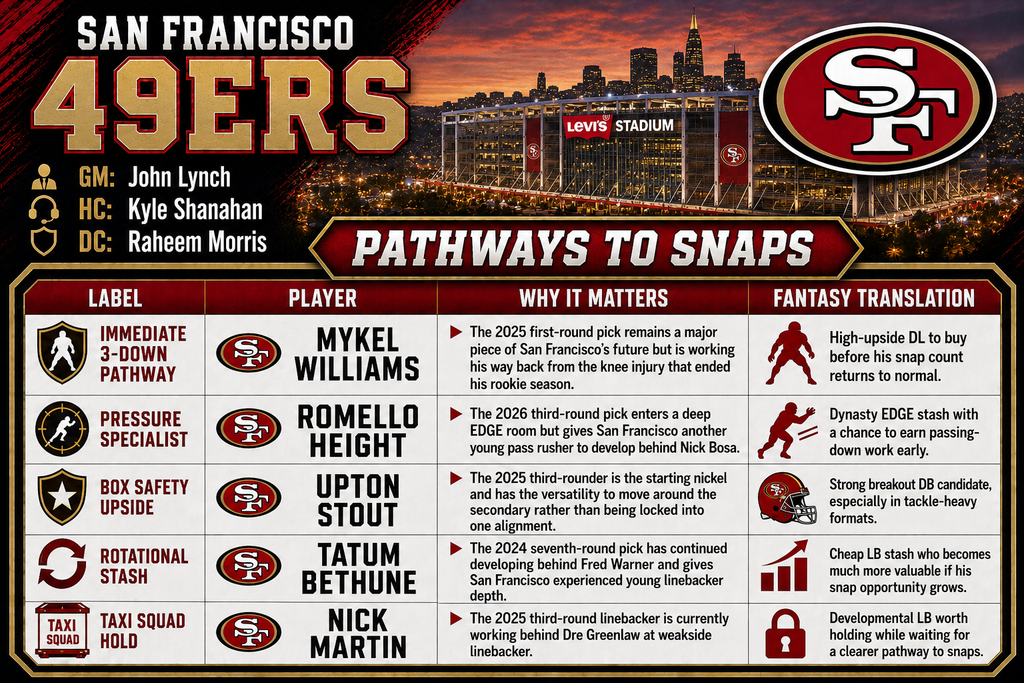
The biggest question among San Francisco’s young defenders is Mykel Williams. The 2025 first-round pick tore his ACL and lateral meniscus during his rookie season and has spent the offseason working his way back. He opened training camp on the PUP list, making his early-season availability something dynasty managers need to follow closely. The injury clouds the immediate projection, but it doesn’t change why San Francisco invested a first-round pick in him. Once healthy, Williams has the clearest pathway among the team’s young defensive linemen to becoming a three-down fixture opposite Bosa.
That uncertainty could also create opportunities elsewhere. Romello Height is one of the more interesting names to watch after San Francisco invested a third-round pick in him in 2026. Height doesn’t need to immediately become an every-down defender to matter. With Bosa commanding attention and Williams working his way back, there is an opportunity for Height to carve out a passing-down role. If he can turn those rotational snaps into pressure production, his role could continue growing throughout his rookie season.
Upton Stout might be my favorite breakout candidate on this entire defense. The 2025 third-round pick enters Year 2 as the starting nickel, but simply calling him a nickel doesn’t really describe what San Francisco can do with him. Stout has the versatility and physicality to be moved around the back seven, allowing Morris to use him closer to the line of scrimmage, in coverage or as part of different pressure looks. That type of role is exactly what we look for in IDP leagues because it keeps a defensive back around the football. If the 49ers truly unleash that versatility this season, Stout could be a beast for fantasy managers.
The linebacker room gets more complicated behind Warner and Greenlaw. Tatum Bethune has quietly developed into a player worth keeping around after entering the league as a seventh-round pick in 2024. He’s still blocked from a clear every-down role, but linebacker situations can change quickly, and Bethune has done enough with his opportunities to remain interesting. Nick Martin is in a similar situation. The 2025 third-rounder currently sits behind Greenlaw at weakside linebacker, which makes him difficult to project for immediate fantasy production, but the draft investment and position make him worth a taxi-squad spot.
There is another rookie linebacker beginning to make some noise as well. Jaden Dugger, a fifth-round pick in 2026, has had a strong camp and gives Morris another versatile developmental piece. San Francisco has experimented with him in different roles, including getting him involved around the pass rush. That doesn’t necessarily mean he’s suddenly going to become a full-time EDGE, but it does make him somebody worth monitoring. If Morris continues moving Dugger around, his eventual positional designation could become particularly important in true-position formats.
The secondary has several more young players who shouldn’t be ignored. Malik Mustapha and Ji’Ayir Brown give San Francisco two physical safeties who can be moved between high and low alignments. Both are capable tacklers, but Mustapha’s coverage ability gives him another element that could allow the 49ers to be especially flexible with how the two are deployed. Neither has to live exclusively in the traditional strong or free safety role, which should make their weekly usage worth tracking.
Renardo Green is another young starter who already has a significant role after being selected in the second round in 2024. Behind him, 2026 fourth-round pick Ephesians Prysock brings a completely different physical profile. His length immediately stands out, and while he doesn’t need to start right away, he’s exactly the type of corner worth remembering if injuries create an opening. For managers in true-position or extremely deep dynasty leagues, that makes him a name to keep tucked away.
San Francisco still belongs to Bosa and Warner, but the next wave is already taking shape. Williams has the talent and draft capital to eventually become another centerpiece up front; Height gives them a young developmental pass rusher, and Stout could be headed toward a much larger role in the secondary. Bethune, Martin, and Dugger make the linebacker depth chart worth watching throughout camp, while Mustapha, Brown, Green, and Prysock give the secondary several young pieces with established or developing roles. For dynasty managers, this isn’t just a defense to watch for the stars at the top. There are multiple places on this roster where getting ahead of the depth chart could pay off.
The 2025 Super Bowl champions might have the most established collection of young defensive talent in the NFC West. This isn’t necessarily a group where we’re waiting around for opportunities to eventually open. Devon Witherspoon, Byron Murphy II, and Nick Emmanwori have already become important pieces of the defense, and Seattle continues to invest draft capital behind them. That makes this a pretty interesting roster for dynasty managers, with both proven young players and another group sitting behind them, waiting for their opportunity.
Mike Macdonald is also a major part of the equation. His defense allows him to move players around and create different looks, rather than asking everyone to play one position. That becomes especially interesting with players like Witherspoon and Emmanwori, who can contribute from several alignments. Add in some deeper names like Bud Clark, Julian Neal, and Deven Eastern, and Seattle has several different levels of dynasty value depending on how deep your league goes.
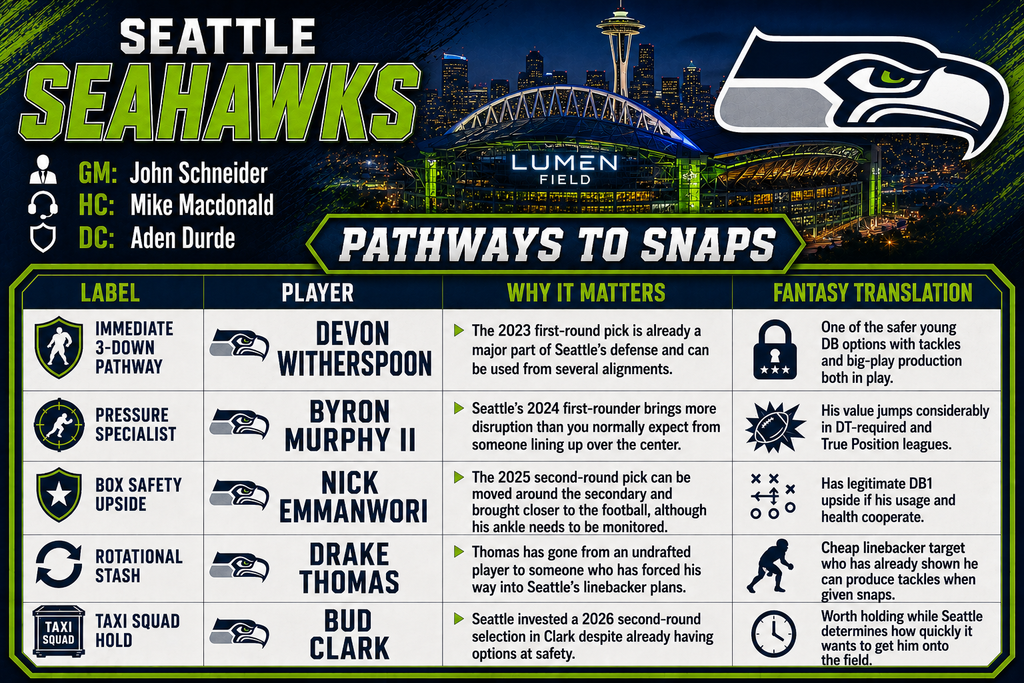
Devon Witherspoon doesn’t really need a pathway to snaps anymore because those snaps are already his. The 2023 first-round pick has become one of the most important pieces of Seattle’s defense, and his versatility is probably his biggest fantasy advantage. Seattle doesn’t have to leave him outside and hope quarterbacks throw at him. Macdonald can move Witherspoon into the slot, bring him closer to the line of scrimmage, and occasionally use him as part of the pressure package.
That’s what keeps me interested in Witherspoon in IDP. Cornerbacks can be extremely inconsistent when their fantasy production depends primarily on interceptions and passes defended. Witherspoon has more ways to get involved. Tackles, tackles for loss, pressures, and sacks can supplement the traditional defensive-back scoring categories. In leagues that separate cornerbacks from safeties, his value becomes even more interesting.
Byron Murphy II is another player whose league format matters significantly. The 2024 first-round pick is currently listed at nose tackle, but I wouldn’t look at him as just a traditional nose whose job is to eat blocks. Seattle drafted him because he can disrupt the interior, and that gives him some legitimate pressure upside from a position that doesn’t always provide it.
For True Position managers, that’s where Murphy really starts to become valuable. Defensive tackle can get ugly pretty quickly once the elite options are gone. Having a young first-round investment who is already starting and still has room to develop as a pass rusher is exactly what I want at the position. If your league just lumps every defensive lineman together, he’s not nearly as valuable.
Nick Emmanwori is probably the most exciting fantasy piece of the group if everything comes together. Seattle took him in the second round in 2025 and immediately found ways to use his combination of size and athleticism. He doesn’t have to be locked into a traditional deep-safety role. Seattle can bring him down, use him around the slot, and put him in situations where he’s much closer to the football.
The concern right now is the ankle. Emmanwori dealt with an ankle injury during his rookie season and underwent another procedure this offseason, so his health is something dynasty managers need to follow entering 2026. That doesn’t make me want to move away from him long term. It just adds some uncertainty to his immediate projection.
When he’s healthy, the role is what makes him so appealing. A defensive back with his physical profile playing around the box can pile up tackles without needing turnovers to save his fantasy week. Add the possibility of sacks, forced fumbles, and interceptions, and there are several different ways he can score points.
Drake Thomas is almost the opposite type of dynasty investment. There wasn’t premium draft capital attached to him at all. Thomas entered the league as an undrafted free agent with the Raiders in 2023 before eventually landing in Seattle. Since then, he has continued to hang around and earn opportunities.
Now he’s sitting atop the depth chart at weakside linebacker.
That doesn’t mean I’m treating Thomas as a locked-in long-term LB1. Seattle still has Tyrice Knight behind him, and Macdonald can adjust his personnel based on the defense’s needs. However, Thomas has already done the difficult part. He went from an undrafted player fighting for a roster spot to someone Seattle trusts with meaningful defensive snaps. In deeper dynasty leagues, that’s exactly the type of linebacker I want to stash before everyone becomes comfortable with his role.
Bud Clark is where we start getting much more speculative. Seattle used a second-round pick on him in the 2026 NFL Draft, but he doesn’t necessarily need to start immediately. Ty Okada is currently listed ahead of him at free safety, which gives Seattle the luxury of developing Clark rather than forcing him onto the field.
That’s why I like him as the taxi squad holds. The draft capital suggests Seattle clearly has plans for him, but dynasty managers don’t have to burn an active roster spot while those plans develop. Safety situations can also change quickly. An injury or strong stretch from Clark could accelerate the timeline considerably.
Julian Neal is another 2026 rookie I want to monitor closely. Seattle spent a third-round pick on him, and there’s a potential opening at outside corner opposite Witherspoon. Josh Jobe currently has the starting spot, but Neal gives Seattle another young option who can compete for snaps throughout the season.
He becomes much more important in leagues requiring cornerbacks. If Neal eventually wins that outside job, the snap volume alone puts him on the radar. I’m not aggressively drafting him in standard DB leagues, but CB-required dynasty managers should know the name before the competition is settled.
The defensive line gets considerably deeper after Murphy. Mike Morris, Seattle’s 2023 fifth-round pick, remains behind Leonard Williams at defensive end. Williams obviously creates a significant roadblock to a larger role, but Morris is still young enough to keep around in deeper formats where defensive line depth matters.
Deven Eastern is an even deeper stash. Seattle selected the nose tackle in the seventh round of the 2026 draft, and right now there simply isn’t enough of a pathway for me to use a normal dynasty roster spot on him. Murphy is already ahead of him, and Eastern still has to prove he belongs in the rotation.
This is where league format becomes everything. If you’re playing in a standard EDGE/DL setup, I’m probably leaving Eastern alone. If you’re playing True Position with defensive tackles separated and extremely deep rosters, then I can at least understand putting him on a taxi squad and seeing what happens. That’s about as far as I would go right now.
Seattle doesn’t have the same type of uncertainty we saw with Arizona. We already know several of these young defenders can play. Witherspoon is established, Murphy has premium draft capital and a starting role, and Emmanwori has the type of usage that can eventually turn him into an elite fantasy defensive back.
The more interesting question is who joins them next. Thomas has already forced his way into the linebacker conversation, while Clark and Neal represent Seattle’s newest investments in the secondary. Even the deeper players like Morris and Eastern have some value depending on roster size and positional requirements.
For dynasty managers, this is a defense I want pieces of. Macdonald’s willingness to move defenders around creates opportunities for tackles and pressure that don’t always exist in more traditional schemes. The obvious names are already valuable, but Seattle has enough young talent behind them that there are still a few places to get ahead of the depth chart.